


Use of intranasal esketamine in the treatment of treatment-resistant depression: a case report
- University Clinical Center of Serbia, Clinic for Psychiatry, Belgrade, Serbia
- University of Belgrade, Faculty of Medicine, Belgrade, Serbia
- University of Belgrade, Faculty of Medicine, Institute of Anatomy “Niko Miljanić”, Belgrade, Serbia
ABSTRACT
Introduction: Treatment-resistant depression (TRD) refers to a depressive episode that has not responded to treatment with two antidepressants. Pharmacological strategies for treating TRD involve a complex process, which includes several options for the use of different psychopharmaceuticals, fundamentally consisting of: (1) substituting/optimizing the dose of antidepressants, or (2) augmenting antidepressant therapy. Within the augmentation strategy, NMDA antagonists, including intranasal esketamine, play a significant role. Current research suggests that the application of intranasal esketamine as an augmentation agent is an effective pharmacological strategy in the treatment of TRD.
Case report: In this paper, we present the successful application of intranasal esketamine in co-administration with a serotonin/norepinephrine reuptake inhibitor (SNRI antidepressant) in a patient with TRD.
Conclusion: Further research is necessary to better understand the mechanisms of action, dosing modalities, as well as the long-term outcomes and safety profile of this approach.
INTRODUCTION
Depression is one of the leading causes of decreased quality of life and significantly contributes to the global economic burden of diseases. It is estimated that depression affects more than 300 million people worldwide [1]. Recent epidemiological studies in the Republic of Serbia, conducted on a representative sample of the population, indicate that the likely prevalence of depression is 5.7% [2], which aligns with the prevalence of major depressive disorder in other countries [3].
The pharmacological treatment of the acute phase of depressive disorder (formerly known as unipolar depression) has been extensively studied over the years, resulting in the publication of treatment recommendations and the suggested use of first and second-line psychopharmacological agents [4],[5]. Despite the multiple applications of commonly recommended antidepressant therapy, administered at adequate doses and for sufficient durations, a significant number of patients do not achieve a therapeutic response [6]. It is estimated that after the use of two first-line antidepressants, this number accounts for about 30% of all patients [7]. Given that such depressive episodes are “difficult to treat,” the concept of “treatment-resistant depression” (TRD) has been defined and intensively studied over the past two decades [6],[8]. Although there is still no clear consensus on the exact definition of TRD, the European Medicines Agency (EMA) [9] and the United States Food and Drug Administration (FDA) [10] describe TRD as the absence of a therapeutic response to two or more antidepressant treatments at adequate doses and for sufficient durations, with adherence to the prescribed treatment regimen.
Pharmacological strategies for treating TRD involve complex procedures, with possibilities including the use of various psychopharmacological agents that essentially involve: (1) replacement or optimization of the antidepressant dose or (2) augmentation. Augmentation involves the co-administration of a drug from the group of antipsychotics, mood stabilizers, or NMDA antagonists, along with the use of antidepressants. A detailed review of pharmacological strategies for treating TRD, with a high level of evidence, is provided elsewhere, to which we refer the interested reader [11]. Within the augmentation strategy, a relatively new pharmacotherapeutic approach involves the use of NMDA antagonists. Esketamine is the S-enantiomer of the racemic mixture of ketamine and has a high affinity for NMDA receptors, acting as an antagonist [12]. The intranasal form of esketamine was approved for use by the FDA in 2019 and by the EMA in 2020 [13]. Initial clinical studies have shown that the application of intranasal esketamine in TRD leads to significant improvements in therapeutic effect after 28 days [14]. Additionally, a series of meta-analytic studies have confirmed the efficacy of intranasal esketamine in TRD [15],[16].
Regarding potential side effects of esketamine, current data indicate that they most commonly occur on the day of application and are transient, including symptoms such as dizziness, drowsiness, paresthesia, dysgeusia, headache, anxiety, and dissociative symptoms [14],[17].
In this paper, we present a case report of a patient with TRD who was treated with intranasal esketamine. Access to the patient’s medical records for the purposes of this case report was approved by the Ethics Committee of the University Clinical Center of Serbia, number 1141/7. The patient was informed of all aspects of the research, including the objectives, potential risks, and benefits, and subsequently provided written consent by signing an informed consent form.
CASE REPORT
A 64-year-old patient presented to the Psychiatry Clinic of the University Clinical Center of Serbia (UCCS) in early 2022 due to symptoms such as low mood, lack of motivation, low energy, sense of tension, anxiety-ruminative tendencies on an existential basis (heteroanamnestically disproportionate to the cause), withdrawal from social life, reduced need for communication with family and friends, and avoidance of activities that previously led to satisfaction. The mentioned symptoms were present for approximately 2 months in a pronounced form and led to a significant decline in functioning across all areas of life. Following outpatient clinical evaluation, the patient was hospitalized and subsequently explored in an inpatient setting. It was determined that the initial issues appeared around 5 years ago when outpatient treatment began at a regional health center. Since 2018, the patient has had three discrete episodes of depressive disorder characterized by the previously mentioned symptoms. From the personal medical history, it is notable that the patient has a secondary education level and a total of 43 years of work experience. There are no known drug allergies. A positive family history of untreated alcoholism (second-degree relatives) has been recorded. Aside from this, no family history of affective or other psychiatric disorders has been observed.
Before the first hospitalization, pharmacotherapy protocols included the use of fluoxetine (40 mg max dose), which was augmented at different times with mirtazapine (15 mg max dose), olanzapine (5 mg max dose), sulpiride (50 mg max dose), and benzodiazepines. Upon admission for inpatient treatment, the patient’s mental status was conscious and properly oriented in all modalities of psychiatric exploration. The mental status was dominated by depressive mood and anhedonia, without delusional elements in thought content or perceptual disturbances. Drive dynamics were compromised in the form of hypoappetite and social restriction, while hypobulia was present in the volitional sphere. Neurological and somatic status across all organ systems showed no particularities. Vital and anthropometric parameters were within physiological ranges.
During hospitalization, psychological testing indicated above-average intelligence with a decline in psychomotor speed, attention, and concentration domains, while reality testing remained intact. Elevated indicators of anxiety, tension, and depression were observed, including behavioral apathy, lack of initiative, chronic fatigue, poor concentration, and low mood. No indicators of psychosis or personality disorders were noted. Laboratory and hormonal tests, including thyroid hormones, showed no significant deviations from reference values. Cranial CT did not reveal any specific pathological substrates. A diagnosis of recurrent major depressive disorder was established. After applying occupational, supportive, and psychotherapeutic measures, the patient was discharged in initial remission with pharmacotherapy including mirtazapine 30 mg/ day, duloxetine 30 mg/day, and pregabalin 150 mg/day
One week after discharge from inpatient treatment, the patient functioned satisfactorily, followed by a partial return of symptoms, mainly psychomotor slowing, reduced will to perform daily activities, abdominal tension, and initial insomnia. During intensive outpatient follow-up, the pharmacotherapy was modified, increasing duloxetine to 120 mg/day and pregabalin to 300 mg/day, with short-term zolpidem 10 mg/ day. The therapeutic protocol was augmented with aripiprazole up to 5 mg/day.
Due to the absence of a therapeutic response to the measures applied so far, a second hospitalization was carried out at the KZP UKCS during 2023. During this hospitalization, depressive spectrum symptoms were present to the same extent and intensity as during the first hospitalization, with no new elements observed in the clinical picture. The patient was discharged without preliminary therapeutic weekend dischargesdue to organizational constraints in place since the beginning of the pandemic of COVID-19. Pharmacotherapy at discharge included bupropion 150 mg/day, aripiprazole 7.5 mg/day, mirtazapine 30 mg/day, and pregabalin 150 mg/day.
In the course of further follow-up, the patient did not achieve satisfactory functionality. Additionally, the application of intensive behavioral activation measures during outpatient treatment did not lead to significant therapeutic effects, leading to a third hospitalization at the end of 2023. During this hospitalization, alongside supportive and occupational measures, the patient was treated with venlafaxine 300 mg/day, alternately augmented with quetiapine 100 mg/day and lithium 300 mg/day, along with pregabalin 225 mg/day. Results of repeated psychological testing showed no deviations from previous testing during the first hospitalization. A detailed analysis of the entire disease course and case formulation in all relevant bio-psycho-social dimensions determined that the patient has treatment-resistant depression, given the use of multiple antidepressants over a sufficient duration and dosage, with verified compliance during inpatient treatment and corroborated by self- and heteroanamnesis in outpatient settings.
In light of the above, and following a team medical review, the patient was started on follow-up with intranasal esketamine. The primary antidepressant was venlafaxine 300 mg/day, administered continuously.
The induction phase was conducted from week 1 to week 4, twice a week, with intranasal esketamine 2x28 mg administered within the facility. The medication was administered by trained medical staff, with continuous monitoring and vital parameter tracking.
The maintenance phase was conducted from week 5 to week 9, once a week, with intranasal esketamine 2x28 mg, under the same conditions.
Immediately before each application, during both the maintenance and induction phases, psychometric testing using the MADRS scale, a clinical standard for assessing depression symptoms validated in the Serbian population, was conducted.
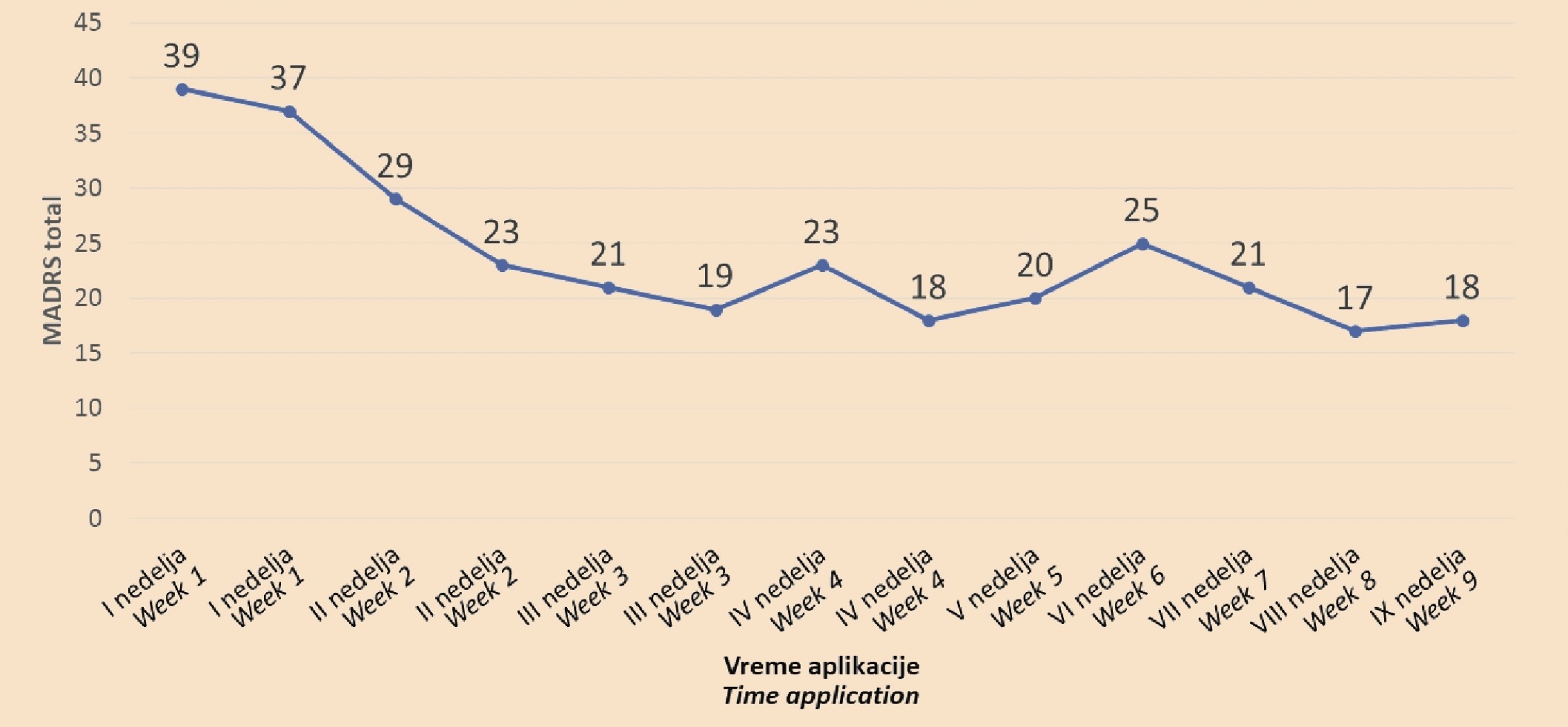
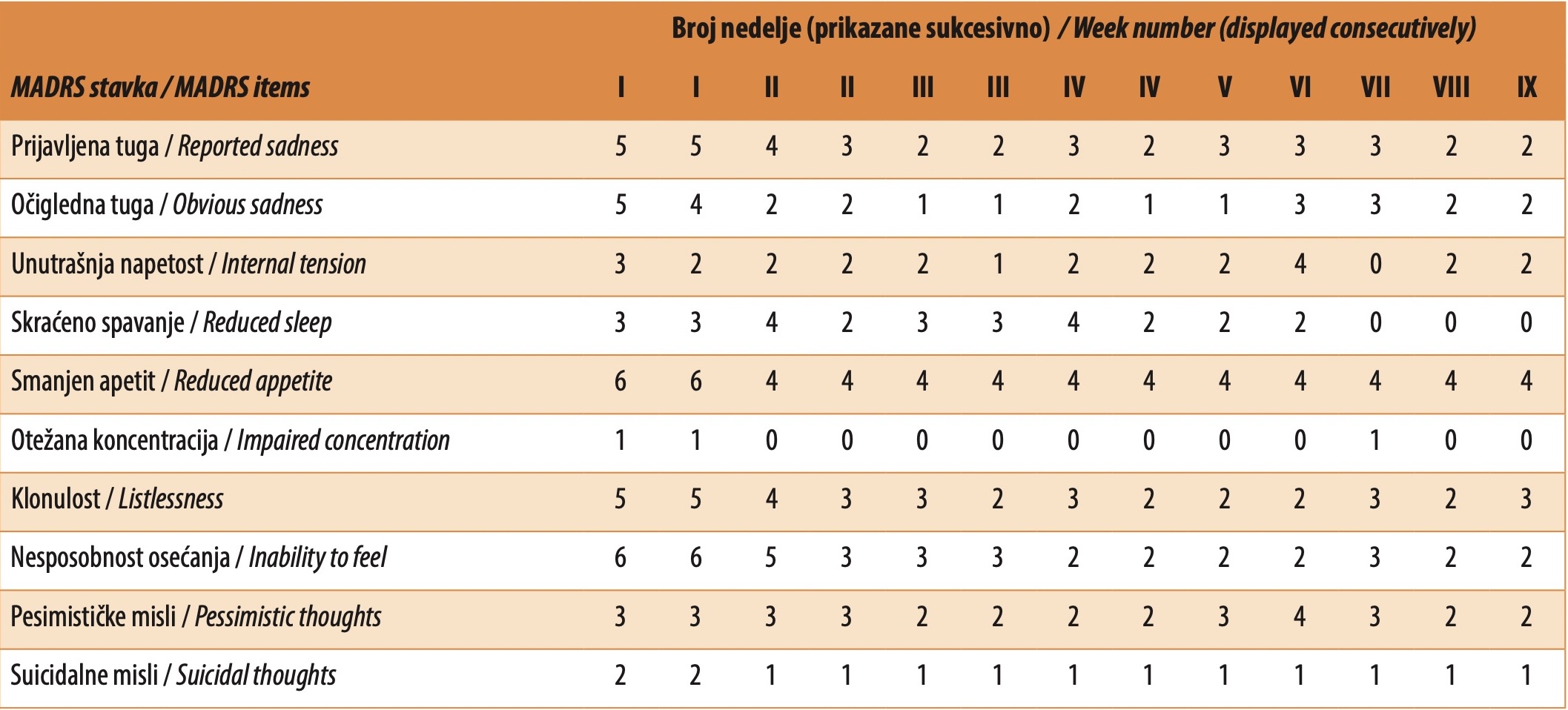
On the seventeenth day of application (second half of the third week), a therapeutic response (50% reduction in symptoms) was observed, verified by the MADRS scale. The progression of overall symptom intensity over time is shown in Graph 1. Symptom intensity for specific items (reported sadness, apparent sadness, inner tension, reduced sleep, decreased appetite, concentration difficulties, lassitude, inability to feel, pessimistic thoughts, suicidal thoughts) is presented in Table 1.
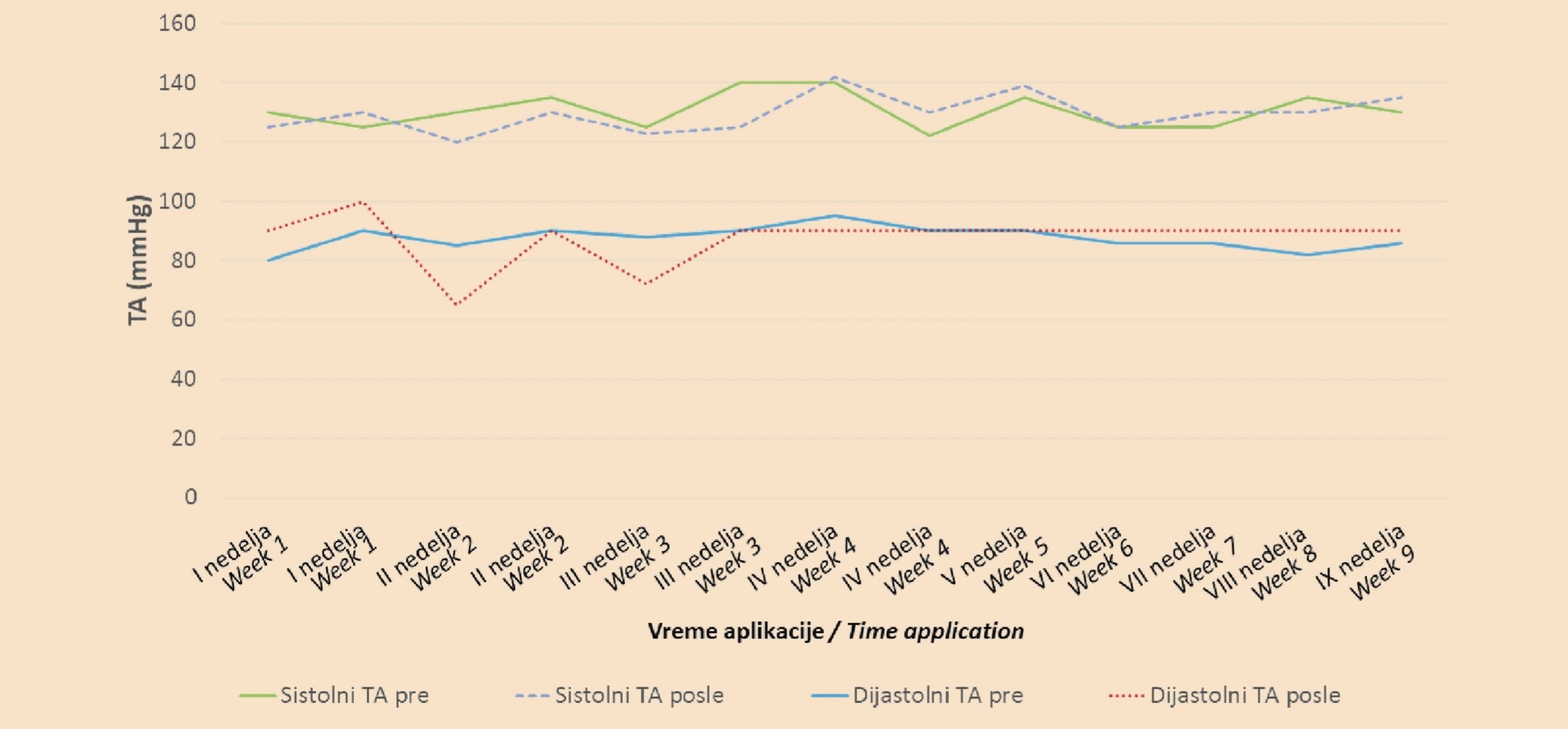
During the first few applications, the patient experienced short-term, transient tingling in the proximal and distal parts of the extremities. Apart from this, there were no occurrences of dizziness, dissociation, nausea, headache, somnolence, dysgeusia, vomiting, or any other reported side effects that would lead the patient to discontinue intranasal esketamine. Blood pressure values before and after the application of intranasal esketamine did not deviate from physiological values and are shown in Graph 2.
Clinically, during the administration of venlafaxine, 300 mg/day in combination with intranasal esketamine, significant reduction in symptoms and improvement in functionality across all life dimensions were recorded during the induction phase and continued thereafter.
DISCUSSION
The absence of therapeutic response in major depressive disorder and the emergence of TRD represent significant challenges for clinical practice. Based on current indicators, it is estimated that over 100 million people worldwide meet the criteria for TRD [6]. Additionally, TRD is characterized by a significant increase in suicidal ideation, attempted, and completed suicides compared to non-resistant depression [19].
Although numerous international guidelines recommend strategies that can be applied in TRD, there are still no clear protocols for dealing with TRD (which psychopharmacologic, how long). In other words, international guidelines do not suggest exact steps in terms of replacing/augmenting psychopharmacological treatments. Nevertheless, based on evidence from multiple positive randomized controlled trials, as well as data from meta-analyses, the use of esketamine has been almost universally recommended in recent years [20],[21],[22]. In addition to demonstrated efficacy in reducing symptoms in TRD, literature data indicate its effectiveness in reducing suicidality and providing a rapid therapeutic response [6].
Our experience with a patient who had an episode of major depressive disorder, without a therapeutic response to a series of applied psychopharmacological treatments considered “first-line” therapy, as well as multiple augmentation agents with a high level of evidence from randomized controlled trials, aligns with these findings. In this case, a rapid therapeutic effect was achieved, with a response (over 50% reduction in symptoms) observed on the 17th day of starting intranasal esketamine therapy, in co-administration with the SNRI venlafaxine 300 mg/day. This was confirmed by a decrease in the MADRS score from 39 (level of severe depressive episode) at the start of treatment to a score of 18 (level of mild depressive episode) at the last follow-up point during week IX. No significant difficulties in terms of drug tolerability were present.
In summary, this paper presents the successful use of intranasal esketamine in co-administration with an SNRI antidepressant in a patient with TRD. We emphasize the importance of future research to better understand the mechanisms of action, dosing methods, as well as long-term outcomes and safety profiles of this approach.
Informations

-
Keywords:
-
Received:
-
Revised:
-
Accepted:
-
Online first:
-
DOI:
-
Cite this article:

Stefan Jerotić
Clinic for Psychiatry, University Clinical Center of Serbia
2 Pasterova Street, 11000 Belgrade, Serbia
E-mail:
1. Herrman H, Kieling C, McGorry P, Horton R, Sargent J, Patel V. Reducing the global burden of depression: a Lancet–World Psychiatric Association Commission. Lancet. 2019;393(10189):e42-3. doi: 10.1016/S0140-6736(18)32408-5. [CROSSREF]
2. Marić NP, Mihić LJ, Lazarević LB, Knežević G. Probable depression and anxiety in seven European countries during the COVID-19: probable overestimation of the problem due to sampling method. J Affect Disord. 2022;311:554-55. doi: 10.1016/j.jad.2022.05.119. [CROSSREF]
3. Thornicroft G, Chatterji S, Evans-Lacko S, Gruber M, Sampson N, Aguilar-Gaxiola S, et al. Undertreatment of people with major depressive disorder in 21 countries. Br J Psychiatry. 2017;210(2):119-24. doi: 10.1192/bjp.bp.116.188078. [CROSSREF]
4. Kennedy SH, Lam RW, McIntyre RS, Tourjman SV, Bhat V, Blier P, et al. Canadian Network for Mood and Anxiety Treatments (CANMAT) 2016 clinical guidelines for the management of adults with major depressive disorder: section 3. Pharmacological treatments. Can J Psychiatry. 2016;61(9):540-60. doi: 10.1177/0706743716659417. [CROSSREF]
5. Bauer M, Severus E, Köhler S, Whybrow PC, Angst J, Möller H-J, et al. World Federation of Societies of Biological Psychiatry (WFSBP) guidelines for biological treatment of unipolar depressive disorders. part 2: maintenance treatment of major depressive disorder-update 2015. World J Biol Psychiatry. 2015;16(2):76-95. doi: 10.3109/15622975.2014.1001786. [CROSSREF]
6. McIntyre RS, Alsuwaidan M, Baune BT, Berk M, Demyttenaere K, Goldberg JF, et al. Treatment‐resistant depression: definition, prevalence, detection, management, and investigational interventions. World Psychiatry. 2023;22(3):394-412. doi: 10.1002/wps.21120. [CROSSREF]
7. Gaynes BN, Lux L, Gartlehner G, Asher G, Forman‐Hoffman V, Green J, et al. Defining treatment‐resistant depression. Depress Anxiety. 2020;37(2):134- 45. doi: 10.1002/da.22968. [CROSSREF]
8. Souery D, Papakostas GI, Trivedi MH. Treatment-resistant depression. J Clin Psychiatry. 2006;67:16-22. [HTTP]
9. European Medicines Agency. Clinical investigation of medicinal products in the treatment of depression – Scientific guideline. 2018.
10. U.S. Food and Drug Administration. Major depressive disorder: Developing drugs for treatment. 2018.
11. Jerotić S, Ivković M. Pharmacological treatment of treatment-resistant depression: towards evidence-based recommendations. Med istraživanja. 2024;57(1):59-66. doi: 10.5937/medi57-48086. [CROSSREF]
12. Sapkota A, Khurshid H, Qureshi IA, Jahan N, Went TR, Sultan W, et al. Efficacy and safety of intranasal esketamine in treatment-resistant depression in adults: a systematic review. Cureus. 2021;13(8):e17352. doi: 10.7759/cureus.17352. [CROSSREF]
13. Buchmayer F, Kasper S. Overcoming the myths of esketamine administration: different and not difficult. Front Psychiatry. 2023;14:1279657. doi: 10.3389/ fpsyt.2023.1279657. [CROSSREF]
14. Popova V, Daly EJ, Trivedi M, Cooper K, Lane R, Lim P, et al. Efficacy and safety of flexibly dosed esketamine nasal spray combined with a newly initiated oral antidepressant in treatment-resistant depression: a randomized double-blind active-controlled study. Am J Psychiatry. 2019;176(6):428-38. doi: 10.1176/appi.ajp.2019.19020172. [CROSSREF]
15. Hock RS, Feeney A, Iovieno N, Murrough JW, Mathew SJ, Iosifescu DV, et al. Rapidity of symptom improvement with intranasal esketamine for major depressive disorder: a systematic review and meta-analysis. J Clin Psychiatry. 2022;84(1):21r14086. doi: 10.4088/JCP.21r14086. [CROSSREF]
16. Jawad MY, Di Vincenzo JD, Ceban F, Jaberi S, Lui LMW, Gillissie ES, et al. The efficacy and safety of adjunctive intranasal esketamine treatment in major depressive disorder: a systematic review and meta-analysis. Expert Opin Drug Saf. 2022;21(6):841-52. doi: 10.1080/14740338.2022.2058488. [CROSSREF]
17. Kryst J, Kawalec P, Pilc A. Efficacy and safety of intranasal esketamine for the treatment of major depressive disorder. Expert Opin Pharmacother. 2020;21(1):9-20. doi: 10.1080/14656566.2019.1683161. [CROSSREF]
18. Mihajlović G, Vojvodić P, Vojvodić J, Andonov A, Hinić D. Validation of the Montgomery-Åsberg depression rating scale in depressed patients in Serbia. Srp Arh Celok Lek. 2021;149(5-6):316-21. doi: 10.2298/SARH200401004M. [CROSSREF]
19. Bergfeld IO, Mantione M, Figee M, Schuurman PR, Lok A, Denys D. Treatment-resistant depression and suicidality. J Affect Disord. 2018;235:362-7. doi: 10.1016/j.jad.2018.04.016. [CROSSREF]
20. Daly EJ, Singh JB, Fedgchin M, Cooper K, Lim P, Shelton RC, et al. Efficacy and safety of intranasal esketamine adjunctive to oral antidepressant therapy in treatment-resistant depression: a randomized clinical trial. JAMA Psychiatry. 2018;75(2):139-48. doi: 10.1001/jamapsychiatry.2017.3739. [CROSSREF]
21. Sanders B, Brula AQ. Intranasal esketamine: From origins to future implications in treatment-resistant depression. J Psychiatr Res. 2021;137:29-35. doi: 10.1016/j.jpsychires.2021.02.020. [CROSSREF]
22. Liu P, Zhang S-S, Liang Y, Gao Z-J, Gao W, Dong B-H. Efficacy and safety of esketamine combined with antidepressants for treatment-resistant depression: a meta-analysis. Neuropsychiatr Dis Treat. 2022;2855-65. doi: 10.2147/ NDT.S388764. [CROSSREF]