


Cytomegalovirus reactivation in patients treated with allogeneic hematopoietic stem cell transplantation
- Faculty of Medicine, University of Belgrade, Belgrade, Serbia
- Institute of Medical Statistics and Informatics, Belgrade, Serbia
- Clinic for Hematology, Clinical Center of Serbia, Belgrade, Serbia
ABSTRACT
Introduction: Opportunistic CMV reactivation is the most common viral complication after allogenic hematopoietic stem cell transplantation (allo-HSCT).
Aim: The aim of our study is to evaluate the frequency of CMV reactivation in relation to the serostatus od the donor and the recipient, and the correlation with the day of leukocyte (Le) and thrombocyte (Tr) engraftment. We compared the frequency of CMV reactivation in myeloablative conditioning (MAC) versus reduced intensity conditioning (RIC), as well as in match related donor (MRD) versus match unrelated donor (MUD) allo-HSCT. We analyzed whether CMV reactivation affected the overall survival (OS) after allo-HSCT.
Materials and methods: In a retrospective cohort study, we inspected 42 patients over the age of 18 years, who were treated at the Clinic for Hematology of the Clinical Center of Serbia, from December 2017 to November 2019.
Results: Most CMV reactivations were noticed if the recipient (R) was seropositive, and the donor (D) was seronegative (R+/D– = 60.0%). The number of CMV DNA copies corelated with the day of leukocyte engraftment of (p = 0.031), but not of thrombocyte engraftment (p = 0.598). The frequency of reactivation in patients treated with RIC was 25.0%, and it was 63.5%, if they were treated with MAC. The intensity of the conditioning regimen corelated with the number of CMV DNA copies (p = 0.025%). There was no correlation found between the type of transplantation (MRD or MUD) and CMV reactivation (p = 0.515). OS after allo-HSCT was 36.39 months (95% CI 26,0 – 46,78). The mean OS in patients with CMV reactivation was 7.39 months (95% CI 5,72 – 9,06), but we did not prove that CMV reactivation had an impact on OS (p = 0.527).
Conclusion: CMV reactivation was most common in the R+/D– group. CMV reactivation did not affect OS after allo-HSCT in our group of patients.
INTRODUCTION
The cytomegalovirus (CMV) is a ubiquitous herpes virus, whose name stems from the enlargement of the infected cells, i.e., they are cytomegalic.
The prevalence of CMV seropositivity varies in the world from 60% do 100%. Primary infection usually occurs in early childhood, and in most cases, it is asymptomatic, though it can manifest in the form of atypical mononucleosis [1]. After primary infection, the genome of the CMV virus persists in the genome of the host, without producing viral particles, i.e., it remains latent, maintaining the possibility of reactivation, if the host is immunocompromised.
Allogenic hematopoietic stem cell transplantation (allo-HSCT) is the replacement and repopulation of the recipient’s hematopoietic stem cells with the stem cells of the donor. The most common indications for carrying out this therapeutic procedure are acute leukemias, myelodysplastic syndromes, aplastic anemia, congenital metabolic disorders, and autoimmune diseases. The donors are HLA identical (brother or sister), or haploidentical relatives, or the donor can be unrelated HLA-matching or partially matching [2],[3].
Morbidity and mortality upon allo-HSCT depend on the relapse rate of the disease, as well as on mortality unrelated to the relapse of the disease (non-relapse mortality – NRM). There is a growing significance of the causes of NRM after allo-HSCT, which is 10 – 30% [4],[5], and amongst these causes are infections, organ dysfunction, as well as graft versus host disease (GvDH) [6]. The most common infections are blood infections with an incidence that can vary from 20% – 70% [7].
Immune reactivity of recipients of bone marrow or organs is artificially suppressed with immunosuppressive therapy, in order to prevent graft rejection, which is why these patients are at high risk of the reactivation of different latent viral infections. Opportunistic CMV reactivation is the most common viral complication after allo-HSCT, which is why DNA viremia is determined with the quantitative PCR method, once to twice a week, in the first 100 days after transplantation [8]. The probability and frequency of reactivation depends on the serostatus of the donor (D) and the recipient (R). Reactivation happens in 60% of seronegative and 10% of seropositive recipients who received their graft from seropositive donors [8],[9]. However, the highest reactivation incidence is recorded in seropositive recipients who received their graft from a seronegative donor [8],[10]. Apart from the serostatus of the donor and recipient, the following are also described as risk factors: older age of the patients, unmatching HLA or unrelated donor, T-cell depletion, graft versus host disease (GvHD) and high doses of corticosteroids in GvHD therapy [8]. The manifestations of CMV disease are the following: pneumonia, hepatitis, gastroenteritis, retinitis, and encephalitis, while the disease can develop as an early or late complication after the procedure [11].
The increasing success of antiviral therapy has decreased the incidence of CMV disease to approximately 10% in the first year after transplantation, however, the incidence of late CMV reactivation has increased, since it has been established that antiviral therapy slows down the restoration of CMV-specific T-cell response. Mortality from CMV pneumonia is still high, approximately 70%, while gastrointestinal CMV disease may manifest without detectible viremia, which makes it difficult to distinguish from gastrointestinal GvHD [12].
There is data in literature related to the protective role of early CMV reactivation against the relapse of myeloid leukemia, however, the same has not been proven for other hematologic neoplasms [13].
In this paper, we have compared CMV reactivation in relation to the serostatus of the donor and the recipient (D/R), and we have analyzed whether there is a correlation between CMV status and the day of Le and Tr engraftment. We have also analyzed whether there is a greater frequency of CMV reactivation in the MAC (myeloablative conditioning) or in the RIC (reduced intensity conditioning) regimen, and whether there is greater frequency in match related donor (MRD) or match unrelated donor (MUD) allo-HSCT. The goal is also to determine whether CMV reactivation affects survival after allo-HSCT.
METHODS
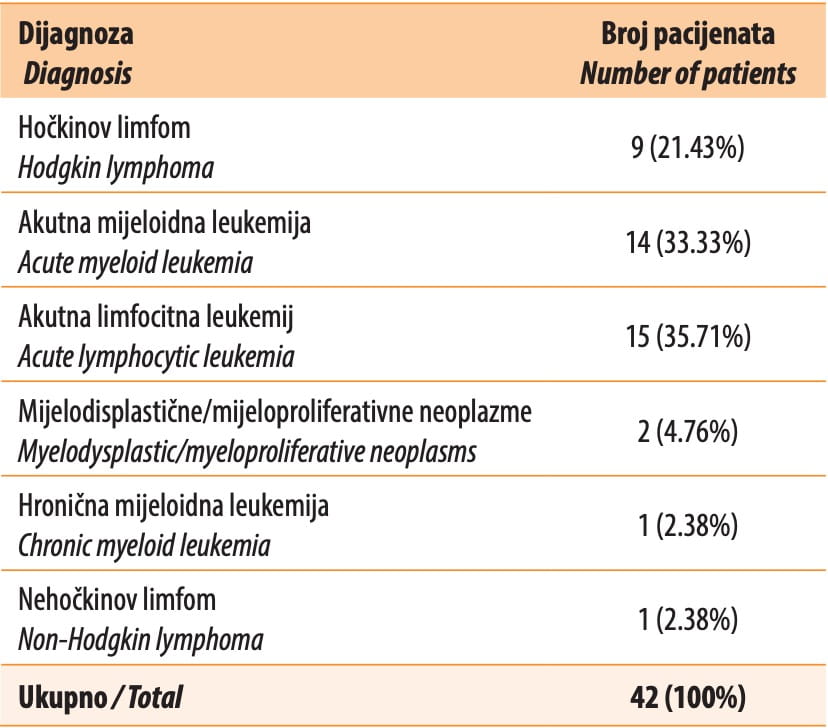
This retrospective cohort study included 42 patients, above the age of 18 years, with one of the following diagnoses: acute myeloid leukemia (AML), acute lymphocytic leukemia (ALL), chronic lymphocytic leukemia (CLL), myelodysplastic/myeloproliferative neoplasm (MDS/MPN), Hodgkin lymphoma (HL), and Non-Hodgkin lymphoma (NHL), who were treated at the Clinic for Hematology of the Clinical center of Serbia, from December 2017 to November 2019. The data on the patients have been obtained from patient medical records (Table 1).
Microbiology methods
After allo-HSCT, CMV reactivation was proven with the quantitative PCR method, determining the number of CMV DNA copies per 1 ml of blood.
Reactivation therapy
CMV reactivation is defined as any value of viremia (number of copies/1 ml of blood) proven with the quantitative PCR method. All of our patients, however, had more than 100 copies of CMV DNA per 1 ml of blood. CMV reactivation was treated with therapeutic doses of valganciclovir (ValcyteR ) 2x900 mg for two weeks, with a lowering of the doses to 2x450 mg during further treatment, or with ganciclovir (CymeveneR ) 2x500mg iv, for two weeks, with the administering of anti-CMV immunoglobulin (CytotectR ) 50mg iv, every two weeks, until the nullification of the number of CMV DNA copies.
Statistical analysis
The SPSS (Statistical Package for Social Sciences) for Windows, version 23.0 was used for statistical analysis. Statistical analysis included the formation of a database with the grouping and tabular presentation of patient data relevant to the study. Descriptive statistical parameters have been expressed through the following: arithmetic mean with measure of dispersion (SD, SE), median, MOD, and the distribution of relevant frequencies. The overall survival (OS) of patients covered the period from the establishing of the diagnosis to the lethal outcome, or ending with November 2019, in living patients. Overall survival in relation to treatment was calculated with the Kaplan-Meier method, while the differences in survival in the context of the analyzed parameters were analyzed with the use of the Log Rank test.
At the beginning of statistical testing, the level of significance was defined at 0.05. Values below 0.05 were considered statistically significant.
RESULTS
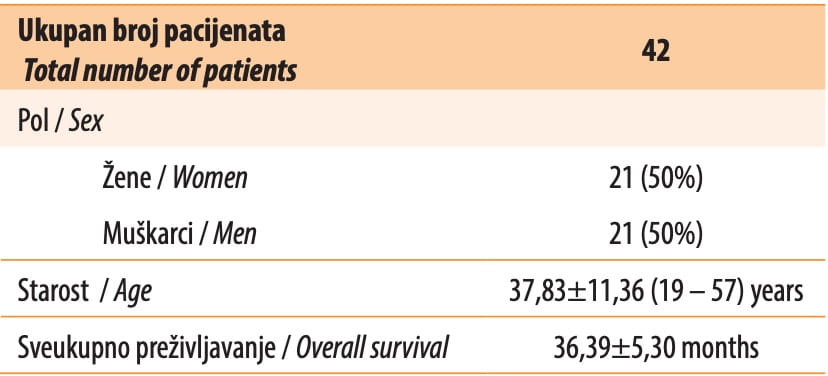
The study included 42 patients of the average age 37.83±11.36 years, in the range of 19 to 57 years, at the time of the allo-HSCT procedure. At the time of diagnosis, the average age was 35.19±12.02 years. Out of 42 patients, 21 were male and 21 were female patients (Table 2).
The relationship (ratio) between the serostatus of the recipient and donor (R/D ratio) was important, and it was determined that the most common combination was when both the recipient and the donor were CMV seropositive, which was found in 28 patients (68.3%). There were 10 combinations of positive recipient and negative donor 10 (24.4%). There were two combinations where the recipient was negative, and the donor was positive 2 (4.9%). In one case, the recipient was positive for both IgM and IgG CMV antibodies, while the donor was IgG positive. In one case, the data on the serostatus of the recipient and donor were missing (Table 3).
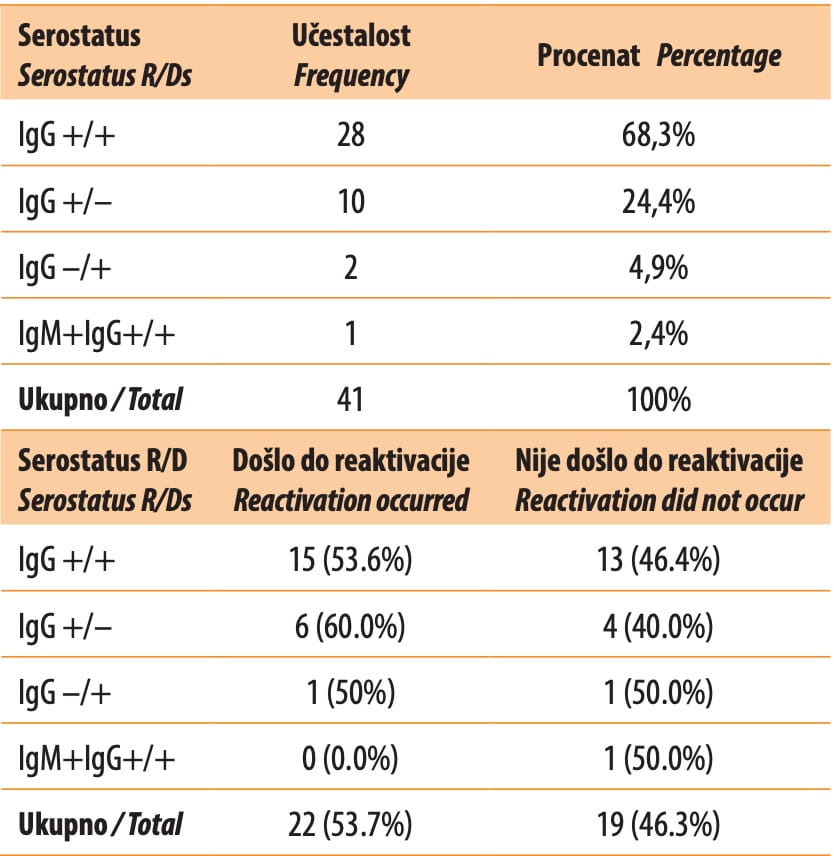
We established a correlation between CMV reactivation and the serostatus ratio between the recipient and donor (R/D). In case of R+/D+, reactivation occurred in 15 patients (53.6%). When the CMV serostatus was R+/D–, reactivation occurred in 6 patients (60.0%). When the CMV status relationship was R–/D+, reactivation occurred in one patient, while it did not occur in the other patient from this group. In the one case where anti-CMV IgM antibody positivity was proven, reactivation did not occur, i.e., viral DNA was not detected (Table 3).
Correlation between the number of CMV copies and Le engraftment (p = 0.031) was established, but not the correlation between the number of CMV copies and Tr engraftment (p = 0.598).
Twelve patients underwent the RIC conditioning regimen (28.6%), while 30 patients (71.4%) underwent the MAC conditioning regimen. Of the 12 patients on the RIC regimen, reactivation occurred in 3 patients (25.0%), while of the 30 patients on the MAC regimen, reactivation of the latent CMV infection occurred in 9 patients (63.5%). Correlation was determined between the intensity of the conditioning regimen and CMV reactivation. Namely, reactivation in patients under the more intensive regimen, i.e., MAC was significantly more frequent (p = 0.025) (Table 4).
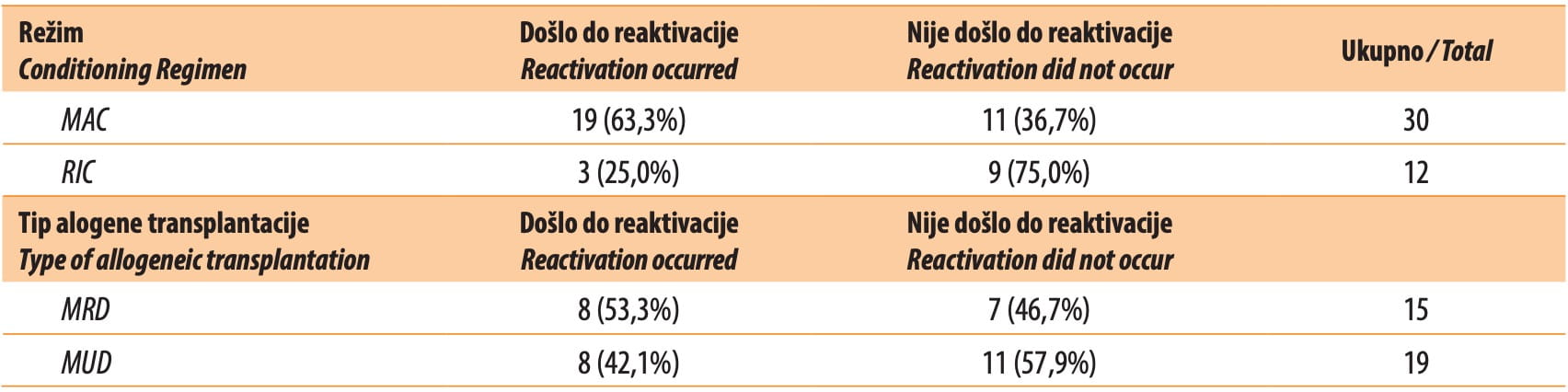
Of the 15 patients who had undergone MRD transplantation, reactivation occurred in 8 patients. In the patient subgroup with related allo-HSCT, in 8 patients, related haploidentical allo-HSCT was performed, but, due to the small number of patients in this group, we did not separate it from the rest of the MRD transplantations. MUD transplantation was performed in 19 patients, and, again, in 8 of them, reactivation of the CMV infection occurred, although correlation between the type of transplantation (MRD or MUD) and the reactivation of CMV was not established (p = 0.515) (Table 4).
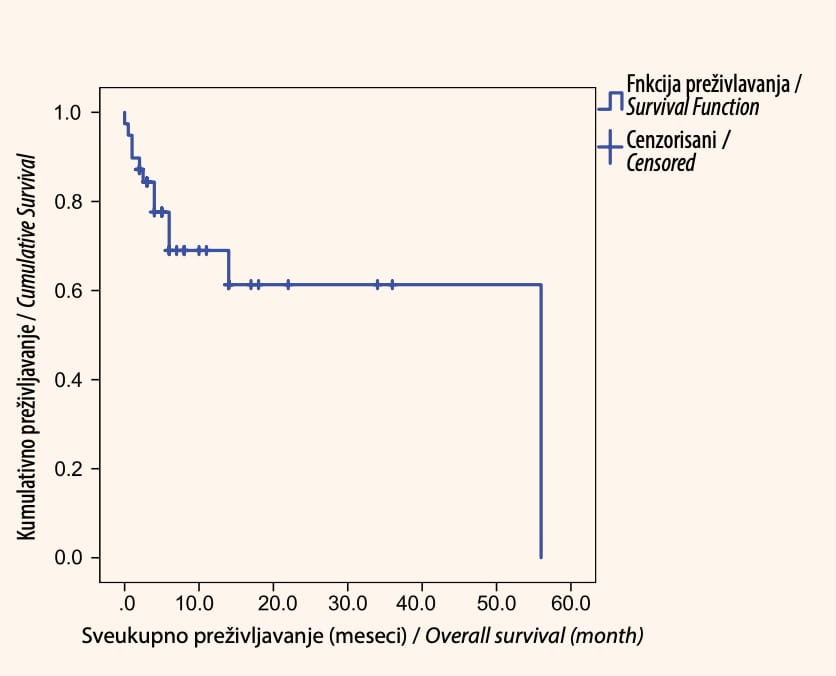
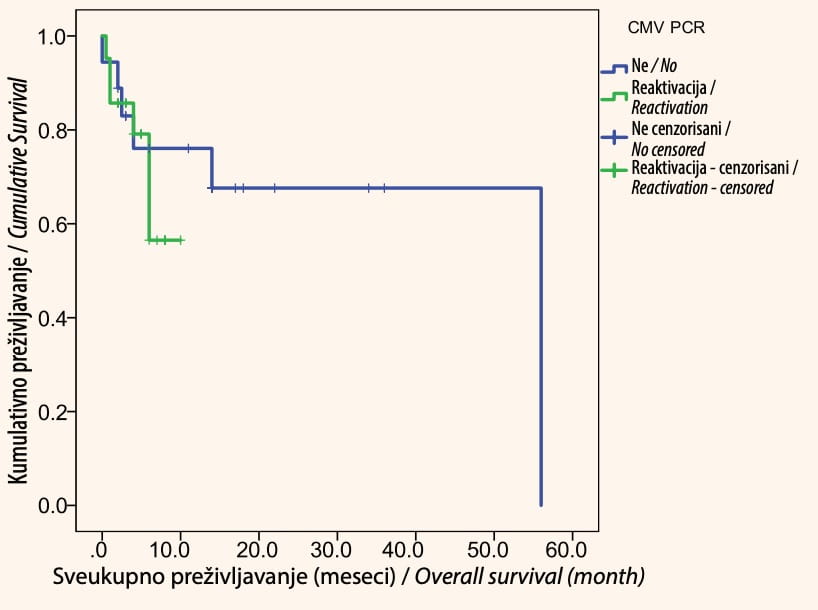
The overall survival after allo-HSCT, calculated on the basis of the Kaplan-Meier study, on a sample of 42 patients, was 36.39 months (95% CI 26.0 – 46.78). The mean value for survival was 39.57 months, if there had been no reactivation, and it was 7.39 months, if reactivation had occurred (95% CI 5.72 – 9.06) (Figure 1). On the basis of the Log Rank test, it was not determined that CMV reactivation affected survival (p = 0.527).
DISCUSSION
Our study analyzed 42 patients, 21 female and 21 male patients, whose average age at the time of the allo-HSCT procedure was 37.83±11.36 years. The distribution of the diagnoses was such that the greatest number of patients was affected by ALL, i.e., 15 of them (35.71%), 14 suffered from AML (33.33%), 9 were afflicted with HL (21.43%), two were MDS/MPN patients (4.76%), and there was one patient suffering from NHL (2.38%) and one affected by CLL (2.38%).
As far as the distribution of the CMV serostatus is concerned, most of the combinations were R+/D+ (68.3%), 24.4% were R+/D– combinations, 4.9% were R–/D+ combinations, and there was one case of a patient who was positive for both IgM and IgG antibodies, while the donor was also IgG positive, though, in this case, viral DNA was not detected. When we compared reactivation frequency with the CMV serostatus of the recipients and donors, the results showed the following: in case of R+/D+, reactivation occurred in 15 patients (53.6%), in R+/D–, reactivation happened in 6 patients (60.0%), in the case of R-/D+, reactivation occurred in one patient. This leads us to the conclusion that the highest reactivation frequency is in case of the R+/D– combination. Similar results were obtained by George et al., who divided their 315 patients, regarding the risk of CMV reactivation, into the following three groups: the low-risk group (R–/D–), the medium-risk group (R–/D+), and the high-risk group (R+/D– or R+/D+) [9]. They established that the highest incidence of reactivation was in the high-risk group, amounting to 53.3% (11 patients). Stern et al. explained the high incidence of reactivation in the R+/D+ group with either the reactivation of the latent CMV infection in the cells of the recipient or/and with reactivation from infected donor cells transplanted in the stem cell graft [8]. The highest incidence of reactivation in the R+/D– group is explained by the delayed CMV-specific immune response, due to the lack of T-specific cells in the graft [8],[14].
Our study also analyzed whether CMV reactivation affected Le and Tr engraftment. We found that there was a correlation between the number of CMV DNA copies and Le engraftment (p = 0.031), but correlation with Tr engraftment was not found (p = 0.598), which means that CMV reactivation, defined here through viremia detected with quantitative PCR, delays graft acceptance and the reconstruction of allogenic hematopoiesis in the case of Le.
The RIC conditioning regimen is an alternative for patients who need allo-HSCT, but who have contraindications for the more intensive regimen (MAC), due to comorbidities or a more advanced age [15]. In our study, prior to transplantation, 30 patients (71.4%) underwent the MAC conditioning regimen, while 12 patients underwent the RIC conditioning regimen (28.6%). Amongst our patients, reactivation occurred in 19 patients who had undergone MAC and three patients who had undergone RIC, whereby we demonstrated that CMV reactivation occurs statistically significantly more often when more intensive conditioning regimens are applied (MAC), i.e., that the intensity of the conditioning regimen correlates with the number of viral DNA copies. A study by Piñana et al. examined the effect of the RIC regimen on CMV reactivation and disease development in 195 patients. They established that reactivation occurred in 36.0% of patients [15].
In their cohort study, Nakamae et al. compared the incidence of reactivation against the MAC and RIC conditioning regimen and came up with different results. In fact, they demonstrated that, in conditioning regimens of reduced intensity, there was a lesser incidence of high viral load in relation to MAC, in the first 100 days upon transplantation, and that CMV disease occurred later, but that there was no significant difference in the incidence of reactivation itself, nor in CMV disease incidence, between the two regimens. They propose that residual memory T-cells act protectively in recipients who were seropositive, in the sense that they prevent high viral load, until complete chimerism occurs, after which their protective effect is no longer apparent [16].
The golden standard for allo-HSCT are HLA identical relatives, marked here as MRD transplantation. If the graft is taken from an HLA-matching, but unrelated donor, this is MUD. Out of 15 patients who underwent MRD transplantation, reactivation occurred in 8 of them. MUD transplantation was performed in 19 patients, and, again, reactivation of the CMV infection occurred in 8 of them, although correlation between the type of transplantation (MRD or MUD) and the reactivation of CMV infection was not established in our study (p = 0.15).
Jaskula et al. came to the same conclusion, in their study wherein they compared CMV reactivation in 71 patients who had received a graft from an unrelated donor, but with an HLA match of 10/10, with 78 patients, who had received a graft from a relative. In the unrelated group, reactivation occurred in 19 patients, whereas in the related group it occurred in 17 patients, and statistically significant correlation was not found, but, if the HLA match was below 10/10, the incidence of reactivation increased (p < 0.08) [17].
Our study did not show that CMV reactivation affected overall survival. International literature mentions the protective effect of CMV reactivation on relapse, especially in case of AML, but this has no influence on the improvement of overall survival [18]. On the other hand, a retrospective study by Sousa et al. showed that CMV infection significantly decreased survival after transplantation, so the median survival was 16 months, if reactivation occurred, and it was 36 months, if there was no reactivation (p = 0.002) [19]. This is partially explained by a higher incidence of infection due to myelosuppression induced by antiviral therapy and due to acute GvHD [18].
Our study had a number of limitations. It included a small number of patients, only 42, who had heterogenous diagnoses, and the analysis itself was performed retrospectively.
CONCLUSION
CMV reactivation after allo-HSCT is still a frequent complication of this procedure, and is affected, to a great extent, by the serostatus ratio of the donor and the recipient (D/R). The highest incidence is in the R+/D– combination, which is why the choice between a seropositive and a seronegative donor is significant for a seropositive recipient. CMV reactivation slows down Le engraftment, i.e., it delays the moment of the reconstitution of allogenic hematopoiesis, which is why appropriate preventive therapy, in patients at risk, is necessary (letermovir). The same correlation was not established for Tr. The choice between MUD and MRD transplantation is not significant, in the sense of the reactivation of latent CMV infection. In our study, the RIC conditioning regimen was connected with a lesser reactivation incidence. Also, the effect of latent CMV infection reactivation on the overall survival of patients was not established.
LIST OF ABBREVIATIONS AND ACRONYMS
CMV – cytomegalovirus
allo-HSCT – allogenic hematopoietic stem cell transplantation
HLA – human leukocyte antigens
GvDH (graft versus host disease)
MAC – myeloablative conditioning
RIC – reduced intensity conditioning
MRD – match related donor
MUD – match unrelated donor
AML – acute myeloid leukemia
ALL – acute lymphocytic leukemia
CLL – chronic lymphocytic leukemia
MDS/MPN – myelodysplastic/myeloproliferative neoplasm
HL – Hodgkin lymphoma
NHL – Non-Hodgkin lymphoma
Informations

-
Keywords:
-
Received:
-
Revised:
-
Accepted:
-
Online first:
-
DOI:
-
Cite this article:

Jovana Lina Kessler
Faculty of Medicine, University of Belgrade, Serbia
229 Bulevar kralja Aleksandra Street, 11000 Belgrade, Serbia
E-mail:
1. Azevedo LS, Pierrotti LC, Abdala E, Costa SF, Strabelli TM, Campos SV, et al. Cytomegalovirus infection in transplant recipients. Clinics (Sao Paulo). 2015 Jul;70(7):515-23.[CROSSREF]
2. Horowitz M. Data collection and management for hematopoietic stem cell transplant centers. Hematopoietic Stem Cell Transplantation: A Handbook for clinicians. Bethesda: AABB; 2009: 617-28.
3. Balint B, Todorović M. Matične ćelije-hemobiologija i terapijska primena. U Balint B., Trkuljić M, Todorović M. Osnovni principi hemoterapije. Beograd: Čigoja štampa; 2010: 257-335.
4. Chang L, Frame D, Braun T, Gatza E, Hanauer DA, Zhao S, et al. Engraftment syndrome after allogeneic hematopoietic cell transplantation predicts poor outcomes. Biol Blood Marrow Transplant. 2014 Sep;20(9):1407-17.[CROSSREF]
5. Gooley TA, Chien JW, Pergam SA, Hingorani S, Sorror ML, Boeckh M, et al. Reduced mortality after allogeneic hematopoietic-cell transplantation. N Engl J Med. 2010 Nov 25;363(22):2091-101.[CROSSREF]
6. Tanaka Y, Kurosawa S, Tajima K, Tanaka T, Ito R, Inoue Y, et al. Analysis of non-relapse mortality and causes of death over 15 years following allogeneic hematopoietic stem cell transplantation. Bone Marrow Transplant. 2016 Apr;51(4):553-9.[CROSSREF]
7. Malagola M, Rambaldi B, Ravizzola G, Cattaneo C, Borlenghi E, Polverelli N, et al. Bacterial Blood Stream Infections Negatively Impact on Outcome of Patients Treated with Allogeneic Stem Cell Transplantation: 6 Years Single-Centre Experience. Mediterr J Hematol Infect Dis. 2017 Jun 20;9(1):e2017036.[CROSSREF]
8. Stern L, Withers B, Avdic S, Gottlieb D, Abendroth A, Blyth E, et al. Cytomegalovirus Latency and Reactivation in Allogeneic Hematopoietic Stem Cell Transplant Recipients. Front Microbiol. 2019 May 28;10:1186.[CROSSREF]
9. George B, Pati N, Gilroy N, Ratnamohan M, Huang G, Kerridge I, et al. Pre-transplant cytomegalovirus (CMV) serostatus remains the most important determinant of CMV reactivation after allogeneic hematopoietic stem cell transplantation in the era of surveillance and preemptive therapy. Transpl Infect Dis. 2010 Aug 1;12(4):322-9.[CROSSREF]
10. Ljungman P, Perez-Bercoff L, Jonsson J, Avetisyan G, Sparrelid E, Aschan J, et al. Risk factors for the development of cytomegalovirus disease after allogeneic stem cell transplantation. Haematologica. 2006 Jan;91(1):78-83.
11. Boeckh M, Ljungman P. How we treat cytomegalovirus in hematopoietic cell transplant recipients. Blood. 2009; 113(23): 5711-19.[CROSSREF]
12. e la Cámara R. CMV in Hematopoietic Stem Cell Transplantation. Mediterr J Hematol Infect Dis. 2016 Jun 20;8(1):e2016031.[CROSSREF]
13. Green ML, Leisenring WM, Xie H, Walter RB, Mielcarek M, Sandmaier BM, et al. CMV reactivation after allogeneic HCT and relapse risk: evidence for early protection in acute myeloid leukemia. Blood. 2013 Aug 15;122(7):1316-24.[CROSSREF]
14. Cwynarski K, Ainsworth J, Cobbold M, Wagner S, Mahendra P, Apperley J, et al. Direct visualization of cytomegalovirus-specific T-cell reconstitution after allogeneic stem cell transplantation. Blood. 2001 Mar 1;97(5):1232-40.[CROSSREF]
15. Piñana JL, Martino R, Barba P, Margall N, Roig MC, Valcárcel D, et al. Cytomegalovirus infection and disease after reduced intensity conditioning allogeneic stem cell transplantation: single-centre experience. Bone Marrow Transplant. 2010 Mar;45(3):534-42.[CROSSREF]
16. Nakamae H, Kirby KA, Sandmaier BM, Norasetthada L, Maloney DG, Maris MB, et al. Effect of conditioning regimen intensity on CMV infection in allogeneic hematopoietic cell transplantation. Biol Blood Marrow Transplant. 2009 Jun;15(6):694-703.[CROSSREF]
17. Jaskula E, Bochenska J, Kocwin E, Tarnowska A, Lange A. CMV Serostatus of Donor-Recipient Pairs Influences the Risk of CMV Infection/Reactivation in HSCT Patients. Bone Marrow Res. 2012;2012:375075.[CROSSREF]
18. Peric Z, Wilson J, Durakovic N, Ostojic A, Desnica L, Vranjes VR, et al. Early human cytomegalovirus reactivation is associated with lower incidence of relapse of myeloproliferative disorders after allogeneic hematopoietic stem cell transplantation. Bone Marrow Transplant. 2018 Nov;53(11):1450-6.[CROSSREF]
19. Sousa H, Boutolleau D, Ribeiro J, Teixeira AL, Pinho Vaz C, Campilho F, et al. Cytomegalovirus infection in patients who underwent allogeneic hematopoietic stem cell transplantation in Portugal: a five-year retrospective review. Biol Blood Marrow Transplant. 2014 Dec;20(12):1958-67.[CROSSREF]
- Table 1. Clinical forms of diseases
- Table 2. Demographic characteristics of patients
- Table 3. Recipient-donor serostatus ratio and frequency of CMV reactivation in relation to the serostatus of the R/D
- Table 4. Frequency of CMV reactivation in relation to the conditioning regimen and the type of allogeneic transplantation (MRD vs. MUD)
- Figure 1. Overall survival after allogenic hematopoietic stem cell transplantation
- Figure 2. Survival in relation to CMV reactivation