


Influence of antifungal prophylaxis on the occurrence of fungal infections in patients undergoing allogeneic transplantation
- Faculty of Medicine, University of Belgrade, Belgrade, Serbia
- Clinic for Hematology, Clinical Center of Serbia, Belgrade, Serbia
ABSTRACT
Introduction: Patients with hematologic malignancies, such as acute myeloid leukemia and acute lymphoblastic leukemia (AML/ALL), myelodysplastic syndrome (MDS), and those undergoing allergenic stem cell transplantation (alloSCT) are at the highest risk of invasive fungal infections (IFI). The most common causative agents are Candida spp. and Aspergillus spp. Among the strategies for preventing IFIs is the adequate implementation of antifungal prophylaxis recommended by the NCCN (National Comprehensive Cancer Network).
Aim: The aim of the study was to analyze the occurrence of IFIs in these patients, as well as to analyze the impact and importance of timely antifungal prophylaxis with regards to the development of these infections.
Materials and methods: The retrospective study included 42 patients, of the average age of 35 years, who underwent the allo-SCT program, between 2017 to 2019, and received antifungal prophylaxis at the Clinic for Hematology of the Clinical Center of Serbia (CCS). Based on information obtained from medical histories, databases were formed. Statistical analysis included descriptive statistical methods that were performed in the SPSS program.
Results: Nineteen (45.2%) patients presented with the clinical manifestation of oral candidiasis. Invasive pulmonary aspergillosis developed in only 3 (7.1%) patients. There was a statistically significant association between clinically manifest aspergillosis (7.1%) and the presence of antigens (Galactomannan) in these patients (p <0.001). There was also a statistically significant association between clinically manifest aspergillosis and graft weakness: 2 (66.6%) vs. 1 (33.3%), (p = 0.016).
Conclusion: The use of adequate antifungal prophylaxis significantly reduces the incidence of IFIs in patients undergoing the allo-SCT program, and this contributes to the reduction of morbidity and mortality.
INTRODUCTION
With the emergence of improved chemotherapeutic regimens, and the possibility of allogenic stem cell transplantation (allo-SCT), as well as with new biologic targeted therapies, the outcome for many serious hematological diseases is constantly improving [1]. However, invasive fungal infections (IFI) remain the leading infective cause of morbidity and mortality in patients with hematological malignancies [8].
Patients with hematological malignancies, such as acute myeloid leukemia and acute lymphoblastic leukemia (AML/ALL), patients with myelodysplastic syndrome (MDS), as well as patients who undergo allogenic hematopoietic stem-cell transplantation (allo-HSCT), are at the highest risk of developing IFI infections [9], with the incidence of these infections being the highest in acute myeloid leukemia (AML) [10]. Bearing this in mind, fungal infections remain a challenge in these, so called, “risky” patients. Additionally, the lack of the application of prophylactic antifungal broad-spectrum therapy contributes to the development of fungal infections [2],[3],[4]. Invasive fungal infections (IFI) are infections of high incidence, they endanger the patient’s life, and they require the investment of significant financial resources in patients who are in the program of allogenic stem-cell transplantation (allo-SCT) [7]. The most common pathogens causing infection are Candida spp. and Aspergillus spp. Infections caused by these species of pathogens, especially, Aspergillus spp., are still on the rise in this population of patients, and they are a significant cause of morbidity and mortality, especially in the context of prolonged neutropenia and immunosuppressive treatment [5],[7].
The prevention and treatment of fungal infections in patients who are in the allo-SCT program is a great challenge. This is why, in the previous two decades, great efforts have been made to find the appropriate strategy for preventing the development of severe IFIs in this population of patients. Timely and adequate application of antifungal prophylaxis is among the strategies for outcome improvement [6]. Currently, there are several antifungal drugs recommended by the National Comprehensive Cancer Network (NCCN) for IFI prophylaxis, namely: fluconazole, itraconazole, voriconazole, posaconazole, and micafungin [6]. The accessibility of these new triazoles (voriconazole, posaconazole), characteristic of the broad spectrum, has lately changed the role of antifungal prophylaxis. The application of posaconazole and micafungin has significantly improved the efficacy of antifungal prophylaxis in this population of patients [11],[12],[13].
The aim of this study was to analyze the occurrence of manifest fungal infections in patients included in the program of allogenic hemopoietic stem-cell transplantation, as well as to analyze the impact and importance of timely antifungal prophylaxis in relation to the development of these infections.
METHODS
The research was carried out as a retrospective observational cohort study, based on the database of the Clinic for Hematology of the Clinical Center of Serbia, during October and November 2019. The study included 42 patients, who had undergone the program of allogenic stem-cell transplantation between 2017 to 2019. The patients were diagnosed with one of the following: Hodgkin lymphoma (HL), Non-Hodgkin lymphoma (NHL), acute leukemia (AML/ALL), chronic lymphocytic leukemia (CLL), and myelodysplastic syndrome (MDS), in the period between 2003 and 2019.
The data on the demographic characteristics (age, sex), data on the diagnosis, which were acquired for the purpose of the study from pathohistological and immunohistochemical analyses of biopsy samples, as well as data on the allogenic transplantation that had been carried out, were obtained from patient medical records (medical histories). The medical records were also the source of the following information: data on the intensity of the applied conditioning regimen (Reduced-Intensity Conditioning – RIC; Myeloablative Conditioning – MAC), data on the presence/absence of specific antibodies to Candida spp and Aspergillus spp. (IgM, IgG), which were obtained on the basis of serological testing (ELISA), data on the presence/absence of antigens specific to Candida spp. and Aspergillus spp. (Candida mannan test and galactomannan test), as well as data on clinically manifest infection in patients, in the form of candidiasis or aspergillosis. Oral candidiasis was diagnosed by the inspection of the buccal mucosa and cultivation of the sample that was taken with a sterile swab from the buccal mucosa and the tongue, while the diagnosis of pulmonary aspergillosis was established based on serological (galactomannan test) and radiological (X-ray, CT scan) analyses and tests.
All patients received antifungal prophylaxis: micafungin 50 mg, intravenously, for a total of 15 days, beginning with the first day of preforming the conditioning regimen, upon which they received posaconazole in a dose of a 5 ml suspension, three times a day until D+100 (day 100 as of the day of allogeneic hemopoietic stem cell transplant).
Statistical processing included the forming of a database, with grouping and tabular presentation of the results by tested patient characteristics. Statistical analysis of the collected data included descriptive and analytical statistical methods and it was performed in the SPSS program (Statistical Package for the Social Sciences), version 25. The significance of the difference in the frequency of the different characteristics was assessed by means of univariate analysis methods, namely the χ2 squared test and Fisher’s exact test of independence for categorical variables. The significance level was 0.05. Additionally, we tested the overall survival of patients upon allogenic transplantation (OS after allo-SCT).
RESULTS
During the abovementioned two-year period, at the Department for Bone Marrow Transplant of the CCS Clinic for Hematology, which was established in 2017, a total of 42 patients were included in the program of allogenic transplantation.
Table 1 shows the demographic and clinical characteristics of the patients.
The study included 42 patients in whom the following six diagnoses were established: 19% HL, 4.8% NHL, 33.3% AML, 35.7% ALL, 2.4% CLL, and 4.8% MDS. In the analyzed group, there were 21 men (50%), and the same number of women. The average age was 35 ± 12.02 years. The youngest patient was 14, while the oldest one was 56 years old, at the time of diagnosis. The RIC conditioning regimen of allo-SCT was carried out in 12 patients (28.6%), while the MAC conditioning regimen was applied in 30 patients (71.4%).
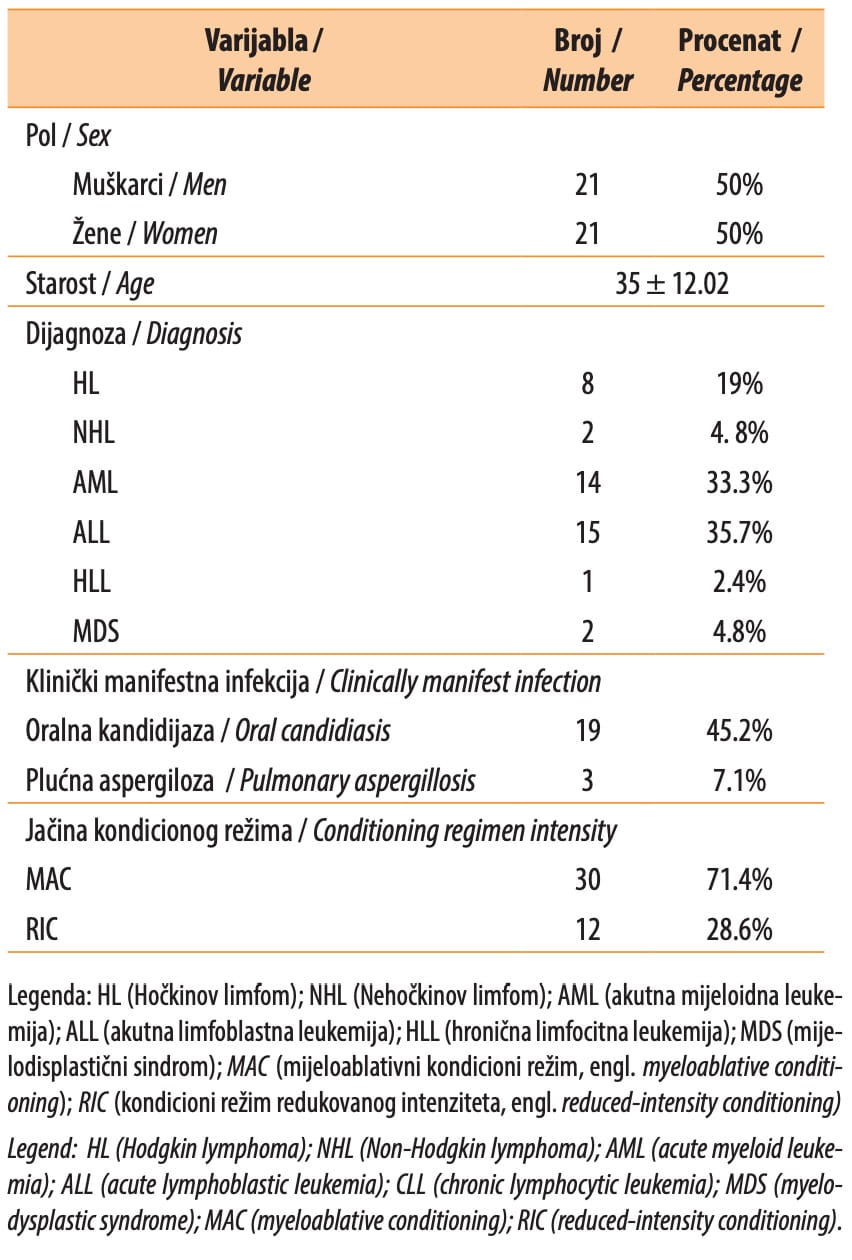
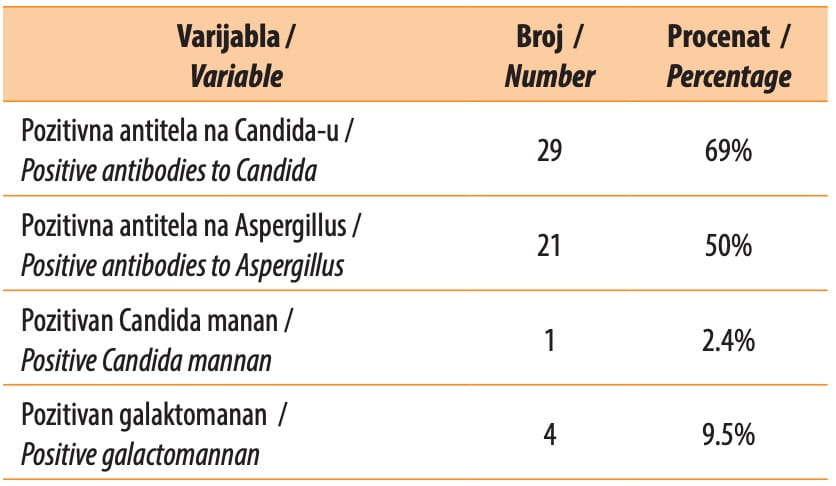
Table 2 shows the data on the presence of specific IgG and IgM antibodies and antigens to Candida spp. and Aspergillus spp.
In 29 patients (69%) the presence of antibodies to Candida spp. was registered, while in 13 patients (31%) the antibody test was negative. The positive antibody test for Aspergillus spp. was registered in 50% of the patients. The Candida spp. mannan test was positive in one patient (2.4%), while the positive galactomannan test was registered in 4 patients (9.5%).
Clinically manifest infection, in the form of oral candidiasis, was present in 19 patients (45.2%), while pulmonary aspergillosis developed in only 3 patients (7.1%).
The existence of a statistically significant connection between clinically manifest infection (oral candidiasis/pulmonary aspergillosis) and the intensity of the applied conditioning regimen was analyzed, however, a statistically significant connection was not found (p = 0.327 MAC, p = 0.256 RIC), i.e., there was no statistically significant difference in the expression of manifest fungal infection between patients on the MAC and the ones on the RIC regimen. Also, there was no statistically significant connection between clinically manifest infection and the diagnosis of the patients (p = 0.580).
Of the three patients (7.1%) who developed clinically manifest pulmonary aspergillosis, all three tested positive on the galactomannan test (100%), which proved statistically significant (p < 0.001). Also, a statistically significant connection between clinically manifest pulmonary aspergillosis and graft weakness was established: 2 (66.6%) vs. 1 (33.3%), (p = 0.016).
The approximated median length of patient survival after allo-SCT was 56 months.
DISCUSSION
Invasive fungal infections (IFI) are a significant cause of morbidity and mortality in patients submitted to the program of allogenic stem-cell transplantation (allo-SCT). There are numerous data in literature on the frequency of IFI infections, the significance of primary antifungal prophylaxis, and its influence on the reduction of the occurrence of fungal infections, in patients submitted to the program of allo-SCT.
A prospective study, which included 23 transplantation centers in the United States of America, analyzed the epidemiology and risk factors in IFIs and provided data confirming invasive aspergillosis to be the most frequent infection, while invasive candidiasis and non-Aspergillus spp. related invasive fungal infections were less frequent [14]. Also, results of a multicentric prospective study from Brazil concluded that IFIs were found in 9.2% of cases, after allo-SCT [15]. In this study, the frequency of the occurrence of aspergillosis and the frequency of occurrence of candidiasis were similar, while, in a prospective study from Italy, aspergillosis was the most common infection (81.1%), while candidiasis was far less frequent (11%).
Based on the results of numerous studies, the application of micafungin, posaconazole, and other antifungal drugs as antifungal prophylaxis, is generally accepted for the prevention of IFIs in patients submitted to the allo-SCT program. This is why analyzing the effect of antifungal prophylaxis remains a challenge and the subject of many studies [17],[18],[19].
A study carried out in Germany confirms the difference between the application of mono and combination prophylaxis [19]. In this study, two prophylactic regimens applied after allo-SCT, were compared: the administering of posaconazole per os (POS), and its combination, i.e., bridging with intravenous micafungin (POS-MIC). According to this study, patients who received POS-MIC had a lesser probability of developing invasive aspergillosis (RR 0.71, 95% CI 0.51 – 1.00) or possible IFIs (RR 0.36, 95% 0.15 – 0.87). These results indicate that the combination of posaconazole with intravenous micafungin (in the from of bridging) may improve antifungal prophylaxis, as well as decrease the frequency of the occurrence of aspergillosis, which was also the result of our study.
In our study, we analyzed whether there was a correlation between the clinically manifest infection and the intensity of the applied conditioning regimen (MAC/RIC), however, a statistically significant connection was not found, although it was expected that, in the group submitted to the MAC conditioning regimen, the frequency of IFIs would be higher. Evidently, the small number of patients in our sample affected the results of the study.
In Germany, in the period between 2013 and 2017, a retrospective study was performed on 156 intensive care patients who were recipients of allo-SCT [21]. Standard diagnostic tests performed on bronchoalveolar lavage (BAL) specimens included conventional bacteria and fungi culture testing, direct microscopy, galactomannan and PCR testing for detecting fungal, bacterial and viral pathogens. According to the results of the tests, fungal infections were the leading group of pathogens, and were discovered in 28 patients (42%). Most of the pathogens belonged to species of molds. Based on the results from the cultures and the BAL tests (galactomannan and PCR), as well as the blood tests (galactomannan), diagnostic processing offered proof on Aspergillus spp. in 20 patients (30%). Sixteen (80%) of these patients were diagnosed with invasive aspergillosis.
Our study also demonstrated a statistically significant connection between the manifestation of graft weakness in patients after allo-SCT and the development of clinically manifest aspergillosis. This finding was expected, as graft weakness renders the patients to be immunocompromised longer, after allo-SCT, whereby it increases the probability of the development of opportunistic infections, such as aspergillosis.
CONCLUSION
This study has shown that, while invasive fungal infections occur also in patients in the program of allo-SCT, who are treated with antifungal prophylaxis, these infections affect a significantly lesser number of such patients. The results of this study have shown that the introduction of dual combination antifungal prophylaxis (micafungin and posaconazole) results in a significant decrease in the incidence of IFIs, in patients submitted to the allo-SCT program.
Informations

-
Keywords:
-
Received:
-
Revised:
-
Accepted:
-
Online first:
-
DOI:
-
Cite this article:

Jelena Cakić
Faculty of Medicine, University of Belgrade, Serbia
8 Dr Subotića Street, 11000 Belgrade, Serbia
E-mail:
1. Peterson L, Ostermann J, Rieger H, Ostermann H, Rieger CT. Posaconazole prophylaxis--impact on incidence of invasive fungal disease and antifungal treatment in haematological patients. Mycoses. 2013 Nov;56(6):651-8.[CROSSREF]
2. Pagano L, Caira M, Nosari A, Van Lint MT, Candoni A, Offidani M, et al. Fungal infections in recipients of hematopoietic stem cell transplants: results of the SEIFEM B-2004 study--Sorveglianza Epidemiologica Infezioni Fungine Nelle Emopatie Maligne. Clin Infect Dis. 2007 Nov 1;45(9):1161-70.[CROSSREF]
3. von Eiff M, Roos N, Fegeler W, von Eiff C, Zühlsdorf M, Glaser J, et al. Pulmonary fungal infections in immunocompromised patients: incidence and risk factors. Mycoses. 1994 Sep-Oct;37(9-10):329-35.[CROSSREF]
4. Lin SJ, Schranz J, Teutsch SM. Aspergillosis case‐fatality rate: systematic review of the literature. Clin Infect Dis. 2001;32:358-66.[CROSSREF]
5. Rüping MJ, Vehreschild JJ, Cornely OA. Patients at high risk of invasive fungal infections: when and how to treat. Drugs. 2008;68(14):1941-62.[CROSSREF]
6. Tamura, K, Drew, R. Antifungal prophylaxis in adult hematopoietic stem cell transplant recipients. Drugs Today. 2008; 44(7): 515[CROSSREF]
7. Vazquez L. Antifungal prophylaxis in immunocompromised patients. Mediterr J Hematol Infect Dis. 2016; 8(1): e2016040.[CROSSREF]
8. Hicheri Y, Cook G, Cordonnier C. Antifungal prophylaxis in haematology patients: the role of voriconazole. Clin Microbiol Infect. 2012; 18(2): 1–15.[CROSSREF]
9. Pagano L, Caira M. Risks for infection in patients with myelodysplasia and acute leukemia. Curr Opin Infect Dis. 2012; 25: 612–8.[CROSSREF]
10. Caira M, Girmenia C, Fadda RM, Mitra ME, Picardi M, Van Lint MT, et al. Invasive fungal infections in patients with acute myeloid leukemia and in those submitted to allogeneic hemopoietic stem cell transplant: who is at highest risk? Eur J Haematol. 2008 Sep;81(3):242-3.[CROSSREF]
11. Goodman JL, Winston DJ, Greenfield RA, Chandrasekar PH, Fox B, Kaizer H, et al. A controlled trial of fluconazole to prevent fungal infections in patients undergoing bone marrow transplantation. N Engl J Med. 1992 Mar 26;326(13):845-51.[CROSSREF]
12. Wingard JR, Carter SL, Walsh TJ, Kurtzberg J, Small TN, Baden LR, et al. Blood and Marrow Transplant Clinical Trials Network. Randomized, double-blind trial of fluconazole versus voriconazole for prevention of invasive fungal infection after allogeneic hematopoietic cell transplantation. Blood. 2010 Dec 9;116(24):5111-8.[CROSSREF]
13. Cornely OA, Maertens J, Winston DJ, Perfect J, Ullmann AJ, Walsh TJ, et al. Posaconazole vs. fluconazole or itraconazole prophylaxis in patients with neutropenia. N Engl J Med. 2007 Jan 25;356(4):348-59.[CROSSREF]
14. Kontoyiannis DP, Marr KA, Park BJ, Alexander BD, Anaissie EJ, Walsh TJ, et al. Prospective surveillance for invasive fungal infections in hematopoietic stem cell transplant recipients, 2001-2006: overview of the Transplant-Associated Infection Surveillance Network (TRANSNET) Database. Clin Infect Dis. 2010 Apr 15;50(8):1091-100.[CROSSREF]
15. Nucci M, Garnica M, Gloria AB, Lehugeur DS, Dias VC, Palma LC, et al. Invasive fungal diseases in haematopoietic cell transplant recipients and in patients with acute myeloid leukaemia or myelodysplasia in Brazil. Clin Microbiol Infect. 2013 Aug;19(8):745-51.[CROSSREF]
16. Girmenia C, Ferretti A, Barberi W. Epidemiology and risk factors for invasive fungal diseases in hematopoietic stem cell transplantation. Curr Opin Hematol 2014;21:459e65.[CROSSREF]
17. Karthaus M. Prophylaxis and treatment of invasive aspergillosis with voriconazole, posaconazole and caspofungin: review of the literature. Eur J Med Res. 2011;16(4):145–52.[CROSSREF]
18. Akan H, Antia VP, Kouba M, Sinkó J, Tănase AD, Vrhovac R, et al. Preventing invasive fungal disease in patients with haematological malignancies and the recipients of haematopoietic stem cell transplantation: practical aspects. J Antimicrob Chemother. 2013 Nov;68 Suppl 3:iii5-16.[CROSSREF]
19. Vehreschild MJ, von Bergwelt-Baildon M, Tran L, Shimabukuro-Vornhagen A, Wisplinghoff H, Bangard C, et al. Feasibility and effectiveness of posaconazole prophylaxis in combination with micafungin bridging for patients undergoing allogeneic stem cell transplantation: a 6-yr analysis from the cologne cohort for neutropenic patients. Eur J Haematol. 2014 Nov;93(5):400-6.[CROSSREF]
20. Corzo-León DE, Satlin MJ, Soave R, Shore TB, Schuetz AN, Jacobs SE, et al. Epidemiology and outcomes of invasive fungal infections in allogeneic haematopoietic stem cell transplant recipients in the era of antifungal prophylaxis: a single-centre study with focus on emerging pathogens. Mycoses. 2015 Jun;58(6):325-36.[CROSSREF]
21. Wohlfarth P, Turki AT, Steinmann J, Fiedler M, Steckel NK, Beelen DW, et al. Microbiologic Diagnostic Workup of Acute Respiratory Failure with Pulmonary Infiltrates after Allogeneic Hematopoietic Stem Cell Transplantation: Findings in the Era of Molecular- and Biomarker-Based Assays. Biol Blood Marrow Transplant. 2018 Aug;24(8):1707-14.[CROSSREF]