


Prognostic factors in elderly patients with acute myeloid leukemia
- Clinic for Pulmonology, Clinical Center of Serbia, Belgrade, Serbia
- Clinic for Hematology, Clinical Center of Serbia, Belgrade, Serbia
- Faculty of Medicine, University of Belgrade, Belgrade, Serbia
ABSTRACT
Introduction: Acute myeloid leukemia (AML) is characterized by pathological proliferation of myeloid lineages. It predominantly occurs in patients over 60 years of age, whose outcome is considerably worse, as compared to younger patients.
Aim: The aim of the study was the analysis of the clinical characteristics of older patients with AML and their impact on the following: achieving complete remission (CR), overall survival (OS), early mortality (EM), and relapse.
Materials and methods: This retrospective study included 94 patients with AML, treated with chemotherapy and palliative treatment, whose information was taken from their medical histories, upon treatment.The following clinical features were analyzed as risk factors for OS, CR, relapse and EM: leukocytes, the level of serum lactate dehydrogenase (LDH), performance status on the ECOG (Eastern Cooperative Oncology Group) scale, the European LeukemiaNet cytoplasmic risk group, the HCT-CI (hematopoietic cell transplantation - comorbidity index) and the NPM1/ FLT3-ITD (nucleophosmin 1/FLT3-internal tandem mutation) molecular status. For the identification of prognostic factors, the Cox regression analysis was used.
Results: The average age of the patients was 69 years (range: 65 – 87). CR was achieved in 23 (46%) of the 50 patients (53.2%) who received intensive chemotherapy, with relapse occurring in 17/23 patients (73.9%). EM was reported in 17 patients (18.1%). Patients with ECOG PS > 2 had a statistically significantly lower OS than patients with ECOG PS < 2 (p = 0.030). Patients with HCT-CI > 3 had a poorer OS than patients with HCT-CI < 3 (p = 0.040). Serum LDH > 450 U/I was found to be a factor, i.e., marker of unfavorable prognosis for the OS, as compared to LDH < 450U/I (p = 0.044).
Conclusion: The conclusion is that older AML patients with poorer ECOG PS, high HCT-CI, increased LDH levels have a poorer OS.
INTRODUCTION
Acute leukemias (AL) are malignant clonal diseases of the hematopoietic stem cell, occurring due to anomaly in the stem cell genome, and resulting in uncontrolled proliferation and infiltration of different tissues [1].
Acute myeloid leukemia (AML) is characterized by pathological proliferation of the cells of the myeloid lineage [1]. AML is a disease predominantly affecting patients above the age of 60 years, i.e., elderly patients [2],[3],[4]. The incidence of AML in patients older than 75 years is more than 15 per 100,000 population, while the incidence of this disease in patients younger than 40 years is approximately 4 per 100,000 population [5],[6].
The outcome of AML treatment is significantly poorer in elderly patients, as compared to patients younger than 60 years [7],[8]. An unfavorable outcome in elderly patients is connected to numerous factors, which can be connected to AML itself, or related to the individual characteristics of the patient [8]. The factors believed to affect the unfavorable outcome of AML treatment in elderly patients, which are related to the individual characteristics of the patients, are the following: existing comorbidities, pharmacodynamic features, organ function weakening due to old age, weaker response to systemic bacterial and fungal infections - as a result of the weakened function of the immune system, as well as poorer general performance status assessed with the ECOG (Eastern Cooperative Oncology Group) scale. On the other hand, markers, i.e., factors predicting an unfavorable outcome in acute myeloid leukemia in elderly patients, which are related to the disease itself, are the following: higher incidence of secondary AML and AML developing after the application of cytotoxic therapy, as well as a less favorable genetic mutation profile, which is all related to resistance to treatment [7],[8],[9],[11].
Also, elderly patients are worse at tolerating standard intensive treatment, which is why less intensive and palliative treatment are frequently resorted to [10],[11],[12]. Early mortality during standard intensive treatment is one of the reasons of unfavorable outcome in the treatment of elderly patients with this form of therapy [11].
However, results showing the prognosis of elderly patients with AML in many available studies, are not frequently presented, due to selection bias in most of these studies, wherein very old and high-risk patients are excluded from the analysis [8],[11].
The aim of the study was the analysis of the clinical characteristics of older patients with AML, and their impact on the following: achieving complete remission (CR), overall survival (OS), early mortality (EM), and relapse.
MATERIALS AND METHODS
This is a retrospective study carried out on the basis of the database of the Clinic for Hematology of the Clinical Center of Serbia, which included 94 patients with AML, older than 65 years, who were diagnosed and treated in the period between November 2013 and November 2018.
The following demographic, clinical and laboratory characteristic of the patients were recorded at diagnosis: sex, age, general performance status according to the ECOG scale [13], complete blood count (hemoglobin, white blood cell count, platelet count, WBC differential), level of serum lactate dehydrogenase (LDH), and the percentage of blasts in peripheral blood and bone marrow. The assessment of comorbidities was performed on the basis of the hematopoietic cell transplantation-comorbidity index (HCT-CI), used in hematopoietic stem-cell transplantation [14]. The cytogenetic risk level was determined on the basis of the recommendations of an international leukemia expert panel, given on behalf of European LeukemiaNet (ELN) [15].
The following was performed as part of the hematological diagnostics:
1. Cytological analysis – performed on smears stained with the use of the May- Grünwald Giemsa (MGG) method, with additional staining (MPO, SBB, PAS, NSE);
2. Immunophenotypization by means of flow cytometry with the use of the direct multicolor immunofluorescence method [17];
3. Classical cytogenetic analysis with the application of the HG-banding technique, in keeping with the International System for Human Cytogenetic Nomenclature [18]; 4. Molecular genetic research - patient bone marrow was tested for the presence of genetic mutations - nucleophosmin/FLT3-internal tandem mutations (NPM1/FLT3-ITD).
Patients were treated with chemotherapeutic protocols for patients older than 60 years, in keeping with ELN recommendations [15]. Depending on the ECOG and HCT-CI, intensive chemotherapy, low-intensity therapy, or palliative treatment were applied. Patients with ECOG ≤ 2, HCT-CI < 3 received high-intensity chemotherapy, following the ‘3+7 light’ regimen; the therapy included: daunorubicin - in the dosage of 45 mg/m2 per day 1, 2, 3 in combination with cytarabine – in the dosage of 100 mg/m2 per day, continuously via iv infusion, for 7 days. Patients with ECOG > 2, HCT-CI ≥ 3, were treated under the ‘2+5’ regimen, which included: daunorubicin – in the dosage of 30 mg/m2 , iv, D 1, 3, and cytarabine – in the dosage of 100 mg/m2 , iv, continuously, D 1-5.
Low-intensity chemotherapy was applied in patients with ECOG > 2, HCT-CI ≥ 3, whose cytogenetic risk, according to the ELN classification, was not unfavorable. This therapy involved the administration of low doses of cytarabine (20 mg, SC, per 12 h, D 1-10), and monotherapy with VePesid infusion vials, 100 mg, D 1-5. Palliative treatment included administering cytoreductive therapy (Litalir capsules) and supportive therapy, in the form of the transfusion of blood products. It was applied in patients who could not tolerate any kind of antileukemia therapy, or patients who refused such treatment.
The assessment of treatment efficacy was made at the end of induction treatment, in keeping with the widely accepted clinical criteria of the International Working Group for AML [19]. The disease is considered refractory if CR has not been achieved, in patients who survived ≥ 7 days after the completion of induction therapy. Overall survival (OS) is defined as the time that has elapsed from diagnosis until death or until the day of the last follow-up. Early mortality is defined as death within 28 days of the initiation of induction chemotherapy [20].
Statistical analysis was performed on the basis of data found in patient discharge papers taken from the Records of the Clinic for Hematology of the Clinical Center of Serbia, with the use of Microsoft Excel. Depending on the types of variables and the normality of distribution, the description of data is presented as n (%) or the median value (range, min-max). The univariate Cox regression model with a 95% confidence interval was used for finding the independent predictor of mortality in elderly patients with AML. Statistical hypotheses were tested at the level of statistical significance (alpha level) of 0.05.
RESULTS
The study included 94 patients, 56 men (59.6%) and 38 women (40.4%). The average age of the patients was 69 years (range: 65 – 87 years). There were 36/94 patients older than 70 years (38.3%), while the largest number of patients, 58 (61.7%), were between 65 and 70 years old.
More patients, 49 of them (53.3%), had a good performance status, and their ECOG score was < 2, while 43 patients (46.81%) had an ECOG score ≥ 2.
At diagnosis, 26 patients (28.6%) had a high HCT-CI score ≥ 3, while 65 patients (71.4%) had an HCT-CI score < 3.
According to the ELN cytogenetic and molecular risk level classification, 5 patients (5.3%) had a favorable, 58 patients (61.7%) had an intermediate, and 31 patients (33%) had an unfavorable level of risk.
Patients were classified, according to the level of serum LDH, in the LDH < 450 U/I group, with 56 patients (60.9%), and the LDH ≥ 450 U/I group, with 36 patients (39.1%).
There were 66 patients (71%) whose WBC count (Le count) was Le < 30x109/l, while 27 patients (29%) had a leukocyte count of Le > 30x109/l.
There were 81 (86.2%) patients with de novo AML, while 13 cases (13.8%) were secondary AML, occurring as a transformation of a different hematological disease.
NPM1/FLT3-ITD status was determined in 19/94 patients, of whom 15 patients (78.9%) had an NPM1-/FLT3-ITD- status, while 4 patients (21.1%) had an NPM1+/FLT3-ITD- status.
The percentage of blasts in peripheral blood (PB) < 50% was present in 73 patients (80.2%), while the percentage of blasts in PB > 50% was present in 18 patients (19.8%). The percentage of blasts in bone marrow < 50% was present in 43 patients (46.7%), while the percentage of blasts in bone marrow > 50% was present in 49 patients (53.3%).
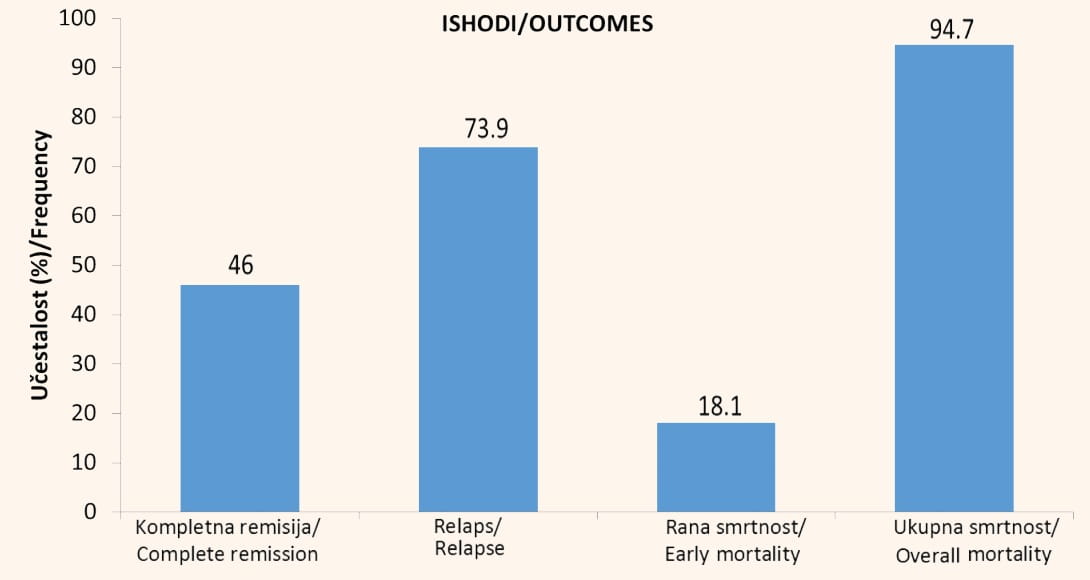
Of a total of 50 patients (53.2%) in the study who had received intensive chemotherapy, complete remission (CR) was achieved by 23 patients (46%).
Relapse occurred in 17 patients (73.9%) who had achieved CR. The median duration of CR was 7 months (range: 1 – 24).
Early mortality was registered in 17 patients (18.1%) involved in the study.
The median overall survival of AML-NK patients was three months (0.1 – 38 months), two-year OS was 5.3%, while median overall survival without signs of illness was 8 months. Throughout the duration of the study a total of 89 patients (94.7%) died (Figure 1).
Univariate Cox analysis revealed factors significant for patient OS, namely: ECOG PS, HCT-CI, and LDH. Patients with ECOG PS > 2 had statistically significantly lower OS, as compared to patients with ECOG PS < 2 (p = 0.030). Also, patients from the HCT-CI >3 group had a lower OS, as compared to patients from the HCT-CI < 3 group (p = 0.040). The serum level of LDH > 450 U/I proved to be a marker of unfavorable prognosis for OS, as compared to LDH < 450 U/I (p = 0.044) (Table 1).
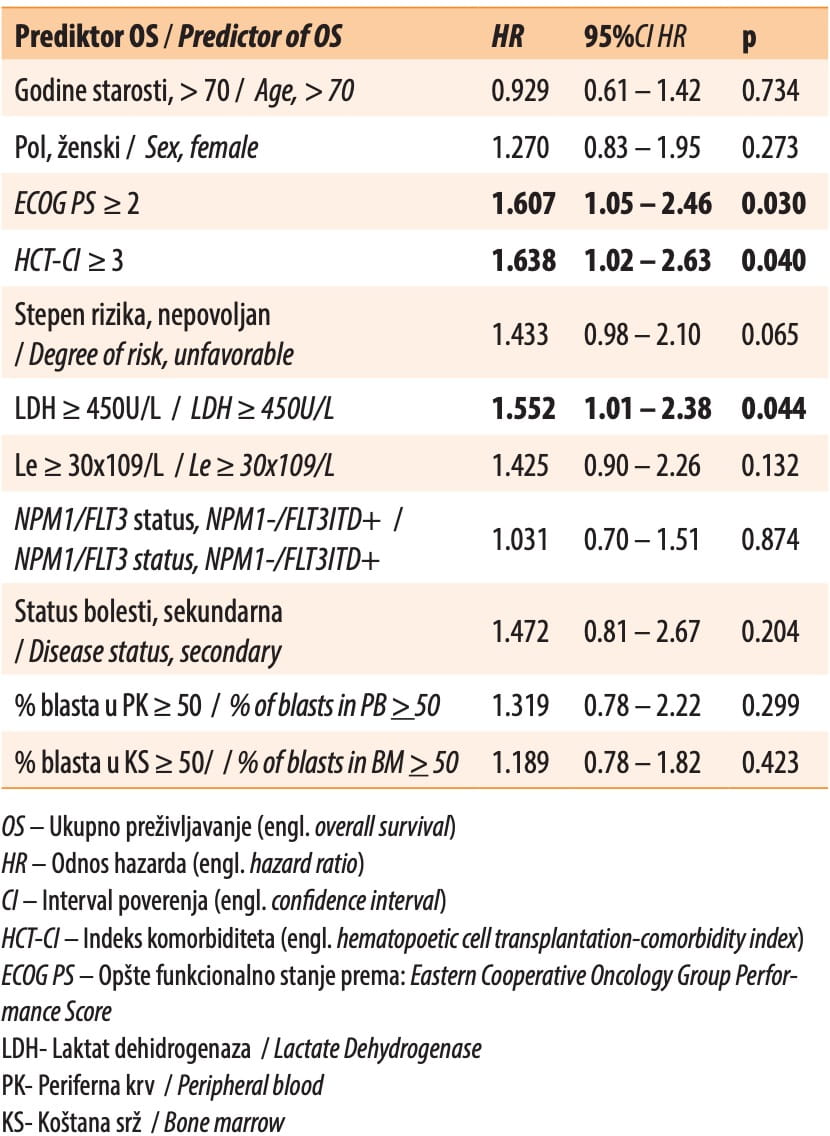
None of the abovementioned parameters was a statistically significant predictor for the following: achieving CR, the occurrence of relapse, early mortality (p > 0.05).
DISCUSSION
Studies analyzing the effect of prognostic factors, i.e., markers in elderly patients have strict inclusion criteria, which is why a small number of patients with a large number of possible associated risk factors are included in these studies [8],[11]. Also, elderly patients suffering from acute myeloid leukemia, included in this type of study, usually had a lethal outcome before assessment on the response to treatment could be made, due to a rapid progression of the illness and significant comorbidities [7],[11],[21]. In our study, 89 patients (94.7%) had a lethal outcome, while 5 patients (5.3%) had a favorable outcome, which is in keeping with the data available in literature [24].
The disease occurs approximately equally in both men and women (59.6% versus 40.4%), not only in our study, but in literature as well [9]. The effect of the sex of the patient, as a factor influencing OS, CR, early mortality, or relapse of the illness, has not been proven.
The average age of the patients included in our study was 69 years (range: 65 – 87). Most of the patients belonged to the 65 – 75 age group (61.7%).
In the prospective AML96 study, which included 909 patients suffering from acute myeloid leukemia, aged 61 – 87 years, the average age was 67 years [9]. Age above 70 years, as an individual prognostic factor in the outcome of AML, was not proven as a statistically significant parameter (p = 0.734) in this study, while data from literature state the opposite [8]. The AML96 study demonstrated that age above 65 years had a statistically significant effect on shorter OS [9].
The average age of the patients with AML included in a multicentric Italian study, which covered 1,005 patients, was 69 years. The study analyzed the effect of intensive and non-intensive treatment on the overall survival of elderly patients and did not demonstrate better survival in patients treated with intensive chemotherapy. A smaller number of patients older than 70 years, as compared to younger patients, received intensive therapy, which lead to an unfavorable outcome [8].
In other studies, which analyzed the prognostic markers related to the outcome of AML in elderly patients, the effect of unfavorable ECOG PS on higher mortality, achieving CR and shorter OS, in patients older than 65 years, has been proven [7],[11]. Our study showed that ECOG PS had a statistically significant effect on the occurrence of early mortality (p = 0.030). The effect of ECOG PS on the following: achieving CR, early mortality, and the occurrence of relapse, was not proven in our study. In the study carried out by the Southwestern Oncology Group (SWOG), where patients aged ≥ 56 years were analyzed, a significant effect of unfavorable ECOG PS on unfavorable outcome of AML was demonstrated [23].
Also, the results obtained from the analysis of the effect of HCT-CI on OS showed statistical significance in our study (p = 0.040), which is in keeping with the results of other studies [10],[21],[25],[26]. In a study carried out at the Clinic for Hematology of the Clinical Center of Serbia, in 2011, which analyzed HCT-CI as a prognostic factor of OS, and which assisted in making decisions on the application of intensive therapy in elderly patients with AML, a statistically significant connection between HCT-CI > 3 and OS was proven [7]. However, the effect of HCT-CI on the following: achieving CR, early mortality, the occurrence of relapse, was not proven in our study.
In our study, elevated levels of LDH (LDH > 450 U/I) proved to be a significant prognostic marker of OS (p = 0.044), which is in keeping with data from previous studies [6],[21],[25]. The effect of elevated LDH serum levels on CR, early mortality, and the occurrence of relapse, were not proven in our study. In the prospective AML96 study, involving 909 patients suffering from AML, the values of LDH > 700 U/I showed a significant effect on shorter OS [9]. Also, in a study carried out at the Clinic for Hematology of the Clinical Center of Serbia, in 2011, which analyzed comorbidities as a prognostic marker of the OS of patients suffering from AML, a negative effect of elevated LDH levels on both OS and CR was demonstrated [7].
There were more patients with intermediate and unfavorable risk levels, according to the ELN classification, as compared to the patients with a favorable risk level (61.7% and 33% vs. 5.3%), in our study, which is in keeping with data that can be found in literature [7]. However, the study did not demonstrate a statistical connection between unfavorable risk levels, according to ELN, and unfavorable values of OS and CR, a more frequent occurrence of relapse, and a more frequent occurrence of early mortality, which can be explained by the small number of patients in our study. A study carried out by the American Society of Hematology indicates the possible connection between unfavorable karyotype, i.e., risk level, and a more unfavorable outcome, due to a greater association of resistant disease with the said karyotype [11].
The NPM1/FLT3 status was determined in 19 patients, in our study. In four patients (21.1%) with NPM1-/FLT3ITD+ status, due to a small number of patients, it was not possible to prove the prognostic significance in relation to OS, CR, early mortality, and relapse. In the prospective AML96 study, which included 909 patients, analysis of 663 patients as to their NPM1 and FLT3 status showed a statistically significant connection of positive NPM1, but not of positive FLT-3ITD status, to better OS [9].
Analysis of all patients included in the study showed that AML occurred more frequently as a de novo disease, as compared to progression of an existing hematological disease (86.2% versus 13.8%). Analysis of the effect of secondary AML on OS, Cr, early mortality, and the occurrence of relapse, did not register any connection, possibly due to a small number of such patients. In the SWOG study, the participation of secondary AMLs was between 22% and 24%. In the German AML HD98-B study, the participation of secondary AMLs was 33% [22].
In our study, there were more patients belonging to the group with Le < 30x109 /l as compared to those belonging to the group with Le > 30x109 /l (71% vs. 29%), while a higher Le blood count did not affect OS, CR, early mortality, and occurrence of relapse.
Some studies indicate that a higher Le count does have an effect on AML outcome, while other studies negate such a connection. A study carried out at the Clinic for Hematology, which analyzed the existence of comorbidities as a prognostic factor for OS in elderly patients with AML, indicated a significant connection between an elevated Le blood count (Le > 30x109 /l) and OS [7].
The percentage of blasts > 50% in peripheral blood, as well as in bone marrow, did not prove to be connected with OS, CR, early mortality, and occurrence of relapse, either in our study or in earlier studies [9].
CONCLUSION
As a conclusion to this study, we can state that the general performance status of patients expressed as the score on the ECOG scale, the existence of comorbidities marked as the HCT-CI score, as well as elevated serum levels of LDH, do have an effect on the OS of elderly patients suffering from AML. However, our study did not prove the significance of these, or other parameters that we monitored, in relation to the frequency of CR, relapse, or early mortality.
Informations

-
Keywords:
-
Received:
-
Revised:
-
Accepted:
-
Online first:
-
DOI:
-
Cite this article:

Anka Poštić
Clinic for Pulmonology, Clinical Center of Serbia
26 Koste Todorovića Street, 11000 Belgrade, Serbia
E-mail:
1. Janković G. Akutna mijeloblastna leukemija. In: Ćolović M, Janković G. Maligne bolesti krvi. Beograd, Zavod za udžbenike i nastavna sredstva, 1999: 81-119.
2. Ries LAG, Melbert D, Krapcho M, Stinchcomb DG, Howlader N, Horner MJ, et al. SEER Cancer Statistics Review, 1975-2005. SEER Database, National Cancer Institute; 2009.
3. Hiddemann W, Kern W, Schoch C, Fonatsch C, Heinecke A, Wörmann B, et al. Management of acute myeloid leukemia in elderly patients. J Clin Oncol. 1999 Nov;17(11):3569-76.[CROSSREF]
4. Stone RM. The difficult problem of acute myeloid leukemia in older adult. CA Cancer J Clin. 2002;52:363–71.[CROSSREF]
5. Appelbaum FR, Gundacker H, Head DR, Slovak ML, Willman CL, Godwin JE, et al. Age and acute myeloid leukemia. Blood. 2006 May 1[CROSSREF]
6. Kantarjian H, O’brien S, Cortes J, Giles F, Faderl S, Jabbour E, et al. Results of intensive chemotherapy in 998 patients age 65 years or older with acute myeloid leukemia or high-risk myelodysplastic syndrome: predictive prognostic models for outcome. Cancer. 2006 Mar 1;106(5):1090-8.
7. Djunic I, Virijevic M, Novkovic A, Djurasinovic V, Colovic N, Vidovic A, et al. Comorbidity as a risk factor for overall survival and decision criteria for intensity of chemotherapy in elderly patients with acute myeloid leukemia. Med Oncol. 2012 Jun;29(2):1077-81.[CROSSREF]
8. Pulsoni A, Pagano L, Latagliata R, Casini M, Cerri R, Crugnola M, et al. Survival of elderly patients with acute myeloid leukemia. Haematologica. 2004 Mar;89(3):296-302.
9. Röllig C, Thiede C, Gramatzki M, Aulitzky W, Bodenstein H, Bornhäuser M, et al. A novel prognostic model in elderly patients with acute myeloid leukemia: results of 909 patients entered into the prospective AML96 trial. Blood. 2010 Aug 12;116(6):971-8.[CROSSREF]
10. Malfuson JV, Etienne A, Turlure P, de Revel T, Thomas X, Contentin N, et al. Risk factors and decision criteria for intensive chemotherapy in older patients with acute myeloid leukemia. Haematologica. 2008 Dec;93(12):1806-13.[CROSSREF]
11. Erba HP. Prognostic factors in elderly patients with AML and the implications for treatment. Hematology Am Soc Hematol Educ Program.2007:420-8.[CROSSREF]
12. Wedding U, Höffken K. Therapy of acute myeloid leukemia in the elderly patient. Z Gerontol Geriatr.2001;34(4):269-76.[CROSSREF]
13. Oken MM, Creech RH, Tormey DC, Horton J, Davis TE, McFadden ET, et al. Toxicity and response criteria of the Eastern Cooperative Oncology Group. Am J Clin Oncol. 1982 Dec;5(6):649-55.[CROSSREF]
14. Sorror ML, Storb RF, Sandmaier BM, Maziarz RT, Pulsipher MA, Maris MB, et al. Comorbidity-age index: a clinical measure of biologic age before allogeneic hematopoietic cell transplantation. J Clin Oncol. 2014 Oct 10;32(29):3249-56.[CROSSREF]
15. Döhner H, Estey EH, Amadori S, Appelbaum FR, Büchner T, Burnett AK, et al. Diagnosis and management of acute myeloid leukemia in adults: recommendations from an international expert panel, on behalf of the European LeukemiaNet. Blood. 2010 Jan 21;115(3):453-74.[CROSSREF]
16. Arber DA, Brunning RD, Le Beau, et al. MM WHO classification. IARC. Lyon, 2008;p.110-46.
17. Béné MC, Nebe T, Bettelheim P, Buldini B, Bumbea H, Kern W, et al. Immunophenotyping of acute leukemia and lymphoproliferative disorders: a consensus proposal of the European LeukemiaNet Work Package 10. Leukemia. 2011 Apr;25(4):567-74.[CROSSREF]
18. International System for Human Cytogenetic Nomenclature (ISCN). Recommendations for the International Standing Committee on Human Cytogenetic Nomenclature. Memphis, Tennessee, USA, 1994.[CROSSREF]
19. Cheson BD, Bennett JM, Kopecky KJ, Büchner T, Willman CL, Estey EH, et al. International Working Group for Diagnosis, Standardization of Response Criteria, Treatment Outcomes, and Reporting Standards for Therapeutic Trials in Acute Myeloid Leukemia. Revised recommendations of the International Working Group for Diagnosis, Standardization of Response Criteria, Treatment Outcomes, and Reporting Standards for Therapeutic Trials in Acute Myeloid Leukemia. J Clin Oncol. 2003 Dec 15;21(24):4642-9.[CROSSREF]
20. Walter RB, Othus M, Borthakur G, Ravandi F, Cortes JE, Pierce SA, et al. Prediction of early death after induction therapy for newly diagnosed acute myeloid leukemia with pretreatment risk scores: a novel paradigm for treatment assignment. J Clin Oncol. 2011 Nov 20;29(33):4417-23.[CROSSREF]
21. Breccia M, Frustaci AM, Cannella L, Stefanizzi C, Latagliata R, Cartoni C, et al. Comorbidities and FLT3-ITD abnormalities as independent prognostic indicators of survival in elderly acute myeloid leukaemia patients. Hematol Oncol. 2009 Sep;27(3):148-53.[CROSSREF]
22. Fröhling S, Schlenk RF, Kayser S, Morhardt M, Benner A, Döhner K, et al. for the German-Austrian AML Study Group. Cytogenetics and age are major determinants of outcome in intensively treated acute myeloid leukemia patients older than 60 years: results from AMLSG trial AML HD98-B. Blood. 2006 Nov 15;108(10):3280-8.[CROSSREF]
23. Appelbaum FR, Gundacker H, Head DR, Slovak ML, Willman CL, Godwin JE, et al. Age and acute myeloid leukemia. Blood. 2006 May 1;107(9):3481-5.[CROSSREF]
24. Menzin J, Lang K, Earle CC, Kerney D, Mallick R. The outcomes and costs of acute myeloid leukemia among the elderly. Arch Intern Med. 2002 Jul 22;162(14):1597-603.[CROSSREF]
25. Etienne A, Esterni B, Charbonnier A, Mozziconacci MJ, Arnoulet C, Coso D, et al. Comorbidity is an independent predictor of complete remission in elderly patients receiving induction chemotherapy for acute myeloid leukemia. Cancer. 2007 Apr 1;109(7):1376-83.[CROSSREF]
26. Giles FJ, Borthakur G, Ravandi F, Faderl S, Verstovsek S, Thomas D, et al. The haematopoietic cell transplantation comorbidity index score is predictive of early death and survival in patients over 60 years of age receiving induction therapy for acute myeloid leukaemia. Br J Haematol. 2007 Feb;136(4):624-7.[CROSSREF]