


Unmet dental health care needs in Serbia
- Institute of Social Medicine, Faculty of Medicine, University of Belgrade, Serbia
- Humanities Department, Faculty of Medicine, University of Belgrade, Serbia
- Primary Health Care Center Požarevac, Department for Preventive and Pediatric Dentistry, Serbia
ABSTRACT
Aim: The aim of this study was the analysis of the social and health status characteristics of the population with unmet dental health care needs.
Materials and methods: This cross-sectional study included 20,069 respondents from the Survey on Income and Living Conditions (SILC) in the Republic of Serbia in 2014.
Results: Nearly every sixth citizen (16.1%) reported unmet dental health care needs. Participants between the ages of 27 and 44 years (OR: 1.48, 95% CI: 1.21 – 1.82), and between 45 and 64 years (OR: 1.49, 95% CI: 1.19 – 1.86), participants who assessed their health status as: good (OR: 1.91, 95% CI: 1.63 – 2.25), fair (OR: 3.16, 95% CI: 2.64 – 3.77), bad (OR: 3.65, 95% CI: 2.94 – 4.53), or very bad (OR: 4.22, 95% CI: 3.10 – 5.74), had a higher likelihood of reporting unmet dental health care needs. The most frequent reasons for unmet dental health care needs were financial obstacles to the accessibility of dental health care (66.6%) and fear or treatment (15.1%).
Conclusion: The study found associations between unmet dental health care needs and social and health status characteristics. Health policy should adopt a multidimensional approach and eliminate barriers which restrict the accessibility of dental health care.
INTRODUCTION
Unmet needs of patients for health care are defined as ‘the difference between health services that are considered necessary for a particular health problem and services that are received’ [1]. Unmet dental health care needs can be an indicator of equity of access to dental health care and are associated with poor oral health [2], which is further associated with poorer general health and quality of life [3]. Both subjective and objective indicators of oral health differ between the populations with disparities in access to dental health care [4]. The reported prevalence of unmet dental health care needs varies from 0.3% in the Netherlands to 24.5% in South Korea [5],[6]. Unmet dental health care needs can be associated with the costs of care [4] and social characteristics of the participants [5],[6],[7]. The prevalence of unmet dental health care needs is higher among the unemployed and those of lower education, or lower socio-economic status [6],[7].
Some countries have taken action with the aim to reduce these disparities and to improve the oral health of the entire population through the reduction of costs of dental health care and an increase in dental health care availability [4],[8]. A good example of a healthcare system which has addressed the unmet dental health care needs is Finland, which has increased the percentage of population covered by health insurance through the abolishment of age restrictions to the access to public dental health care services, along with a wider implementation of reimbursement of treatment costs for dental health care [8]. Brazil has implemented a national program called ‘Smiling Brazil’ [9], which has included the establishment of an Oral Health Team and a wider availability of dental services for the population [10].
Dental health care in Serbia is organized as a service that is available at the primary health care level in stateowned public health institutions and in the private sector. Traditionally, all services were available to all residents in Serbia who had mandatory health insurance. After the year 2000, the reforms in the Serbian health care system began, bringing great changes in the provision of dental health care. In 2005, the Health Insurance Law introduced changes in the funding of dental health care, and dental health care without any out-of-pocket payment is now only available to minors, pregnant women and for emergency dental care in the public health care system. The changes introduced in 2010 added college and university students under the age of 26 to the list [11],[12]. This has led to a decrease in the use of dental health care services among adults [13]. In the year after the new Health Insurance Law was passed, there was a marked decline in the percentage of adults who used dental health care services at least once a year from 36.8% to 30.7% [13]. Between 2006 and 2013, the number of toothless persons increased from 10.4% to 12.4% [13],[14]. Instead of receiving dental health care at the early stages of illness, patients often opted to wait for the treatment and later had to receive more expensive treatment for a more severe illness [13]. Although there has been a marked development of privately-owned dental health care during the past decade, dental health care services provided in Serbia today are insufficient to meet the long-term needs of the population [13]. To the best of our knowledge, there have been no studies examining the prevalence of unmet dental health care needs among adults in Serbia, or its association with social characteristics. The study aims were to analyze the socio-demographic, socio-economic and health status characteristics of the population with unmet dental health care needs in Serbia and to identify predictors of unmet dental health care needs in Serbia.
METHODS
The data from the Survey on Income and Living Conditions (SILC) in Serbia, conducted in 2014, were analyzed in this study [15],[16]. The sampling and the questionnaires used have been described elsewhere [18]. The response rate was 80.8% (16,220/20,069). The sampling frame included all residents of Serbia, above the age of 16 years.
The dependent variable - unmet dental health care needs, was defined by the question: “Was there any time during the past 12 months that you should have visited a dentist, but did not?” (Yes / No). Those who answered ‘Yes’ to the previous questions were then asked to report the causes for not receiving dental health care.
We examined the association of the outcome variable with the following: social variables (socio-economic and socio-demographic), health status, presence of chronic diseases, limitations in daily activities caused by any existing problems with health, household disposable income.
The Ethics Committee of the Faculty of Medicine in Belgrade approved the research (No. 29/IX-5, 21. 09. 2016).
Descriptive and analytical statistics were used, and data were presented as the absolute number and frequency (percentages). Pearson’s chi-square test was used to analyze the differences in general characteristics between respondents with unmet dental health care needs, and those whose dental health care needs had been met, for weighted values. Multicollinearity was examined using the variance inflation factor (VIF).
All variables found to be significant were used as independent variables in the multivariate logistic regression model with the self-perceived unmet dental health care needs as an outcome variable. The analysis was performed using the Statistical Package for Social Sciences (SPSS) version 22.0.
RESULTS
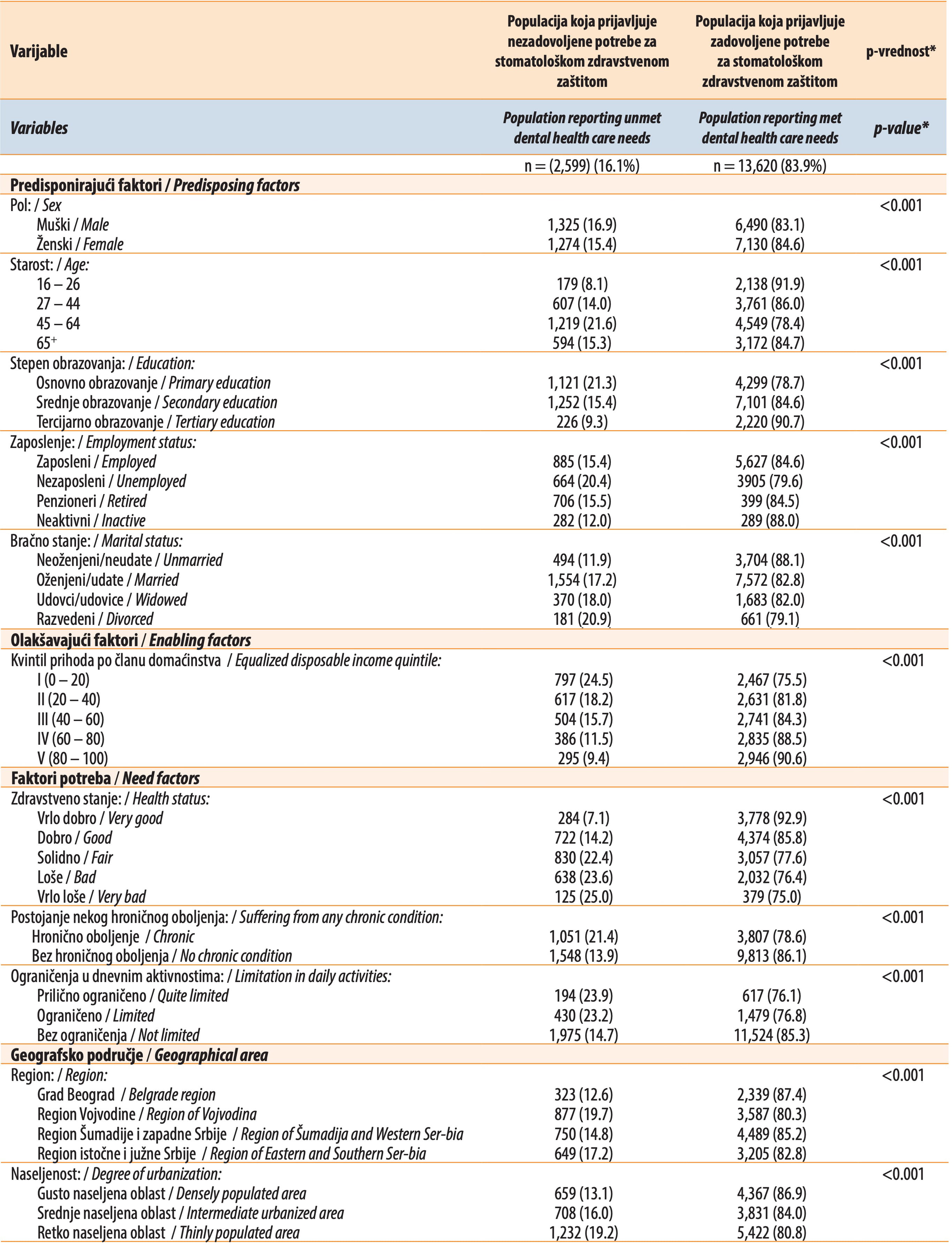
An estimated 16.1% of Serbian adults stated that they needed dental health care but had been unable to obtain it within the previous year. A significantly higher percentage of males reported unmet dental health care need (16.9% vs. 15.4%, p < 0.001). A significantly higher percentage of participants with only primary education reported that they had the unmet dental health care needs (21.3%), as compared with participants with secondary education (15.4%) and a college diploma or university degree (9.3%), p < 0.001. Among the participants with unmet dental health care needs, there was a significantly higher percentage of those who assessed their health as very bad or bad. Socio-demographic and socio-economic characteristics of the respondents reporting met and unmet dental health care needs are presented in Table 1.
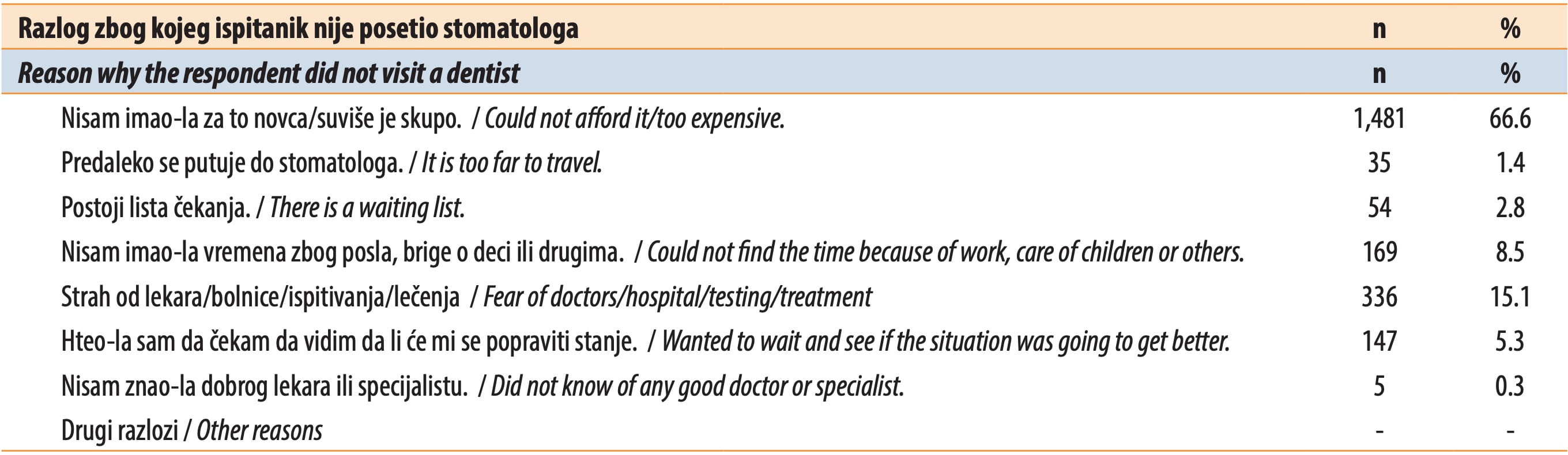
The most common reason for not visiting the dentist during the previous year was related to financial obstacles to the accessibility of dental health care, which was stated by two-thirds of our respondents with unmet dental health care needs (66.6%), followed by the fear of doctors/hospital/testing/treatment, which was stated by 15.1% of participants.
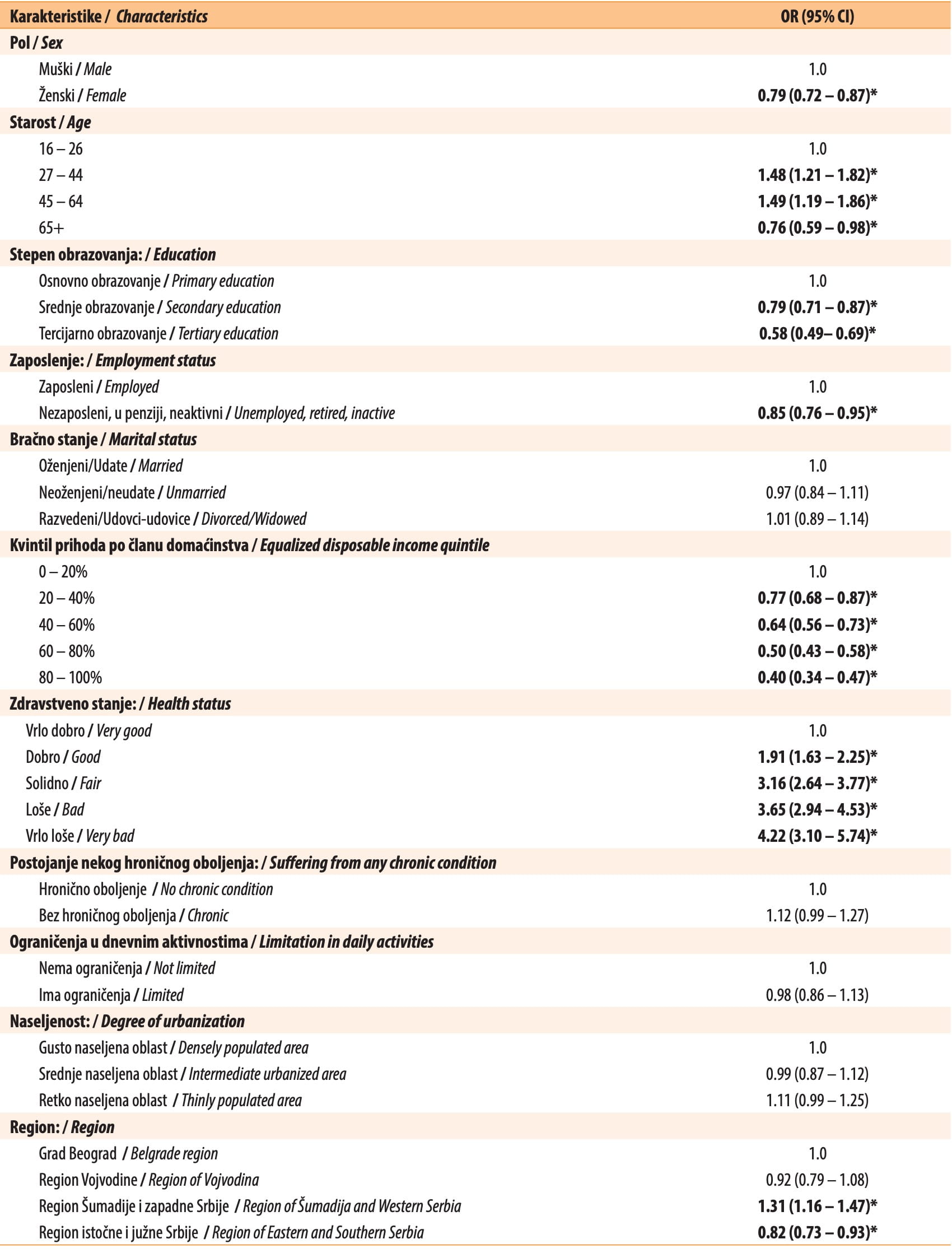
The multivariate logistic regression with self-perceived unmet dental health care needs as an outcome variable showed that females (OR: 0.79, 95% CI: 0.72 – 0.87), participants over 65 years of age (OR: 0.76, 95% CI: 0.59 – 0.98), those with secondary education (OR: 0.79, 95% CI: 0.61 – 0.89), those with a college diploma or university degree (OR: 0.58, 95% CI: 0.49 – 0.69), unemployed, inactive or retired persons (OR: 0.85, 95% CI: 0.76 – 0.95) had a lower likelihood to report unmet dental health care needs. With an increase of equalized disposable income, there was a statistically significant decrease in the likelihood of unmet dental health care needs. Participants between the ages of 27 and 44 years (OR: 1.48, 95% CI: 1.21 – 1.82), and 45 and 64 years (OR: 1.49, 95% CI: 1.19 – 1.86), participants who assessed their health status as good (OR: 1.91, 95% CI: 1.63 – 2.25), fair (OR: 3.16, 95% CI: 2.64 – 3.77), bad (OR: 3.65, 95% CI: 2.94 – 4.53) or very bad (OR: 4.22, 95% CI: 3.10 – 5.74) had a higher likelihood of reporting unmet dental health care needs.
DISCUSSION
This study analyzed the factors associated with the unmet dental health care needs within the Serbia national representative sample. Our research showed that 16.1% of the population or nearly every sixth inhabitant of Serbia had unmet dental health care needs. The prevalence of unmet dental health care needs in Serbia is the second highest prevalence among European countries which conducted the SILC survey, immediately after Latvia which had a prevalence of 16.8% [5]. The most significant reason stated by our respondents for their unmet dental health care need was related to the financial obstacles to the accessibility of dental health care, followed by fear of doctors or treatment, and difficulty to arrange the visits due to work and family commitments or acceptability of dental health care. Financial obstacles, i.e., ‘too expensive’ dental health care was the main reason for unmet dental health care needs in the European Union, as well [5].
Our results have confirmed that some respondents face numerous and complex systemic barriers to accessing dental health care, which include demographic, social, cultural, economic, structural and geographic factors [3]. We found that there were gender differences in experienced unmet dental health care needs, contrary to other studies, where women had a higher likelihood of having unmet dental health care needs [3]. The National Health Survey of the Republic of Serbia showed that a significantly higher percentage of women in Serbia have lost all of their teeth and that women use dentures more often than men (85.7% vs 75.2%) [14]. In our study, the population aged 27 to 44 years, and 45 to 64 years, had a higher likelihood to have unmet dental health care needs. The younger and the older populations are covered with mandatory health insurance, and the dental health care services are available to them. Our findings showed that the unemployed, inactive and retired, who usually belong to the population of older age groups, had a significantly lower probability of having unmet dental health care needs than the working and young age group.
A previous study carried out in Serbia showed the association between the levels of education, income and use of health care services in the private health care sector. The association in this study was positive. Similarly, in our study, participants with higher education levels had a lower likelihood of reporting unmet dental health care needs [17].
Our study has shown that, with the increase of income per household, the likelihood of unmet dental health care needs decreases [3],[7],[18],[19]. The average salary in Serbia in 2013 was around 370 euros, and the financial burden of paying for dental health care services could be rather significant for many families in Serbia. There were also regional differences in the likelihood of unmet dental health care needs - the highest probability of experiencing unmet dental health care needs was in the Region of Šumadija and Western Serbia. The reason behind this could be that there is a high percentage of the population from Southern and especially Eastern Serbia working abroad, and out-ofpocket payment of dental health care services is more available to them [20]. Additionally, the self-perceived need for dental services might be lower in some regions with a higher prevalence of lower education.
The strength of this study is that it represents the first survey on unmet dental health care needs in Serbia based on a large nationally representative sample. The only previous study examined the unmet dental health care needs among persons with intellectual disabilities [21]. This study has some limitations. Firstly, this is a cross-sectional study and self-perceived unmet dental health care needs are considerably influenced by personal views, the cultural background, environmental factors and socio-economic status. Secondly, data obtained in this study did not include persons residing in institutions of health and social care and whose health is much more deteriorated than is the case with people living in their own homes. The SILC survey did not include questions about self-perceived oral health, which would have contributed to a better understanding of unmet dental health care needs in Serbia.
CONCLUSION
This study highlights inequalities in self-perceived unmet dental health care needs, according to socio-demographic, socio-economic, health, and regional characteristics of the population, and, consequently, defines the scale of inequalities in Serbia. Male participants, participants aged from 27 to 64 years, participants with a low income and lower educational status, participants with worse self-perceived health, participants living in the Region of Šumadija and Western Serbia, had a higher likelihood of having unmet dental health care needs. A multidimensional approach to health care system organization and elimination of barriers, which restrict the accessibility of dental health care, should be adopted. This approach could reduce inequality in unmet dental health care needs and improve dental health care outcomes.
Informations

-
Keywords:
-
Received:
-
Revised:
-
Accepted:
-
Online first:
-
DOI:
-
Cite this article:

Todorović Jovana
Institute of Social Medicine, Faculty of Medicine, University of Belgrade
15 Dr Subotića Street, 11000 Belgrade, Serbia
E-mail:
1. Carr W, Wolfe S. Unmet needs as sociomedical indicators. Int J Health Serv. 1976;6(3):417-30.[CROSSREF]
2. Calvasina P, Muntaner C, Quiñonez C. Factors associated with unmet dental care needs in Canadian immigrants : an analysis of the longitudinal survey of immigrants to Canada. BMC Oral Health. 2014;14:145.[CROSSREF]
3. Kim N, Kim C, Shin H. Inequality in unmet dental care needs among South Korean adults. BMC Oral Health. 2017;99:1–9.[CROSSREF]
4. Malecki K, Wisk LE, Walsh M, Mcwilliams C, Eggers S, Olson M. Oral Health Equity and Unmet Dental Care Needs in a Population-Based Sample: Findings From the Survey of the Health of Wisconsin. Am J Public Health. 2015;105 Suppl 3:S466–S74.[CROSSREF]
5. EUROSTAT. Self-reported unmet needs for dental examination by sex, age, main reason declared and educational attainment level. 2019.
6. Choi JW, Choi Y, Lee T, Lee HJ, Ju YJ, Park E. Employment status and unmet dental care needs in South Korea: a population- based panel study. BMJ Open. 2019 30;9(3):e022436.[CROSSREF]
7. Bladani MH. Inequalities in access and utilization of dental services : a cross-sectional study in an area covered by the Family Health Strategy. Cad Saude Publica. 2011;27:272–83.[CROSSREF]
8. Raittio E, Kiiskinen U, Helminen S, Aromaa A, Suominen AL. Dental attendance among adult Finns after a major oral health care reform. Community Dent Oral Epidemiol. 2014 Dec;42(6):591-602.[CROSSREF]
9. Alfredo G, Junior P. Oral Health Policies in Brazil. Braz Oral Res. 2009;23 Suppl 1:9-16.[CROSSREF]
10. Mendes SR, Martins RC, Matta-machado ATG, Mattos GCM, Gallagher JE, Abreu MHNG. Dental Procedures in Primary Health Care of the Brazilian National Health System. Int J Environ Res Public Heatlh. 2017;14:1480–5.[CROSSREF]
11. Official Gazzete of the Republic of Serbia (No 110/12). Law on Health Insurance. Belgrade: National Assembly of the Republic of Serbia; 2012.
12. Official Gazzete of the Republic of Serbia (No. 57/11). Law on Health Care. Belgrade: National Assembly of the Republic of Serbia; 2011.
13. Kanjevac T. Dental Services Funding and Affordability in Serbia - Decade-Long Perspective. Front Public Health. 2015 Jun 12;3:145.[CROSSREF]
14. Results of the national health survey of the republic of Serbia 2013. 2014.
15. Eurostat: European Union Statistics on Income and Living Conditions (EUSILC). Available from: https://ec.europa.eu/eurostat/web/microdata/european-union-statistics-on-income-and-living-conditions Accessed: 17.04.2019.
16. Statistical Office of the Republic of Serbia. Income and Living Conditions in the Republic of Serbia-2013. Final Report. Belgrade; 2015.
17. Popovic N, Terzic-Supic Z, Simic S, Mladenovic B. Predictors of unmet health care needs in Serbia; Analysis based on EU-SILC data. Plos One. 2017;1–20.[CROSSREF]
18. Jamieson LM, Thomson WM. Adult oral health inequalities described using area-based and Household-based socioeconomic status measures. J Public Health Dent. 2006;66(2):104–9.[CROSSREF]
19. Al-haboubi M, Jones K, Gallagher JE. Inequalities in the use of dental services among adults in inner South East London. Eur J Oral Sci. 2013;121(3 Pt.1):176-81.[CROSSREF]
20. Statistical Office of the Republic of Serbia. Population Census of the Republic of Serbia 2011. Belgrade; 2011.
21. Petrovic BB, Peric TO, Markovic DLJ, Bajkin BB, Petrovic D, Blagojevic DB, et al. Research in Developmental Disabilities Unmet oral health needs among persons with intellectual disability. Res Dev Disabil. 2016;59:370–7.[CROSSREF]