


Methylprednisolone therapy in acute spinal cord injuries
- University Clinical Center of Serbia, Belgrade, Serbia
ABSTRACT
Spinal cord injuries represent a major challenge in terms of current concepts of treatment. This condition is frequently associated with long term therapy in addition to a greater incidence of early and late complications. The goal of treatment is to alleviate pressure on the spinal cord caused by hematomas or bone fragments, in the shortest time possible. Hence, surgical decompression of the spinal cord is the first line of treatment, in cases where this approach is indicated. Apart from invasive methods, treatment also consists of the use of various pharmacological agents, whose therapeutic goal is to decrease edema and inflammation, especially in the first several days following injury. One of the most commonly administered drugs in such cases is methylprednisolone, however, controversy with regards to the timing of its administration and proper dosing, still exists. This drug has been in use for decades in the treatment of spinal cord injuries with various protocols having been introduced and revised overtime. The aim of this article is to showcase the current understanding of the use of corticosteroids in acute spinal cord injuries. The most significant protocols in use today for the administration of methylprednisolone (National Acute Spinal Cord Injury Studies-NASCIS I, II and III), along with a brief overview of pertinent literature, are discussed in this paper. Analysis of the available data suggests that the use of methylprednisolone in spinal cord injuries is still highly controversial due to the inconclusive relationship between the therapeutic benefits and the risk of side effects. The current understanding is that the use of the drug is justified in the first eight hours following injury, especially in cases involving incomplete neurological deficits, more specifically quadriparesis and paraparesis.
INTRODUCTION
Spinal cord injuries are a significant medical and socio-economic problem. The patients are often young individuals with a severe neurological deficit (type: quadri- or paraplegia, i.e., paresis), which is permanent in character, and which carries with it the development of secondary complications, such as infection, thrombosis, decubitus ulcers, contracture, and spasm [1].
According to the data of the World Health Organization, annually, 250,000 – 500,000 people across the world sustain spinal cord injury, occurring primarily as the result of high-intensity trauma, most frequently caused by road traffic crashes. These injuries often result in paraplegia or quadriplegia [2]. For years now, methylprednisolone has been considered one of the most controversial drugs applied in the treatment of acute spinal cord injuries [3]. It was in 1951 that Woodward synthesized the first cortisone based medicament and this substance was recognized right away as a very potent drug in many pathological conditions [4]. As is already known, cortisol is a hormone of vital significance, in both animals and humans, as a stress hormone and potent immunomodulator. Bearing this in mind, the aim of the treating acute spinal cord injury with methylprednisolone is achieving anti-inflammatory and anti-edematous effect, thereby decreasing secondary damage and achieving a more favorable long-term outcome. It is important to emphasize the term ‘acute spinal cord injury’, as a majority of the studies analyzing the effect of corticosteroid therapy is, in fact, related to acute events. Many studies have been performed with the aim of determining the role of methylprednisolone and designing protocols for its application. Amongst these, the most prominent are the National Acute Spinal Cord Injury Studies (NASCIS) from USA. These studies are considered to be the framework for medicamentous therapy of spinal cord injuries worldwide [5],[6]. However, after the initial enthusiasm of the professional community with this mode of treatment, as time went by, the clinical effect of methylprednisolone treatment started to be questioned, more and more [7].
The pathogenesis of spinal cord injuries has been divided into two phases: primary and secondary (Figure 1). The primary phase begins at the time of the traumatic event. In this phase, the impact of the mechanical force (compression, stretching, dislocation) leads to structural damage of the spinal cord. It is characterized by the tearing and distension of nerve and vascular structures and poses a great challenge in treatment.
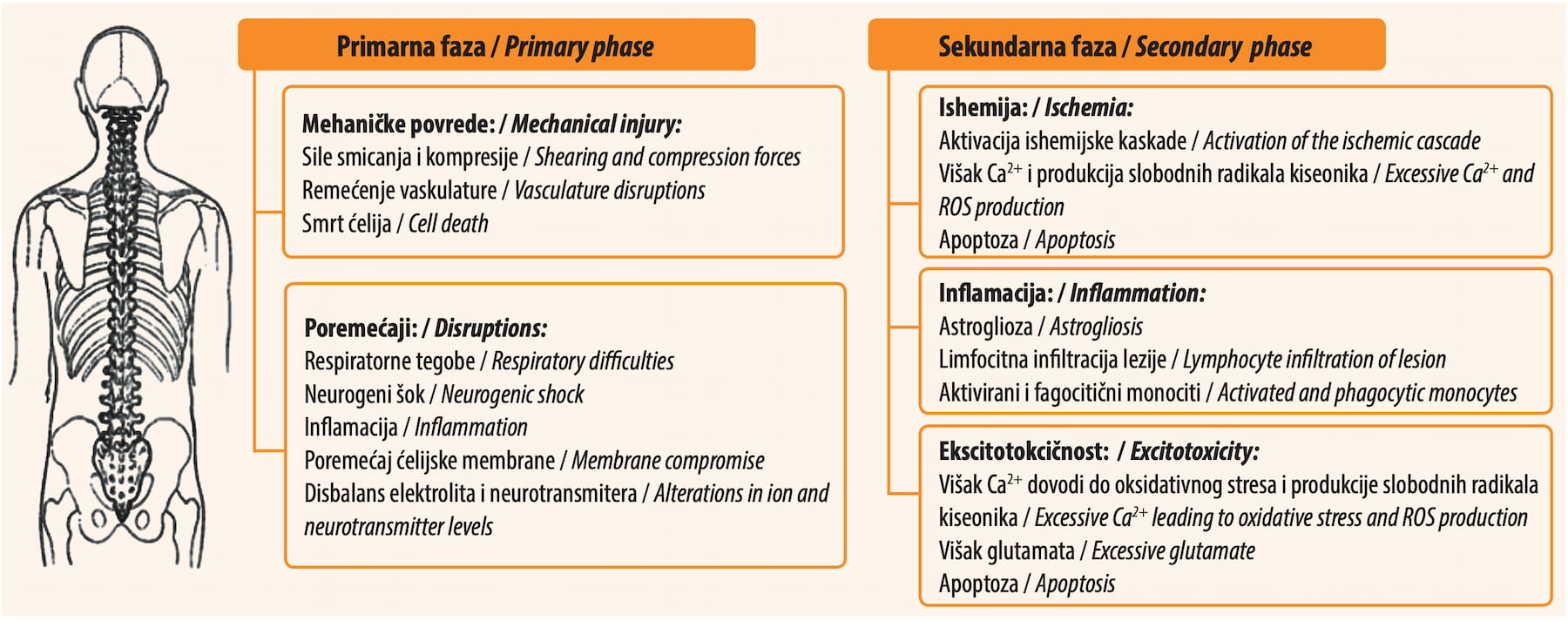
After the primary phase, the secondary phase ensues, and it can be divided into three stages:
− initial (first two hours following spinal cord injury)
− early acute (2 – 48 hours following spinal cord injury)
− sub-acute (three day to two weeks following spinal cord injury).
The secondary phase is characterized by cerebrospinal fluid (CSF) leaking, electrolyte imbalance, and ischemia. These pathological processes lead to cell death. The grey matter is damaged, craniocaudally, as well as horizontally, towards the white matter, resulting in a corresponding segmental neurological deficit. In the damaged axons, retraction and ballooning occur, while the distal sections of the axons undergo Wallerian degeneration. At the site of the central injury, a pseudocyst – syrinx is formed, i.e., a cavity around which scar tissue, made up of astrocytes, microglia, fibroblasts, and extracellular chondroitin sulfate, is further formed [8]. This phase represents the object of analysis of numerous studies dealing with biological therapy (stem cell therapy).
According to current guidelines, surgical decompression is indicated in the early acute stage, with the aim of reducing the pressure on the spinal cord. Many studies indicate the importance of early decompression within the first 24 hours following injury, which results in the improvement of the impaired neurological status [9],[10].
The data on the complications resulting from the application of high doses of methylprednisolone are controversial. Some studies have confirmed a higher frequency of complications, such as pneumonia urinary infections, sepsis, wound complications, gastrointestinal bleeding, and decubitus [11]. In their study, Matsumoto et al. discovered a higher incidence of pneumonia, which has also been indicated by the NASCIS II protocol [12],[13]. One of the studies showed a higher mortality in patients with head injury [14]. However, there are still conflicting opinions amongst spinal surgeons in relation to the real effectiveness of methylprednisolone. Eck et al. carried out an interesting study which showed that 90.5% of spinal surgeons used methylprednisolone in the treatment of spinal cord injury, yet only 24.0% of them actually believed that there was clinical benefit to be gained by its application [15]. Most of these respondents used the NASCIS protocol.
DISCUSSION
A study by Hall et al., from 1982, indicates three possible mechanisms of the effect of methylprednisolone [16]:
− maintaining neuron function
− improving blood flow
− preserving the ultrastructure of the spinal cord through the reduction of free-radical driven lipid peroxidation.
The conclusion of this study was the basis for further research, and it referred to the earliest possible introduction of treatment and rigorous control of the dosing of this drug. This topic remains controversial.
Two years after this study, Bracken et al. published a study of great significance –NASCIS I [17]. The object of analysis was the comparative application of the usual and a high dose of methylprednisolone, and the conclusion was not particularly optimistic. The study indicated that there was a difference in the speed and degree of neurological recovery of motor and sensory function among the patient test groups, six weeks and six months after injury, but also a significantly higher risk of early mortality and wound infection in patients who had received high doses of methylprednisolone as compared to those who had received the usual doses. NASCIS I is a double-blind randomized study, which compared the influence of high doses of methylprednisolone on neurological recovery following acute spinal cord injury. The results of this study showed that there was no dose-dependent difference regarding the level of neurological recovery, but that there was an increase in the incidence of wound-related complications, as well as in mortality related to the application of high doses of methylprednisolone. The main shortcoming of the study is that it did not include a placebo group.
In the subsequent study - NASCIS II, the following groups were included: the group of patients who received high doses of methylprednisolone, the placebo group, the group of patients who received naloxone. This study indicated a better recovery of motor functions in individuals who had received high doses of methylprednisolone, within 8 hours following injury [18].
The NASCIS III, published in 1997, was aimed at demonstrating whether the application of methylprednisolone within 48 hours following injury could achieve better results when compared to application within the first 24 hours following injury. The results showed that therapy administered in the period of 3 – 8 hours following injury (initially, IV bolus 30mg/kg), and then 5.4 mg/kg in the following 48 hours, had a significantly better outcome after 12 months than was the case with patients who had received this therapy only in the first 24 hours following injury [19]. American Orthopedic Association (AOA) guidelines recommend methylprednisolone treatment during a period of 24 hours, if the injury is not older than 8 hours [20]. Several studies were involved in the reevaluation of the results of the NASCIS studies. More than 1,500 patients with acute spinal cord injury were included in 5 randomized control studies, whose results showed that treatment with high doses of glucocorticoids did not lead to significant improvement in the recovery of motor function. It was also pointed out that glucocorticoid therapy was more effective in patients with incomplete acute spinal cord injury. It is interesting that all three NASCIS studies demonstrated an increased risk of adverse effects in patients on corticosteroid therapy. Although high doses of steroids may be safe in certain groups of patients, the NASCIS studies indicate necessary caution in the application of this type of therapy in patients with acute spinal cord injury [21].
In their study, Bowers et al. analyzed a very interesting aspect of methylprednisolone therapy - patient consent [22]. They believe that patients are not given sufficient autonomy when it comes to the decision on the application of this therapy. A particular problem here is the fact that a very large number of subjects who sustain spinal cord injury also have other accompanying injuries (most commonly of the head and thorax). These patients are frequently intubated or have an altered state of consciousness, which prevents communication with them and makes it difficult to make a decision on introducing methylprednisolone into their treatment. The same researchers feel that science has not as yet discarded the NASCIS protocol and that studies on this protocol are taking on a philosophical dimension. Taking this into consideration, the authors are asking an important question: can spinal cord injuries be viewed in the same way as other serious diseases, such as cancer, where, to a certain extent, the adverse effects of oncology treatment are disregarded for the sake of the benefits?
In 2013, the American Association of Neurological Surgeons (AANS) and the Congress of Neurological Surgeons (CNS) published a consensus which does not recommend the use of glucocorticoids in the treatment of acute spinal cord injuries [21]. Cochrane’s study revised this problem and showed that high doses of methylprednisolone are useful if they are started within 8 hours following injury, with continued application until 48 hours after injury [23]. The Surgical Timing in Acute Spinal Cord Injury Study (STASCIS) showed a positive effect of methylprednisolone and early surgical decompression, which has been proven to contribute to better neurological recovery. However, this study analyzed only cervical injuries of the spinal cord, which is why further research is necessary [24]. The German Neurological Society (Deutsche Gesellschaft für Neurologie - DGN) are reserved in their attitude towards the application of methylprednisolone in the treatment of spinal cord injuries. This form of treatment in the first 24 hours following injury is not listed as a recommendation, rather, it is identified as a treatment option. The Section on Disorders of the Spine and Peripheral Nerves of the American Association of Neurological Surgeons (AANS) does not recommend the use of methylprednisolone in the treatment of acute spinal cord injuries [21].
In a study from 2017, related to the application of methylprednisolone in doses recommended within the NASCIS II protocol for the acute phase of spinal cord injury, a statistically significant improvement of motor response was not proven [25].
In their study, Bowers et al. analyzed the most important misconceptions related to the scientific analysis of methylprednisolone treatment [22]. They feel that the criticism of the effect of methylprednisolone in the treatment of spinal cord injury is not sufficiently scientifically founded. In relation to the analysis of the first 8 hours following injury, they suspect that the NASCIS researchers had tried to leave out certain results by presenting unilateral data. Also, Bowers et al. criticize the proof related to the adverse effects of this treatment modality and point out that it is a misconception that there is level I evidence against the use of methylprednisolone in the treatment of spinal cord injury.
CONCLUSION
Treatment of acute spinal cord trauma with methylprednisolone remains problematic. Recommendations are based on randomized studies and on personal experience. Studies indicate the improvement of motor response, when methylprednisolone is administered within the first 8 hours after injury, with continuous application in the following 24 or 48 hours, if the application of the drug starts 3 – 8 hours following injury. This mode of application can be considered justified. Definitely, whenever possible, the goal is to perform early surgical decompression, within the first 24 hours following injury.
After a detailed analysis of available studies, we can conclude that the decision on the application of methylprednisolone, after all, is up to the doctor, who should make this decision based on data founded on evidence. Special attention must be given to the patients with incomplete spinal cord injury and partial neurological deficit. The approach to this group of patients must be based on the moto “time is spine”, i.e., the first hours following injury are essential for recovery, whether surgical or medicamentous treatment is applied.
Informations

-
Keywords:
-
Received:
-
Revised:
-
Accepted:
-
Online first:
-
DOI:
-
Cite this article:

Slaviša Zagorac
University Clinical Center of Serbia
2 Pasterova Street, 11000 Belgrade, Serbia
E-mail:
1. Eckert MJ, Martin MJ. Trauma: Spinal Cord Injury. Surg Clin North Am. 2017 Oct;97(5):1031-45. doi: 10.1016/j.suc.2017.06.008.[CROSSREF]
2. Spinal cord injury [Internet]. Who.int. 2020 [cited 9 July 2020]. Available from: https://www.who.int/news-room/fact-sheets/detail/spinal-cord-injury [HTTP]
3. Fehlings MG, Wilson JR, Harrop JS, Kwon BK, Tetreault LA, Arnold PM, et al. Efficacy and Safety of Methylprednisolone Sodium Succinate in Acute Spinal Cord Injury: A Systematic Review. Global Spine J. 2017 Sep;7(3 Suppl):116S-37S. doi: 10.1177/2192568217706366.[CROSSREF]
4. Burns CM. The History of Cortisone Discovery and Development. Rheum Dis Clin North Am. 2016 Feb;42(1):1-14, vii. doi: 10.1016/j.rdc.2015.08.001.[CROSSREF]
5. Cheung V, Hoshide R, Bansal V, Kasper E, Chen CC. Methylprednisolone in the management of spinal cord injuries: Lessons from randomized, controlled trials. Surg Neurol Int. 2015 Aug 24;6:142. doi: 10.4103/2152-7806.163452.[CROSSREF]
6. Hadley MN, Walters BC. The case for the future role of evidence-based medicine in the management of cervical spine injuries, with or without fractures. J Neurosurg Spine. 2019 Oct 1;31(4):457-63. doi: 10.3171/2019.6.SPINE19652.[CROSSREF]
7. Liu Z, Yang Y, He L, Pang M, Luo C, Liu B, et al. High-dose methylprednisolone for acute traumatic spinal cord injury: A meta-analysis. Neurology. 2019 Aug 27;93(9):e841-e50. doi: 10.1212/WNL.0000000000007998.[CROSSREF]
8. Hayta E, Elden H. Acute spinal cord injury: A review of pathophysiology and potential of non-steroidal anti-inflammatory drugs for pharmacological intervention. J Chem Neuroanat. 2018 Jan;87:25-31. doi: 10.1016/j. jchemneu.2017.08.001.[CROSSREF]
9. Anderson KK, Tetreault L, Shamji MF, Singh A, Vukas RR, Harrop JS, et al. Optimal Timing of Surgical Decompression for Acute Traumatic Central Cord Syndrome: A Systematic Review of the Literature. Neurosurgery. 2015 Oct;77 Suppl 4:S15-32. doi: 10.1227/NEU.0000000000000946.[CROSSREF]
10. Piazza M, Schuster J. Timing of Surgery After Spinal Cord Injury. Neurosurg Clin N Am. 2017 Jan;28(1):31-39. doi: 10.1016/j.nec.2016.08.005.[CROSSREF]
11. Evaniew N, Noonan VK, Fallah N, Kwon BK, Rivers CS, Ahn H, et al. Methylprednisolone for the Treatment of Patients with Acute Spinal Cord Injuries: A Propensity Score-Matched Cohort Study from a Canadian Multi-Center Spinal Cord Injury Registry. J Neurotrauma. 2015 Nov 1;32(21):1674-83. doi: 10.1089/neu.2015.3963. Epub 2015 Jul 17.[CROSSREF]
12. Bracken MB, Shepard MJ, Holford TR, Leo-Summers L, Aldrich EF, Fazl M, et al. Administration of methylprednisolone for 24 or 48 hours or tirilazad mesylate for 48 hours in the treatment of acute spinal cord injury. Results of the Third National Acute Spinal Cord Injury Randomized Controlled Trial. National Acute Spinal Cord Injury Study. JAMA. 1997 May 28;277(20):1597-604.[HTTP]
13. Matsumoto T, Tamaki T, Kawakami M, Yoshida M, Ando M, Yamada H. Early complications of high-dose methylprednisolone sodium succinate treatment in the follow-up of acute cervical spinal cord injury. Spine (Phila Pa 1976). 2001 Feb 15;26(4):426-30. doi: 10.1097/00007632-200102150-00020.[CROSSREF]
14. Edwards P, Arango M, Balica L, Cottingham R, El-Sayed H, Farrell B, e al. Final results of MRC CRASH, a randomised placebo-controlled trial of intravenous corticosteroid in adults with head injury-outcomes at 6 months. Lancet. 2005 Jun 4-10;365(9475):1957-9. doi: 10.1016/S0140-6736(05)66552-X.[CROSSREF]
15. Eck JC, Nachtigall D, Humphreys SC, Hodges SD. Questionnaire survey of spine surgeons on the use of methylprednisolone for acute spinal cord injury. Spine (Phila Pa 1976). 2006 Apr 20;31(9):E250-3. doi: 10.1097/01. brs.0000214886.21265.8c.[CROSSREF]
16. Hall ED, Braughler JM. Glucocorticoid mechanisms in acute spinal cord injury: a review and therapeutic rationale. Surg Neurol. 1982 Nov;18(5):-7. doi: 10.1016/0090-3019(82)90140-9.[CROSSREF]
17. Bracken MB, Collins WF, Freeman DF, Shepard MJ, Wagner FW, Silten RM, et al. Efficacy of methylprednisolone in acute spinal cord injury. JAMA. 1984 Jan 6;251(1):45-52. PMID: 6361287[HTTP]
18. Bracken MB, Shepard MJ, Collins WF, Holford TR, Young W, Baskin DS, et al. A randomized, controlled trial of methylprednisolone or naloxone in the treatment of acute spinal-cord injury. Results of the Second National Acute Spinal Cord Injury Study. N Engl J Med. 1990 May 17;322(20):1405-11. doi: 10.1056/ NEJM199005173222001. PMID: 2278545.[CROSSREF]
19. Bracken MB, Shepard MJ, Holford TR, Leo-Summers L, Aldrich EF, Fazl M, Fehlings M, et al. Administration of methylprednisolone for 24 or 48 hours or tirilazad mesylate for 48 hours in the treatment of acute spinal cord injury. Results of the Third National Acute Spinal Cord Injury Randomized Controlled Trial. National Acute Spinal Cord Injury Study. JAMA. 1997 May 28;277(20):1597-604. PMID: 9168289.[HTTP]
20. Fehlings MG, Tetreault LA, Wilson JR, Kwon BK, Burns AS, Martin AR, et al. A Clinical Practice Guideline for the Management of Acute Spinal Cord Injury: Introduction, Rationale, and Scope. Global Spine J. 2017 Sep;7(3 Suppl):84S-94S. doi: 10.1177/2192568217703387. Epub 2017 Sep 5.[CROSSREF]
21. Hurlbert RJ, Hadley MN, Walters BC, Aarabi B, Dhall SS, Gelb DE, et al. Pharmacological therapy for acute spinal cord injury. Neurosurgery. 2013 Mar;72 Suppl 2:93-105. doi: 10.1227/NEU.0b013e31827765c6.[CROSSREF]
22. Bowers CA, Kundu B, Hawryluk GW. Methylprednisolone for acute spinal cord injury: an increasingly philosophical debate. Neural Regen Res. 2016 Jun;11(6):882-5. doi: 10.4103/1673-5374.184450.[CROSSREF]
23. Bracken MB. Steroids for acute spinal cord injury. Cochrane Database Syst Rev. 2012 Jan 18;1(1):CD001046. doi: 10.1002/14651858.CD001046.pub2.[CROSSREF]
24. Fehlings MG, Vaccaro A, Wilson JR, Singh A, W Cadotte D, Harrop JS, et al. Early versus delayed decompression for traumatic cervical spinal cord injury: results of the Surgical Timing in Acute Spinal Cord Injury Study (STASCIS). PLoS One. 2012;7(2):e32037. The Spine Journal. 2012;12(6):540. doi: 10.1371/ journal.pone.0032037.[CROSSREF]
25. Cabrera-Aldana EE, Ruelas F, Aranda C, Rincon-Heredia R, Martínez-Cruz A, Reyes-Sánchez A, et al. Methylprednisolone Administration Following Spinal Cord Injury Reduces Aquaporin 4 Expression and Exacerbates Edema. Mediators of Inflammation. 2017;2017:1–7. doi: 10.1155/2017/4792932.[CROSSREF]