


Exploring the association between narcissistic personality disorder and social media use
- Faculty of Organisation Studies, Novo Mesto, Slovenia
- University Džemal Bijedić, Mostar, Bosnia and Herzegovina
ABSTRACT
Introduction/Aim: Narcissistic personality disorder has become more and more noticeable in modern times. For an increasing number of people, their ego has become a springboard in society or an obstacle to their progress. The question is whether and to what extent narcissistic personality disorder is related to the use of social media networks. For young and older people alike, social media networks have become a part of everyday life. Social media networks are used in an attempt to show a reflection of everyday life that often represents a non-existent illusion. Therefore, social media networks present a false image, a fake splendor, in an attempt to show what is not there, so as to impress other people and induce them to think that the author of the content is somehow better or more important, i.e., more successful than them. This study attempts to link narcissistic personality disorder and the use of social media networks, in order to determine whether these two variables are related.
Materials and methods: The basic research methods applied in this study are the method of analysis and synthesis, the method of induction and deduction, and the statistical and comparative methods. A total of 58 university students participated in the data collection process. The Narcissistic Personality Inventory and the Statements of Social Networking Usage Questionnaire (i.e., an inventory of social media presence and its purpose – academic, socialization, entertainment, information, compulsive use) were used in the study. Questions of a general nature (for collecting socio-demographic data) were also included. The study was conducted in Slovenia and Bosnia and Herzegovina, from January to June 2024.
Results: A very low degree of correlation was found between narcissism and the academic purpose of using social media networks (r = 0.20). A moderately strong correlation was found between narcissism and socialization as the purpose of using social media networks (r = 0.663). A very weak correlation was found between narcissism and the informative purpose of using social media networks, more precisely, the correlation coefficient was (r = 0.28). Finally, a high level of correlation was found between narcissism and entertainment as the purpose of using social media networks – the degree of correlation between these two variables was r = 0.88.
Conclusion: The research results indicate the existence of a significant relationship between narcissistic personality disorder and presence on social media networks.
INTRODUCTION
The use of social media networks has become a daily routine for most people worldwide. The content posted on social media is very diverse, and its influence can largely steer certain people towards particular activities. This paper will analyze people with narcissistic personality disorder (NPL) and people known as narcissists, and their attitudes towards social networks. People with narcissistic personality disorder have specific patterns of behavior, which, as such, steer them toward certain activities, to a lesser or greater extent. Previous research indicates that people with narcissistic personality disorder use social media networks for particular purposes.
The different purposes of using social media networks can be divided into five basic categories: academic purpose, socialization purpose, informative purpose, entertainment purpose, and compulsive use of social media networks.
The empirical segment of this study researched a group of university students who, according to the criteria of narcissism, are narcissists (or suffer from narcissistic personality disorder), and analyzed the most common purpose for using social media networks in this group. The correlation coefficient was used to examine which purpose for using social networks correlates with narcissism the most.
Narcissism has become a defining characteristic of the modern age: interest in the concept has captured the public’s imagination, the media, and literature. In the 1970s, American journalist Tom Wolfe coined the phrase the ‘me’ decade to describe the rise of self-celebration, and American historian and social critic Christopher Lasch published the book, The Culture of Narcissism, wherein he explored the rise in narcissistic personality disorder and decadence. These popularized texts have sparked increasing academic interest and empirical research, especially in the domains of psychology, social sciences, and cultural studies [1].
The basic characteristics of narcissism are [2]:
- evident concentration on oneself in interpersonal exchanges;
- lack of psychological awareness (see also insight, ego syntonic);
- difficulty with empathy, inability to see the world from the point of view of others;
- difficulty in distinguishing oneself from others, the others are seen as their “extension”;
- exploitation of others for their own goals, with no consideration of the price of their action;
- vulnerability to shame or guilt;
- denial of remorse and gratitude;
- irritation towards people who do not admire them;
- flattery towards people who admire them;
- ostentation of one’s successes;
- fiction of non-existent successes;
- ostentation or pretense of competence;
- haughtiness expressed with body language.
Narcissistic personality disorder can be described as a pervasive pattern of grandiosity, a need for admiration, and a lack of empathy. The nine criteria that characterize people with NPL are as follows: grandiose sense of self-importance and accompanying grandiose fantasies, belief in one’s specialness and uniqueness, need for excessive admiration, sense of entitlement-privilege (expectation of special treatment and the right to exception), exploitation (taking advantage of other people), arrogance and haughtiness, lack of empathy (i.e. reluctance to recognize or identify with the feelings and needs of others), and envy of others or belief of being envied by others.
Features associated with narcissistic personality disorder include vulnerable self-esteem – feelings of shame, sensitivity, and intense reactions of humiliation, emptiness, or contempt to criticism or defeat, as well as poor work ethics, arising from difficulties in tolerating criticism or competition [3]. This disorder includes three elements: an exaggerated sense of self-importance, a lack of warmth or empathy in relationships with other people, and the use of various strategies to maintain an exaggerated opinion of oneself. Narcissism is not associated with seeing oneself as more caring or kinder than others [4].
Diagnostic dilemmas regarding narcissistic personality disorder stem from the highly variable presentation and a wide range of disorder severity that can characterize narcissistic pathology. Individuals with narcissistic personality disorder may be grandiose or self-loathing, extroverted or socially isolated, masters of their trade or incapable of holding down a steady job, exemplary citizens or prone to antisocial activities [5]. Contemporary conceptualizations of pathological narcissism emphasize its manifestations in grandiosity and vulnerability. Narcissistic grandiosity is associated with feelings of attachment, self-importance, and exploitative behavior. Individuals exhibiting a high level of grandiosity are likely to be overtly immodest, self-promoting, and prone to self-aggrandizement. Narcissistic vulnerability is associated with a sense of entitlement and antagonism towards other people but is also characterized by shame and negative emotionality. Thus, rather than being reflected in reward-seeking behaviors such as grandiosity, vulnerability is reflected in motives such as avoidance of unpleasantness and tends to be broadly associated with other forms of personality pathology [6].
On the other hand, classic personality disorder is a definition used for common physical, psychological, and spiritual characteristics [7]. Most definitions of personality disorders emphasize the chronic, long-lasting nature of distress response characteristics and patterns, which are often of limited variability, and are applied regardless of contextual appropriateness. For example, in the Diagnostic and Statistical Manual of Mental Disorders (DSM), personality disorders are described as a pattern of inner experience and behavior that deviates from cultural norms. These patterns of perceiving, relating, and thinking about the environment and oneself are pervasive, inflexible, and stable over time, and result in problems or impairment in functioning. Individuals with a personality disorder tend to find themselves in “vicious circles” where the very experiences that they are trying to avoid occur, and these patterns begin to define this individual’s experience. How an individual thinks, feels, acts, and relates to others directly limits their ability to work, achieve goals, and enjoy sexual relations [5]. Narcissistic patients try to maintain an image of perfection and invincibility and to project such an image of themselves onto others. Physical illness can shatter this illusion, and the patient can lose the sense of security inherent in a cohesive experience of self. This loss accelerates a sense of panic wherein these individuals feel: “My world is falling apart”, and the patient has a sense of personal fragmentation [8].
In recent years, the use of social media networks has become a worldwide phenomenon. The use of social media networks is undoubtedly one of the activities that take up the greatest amount of free time in many countries. Through social media networks, individuals can, among other things, connect with their friends and followers, express emotions, tag their location, and share photos and videos. This process allows individuals to express themselves instantly and vividly. Personality traits can influence excessive and pathological use of social media networks. In addition, social media addiction was found to predict narcissistic personality traits. In a minority of cases, social media activity can cause negative social and psychological effects, and some argue that extremely problematic social media use can be addictive. Social media addiction can lead to negative social, professional, and/or educational outcomes and is associated with various forms of psychopathology, academic problems, and loneliness.
These effects have led researchers to theorize and empirically examine the nature of social network addiction and related variables [9]. It has been proven that social media networks have a significant effect on the self-confidence of their users. Psychologists have extensively studied the need to belong, and some have postulated that social media networks provide a convenient method of fitting in with others. Belonging to a group encourages the development of collective self-esteem, which social psychologists describe as an aspect of an individual’s self-concept derived from his/ her awareness of belonging to a social group, along with the value and emotional significance attached to that membership. In this sense, the use of social media networks could increase a person’s level of self-esteem [10].
The first study on the relationship between social media use and narcissism found that users’ self-reported grandiose narcissism was significantly linked to the number of their social interactions (a composite measure of the number of friends and number of posts on the user’s wall), but not to the amount of information listed in the “About” section. Furthermore, the researchers rated the extent of self-promotional content (mainly self-promotion through pictures and quotes) posed on the subjects’ Facebook pages. They correlated those ratings with self-reported grandiose narcissism. Several indicators of Facebook profile content, such as self-promotional quotes, yielded a positive relationship with the subjects’ self-reported narcissism, while others (e.g., self-promotional pictures) did not. These results suggest that narcissists appear to be particularly attracted to activities that enhance their sense of self-importance and provide them with the opportunity to present themselves to others in a favorable light. Furthermore, narcissists strive for a large audience by collecting large numbers of Facebook friends and frequently updating statuses that reflect their grandiose self-image. When this seminal study was published, Facebook had about 29 million active users – about 2% of its current active membership.
In the meantime, extensive research has been conducted on the link between social media use and narcissism and this topic has received significant media coverage. Thus far, research has been conducted in various disciplines, with somewhat inconclusive results. Namely, while many studies support the idea of a positive relationship between grandiose narcissism and the number of contacts on social networks, other studies have found no connection or have even found reverse connections. Similarly, while some observational studies tend to emphasize the link between narcissism and social media use, others find that no link has been established [11].
Individuals use social media to emphasize their self-importance, attract attention, and secure respect and status. They post flattering photos and share the most interesting information about themselves to achieve this.
The relationship between narcissism and behavior when taking a selfie is also intriguing. In a study conducted to examine this relationship, the authors found that subjects with high levels of narcissism paid more attention to comments and other people’s “likes” on social media and followed other people’s selfies more. Another study found that sharing selfies was associated with narcissism only in male participants, but not in female participants. Another study investigated the relationship between selfie posting and three aspects of narcissism (leadership / authority, magnificent exhibitionism, authority / exploitation). According to the obtained results, a positive significant relationship was found between the frequency of sharing selfies and leadership / authority, magnificent exhibitionism, as well as authority / exploitation [12].
MATERIALS AND METHODS
Our study on the influence of narcissistic personality on social media posts was conducted in Slovenia and Bosnia and Herzegovina, from January to June 2024, on a sample of 58 university students majoring in different areas. The sampling criteria were as follows:
- that the person is a university student;
- that the person has a profile on social media networks: Facebook, Twitter, Instagram, TikTok;
- that the person exhibits certain elements of narcissism.
The study was conducted via Google Survey, with the questionnaire containing the following elements:
- The Narcissistic Personality Inventory – the most widely used instrument for measuring individual differences in narcissism in a non-clinical population. Although the self-evaluation items for NPL are derived from the criteria for narcissistic personality disorder defined in DSM-III, these behaviors, in fact, reflect narcissism as a normal personality trait, unless manifested in extreme forms. The inventory originally included 223 items and was later condensed to a 40-item inventory that, for over two decades, has been predominantly used for researching narcissistic personality traits [13]. This measuring instrument contains elements measured on a Likert scale ranging from 1 to 5 (1 – the lowest score; 5 – the highest score). In addition to the aforementioned inventory, certain dichotomous questions related to narcissism were also used.
- The Statements of Social Networking Usage Questionnaire – (i.e., an inventory of social media presence and its purpose – academic, socialization, entertainment, information, compulsive use) [14]. In addition to the above inventory, certain dichotomous or multiple-choice questions related to the use of social networks were also used.
- Questions related to the sample and general (socio-demographic) questions.
The study aimed to determine how much narcissistic personality disorder influences the use of social media networks, as well as to identify the purposes (academic, socialization, entertainment, information, compulsive use) for which people with narcissistic personality disorder most often use social networks.
Depending on the type of variables and the normality of the distribution, the data description is presented as n (%), arithmetic mean (A) ± standard deviation (SD), or median (min-max). Pearson’s correlation coefficient was used to assess the association. Statistical hypotheses were tested at the statistical significance level (alpha level) of 0.05. All data were processed with the software package IBM SPSS Statistics 22 (SPSS Inc., Chicago, IL, USA).
RESULTS OF EMPIRICAL RESEARCH
The data related to the sample are presented at the very beginning of the study results presentation.
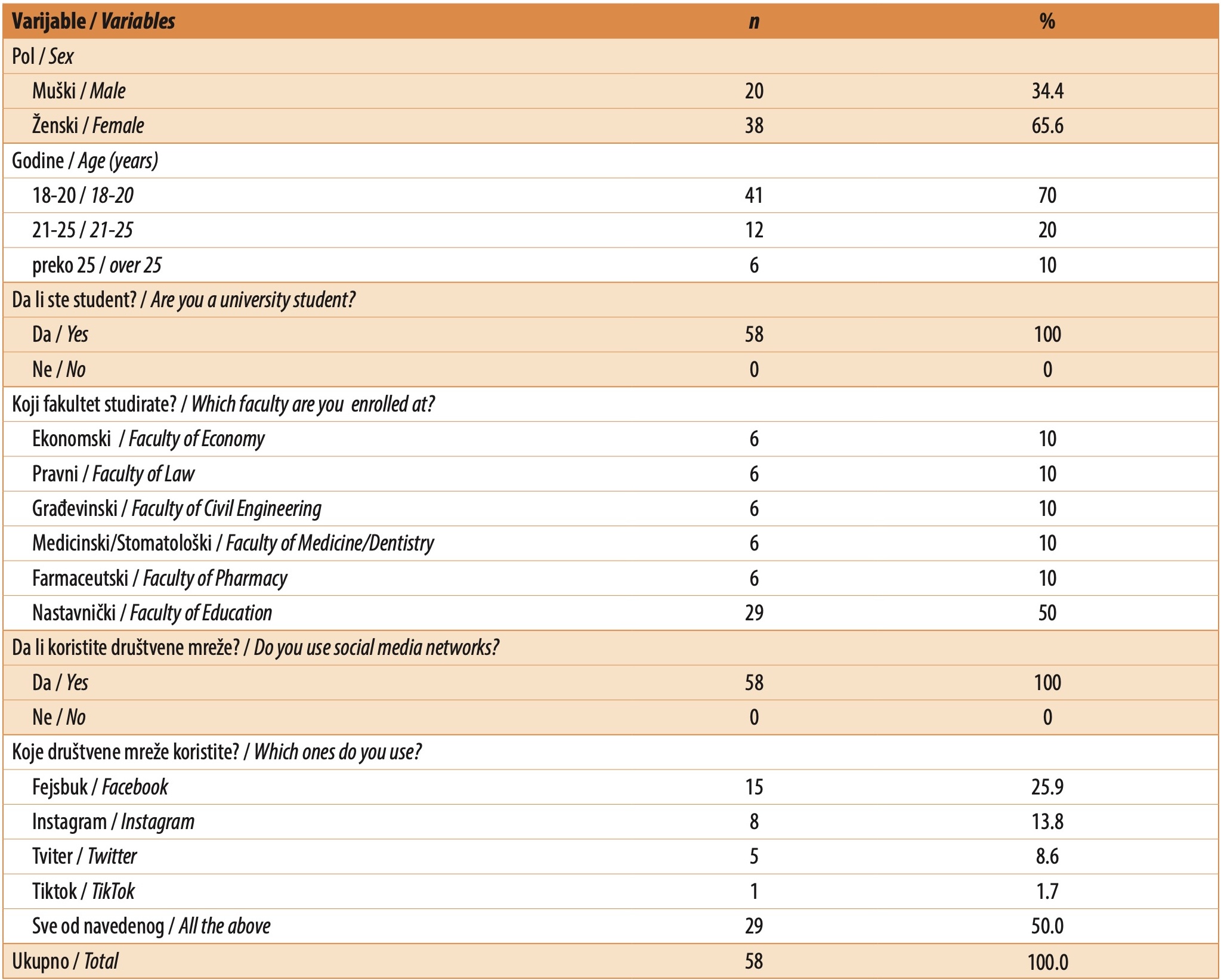
The data analysis on the given sample yielded the results presented in Table 1. A total of 58 respondents participated in the research process. Of the total number of respondents, 34.4% were male, while the remaining respondents were female (65.6%). Also, 70% of the respondents were between 18 and 20 years old, and the highest number of them were students of the Faculty of Education (50%). All respondents in the sample were university students (100%) and all respondents in the sample were social media users (100%). The research results show that as many as 50.0% of respondents used all of the social media networks (Facebook, Instagram, Twitter, and TikTok) listed in the questionnaire. Of the remaining 50.0%, 25.9% only used Facebook, 13.8% only used Instagram, 8.6% only used Twitter, and 1.7% only used TikTok. The conclusion is that social media networks, which are used for different purposes, are widespread and very popular among university students.
The presence of narcissism in the sample is presented next.
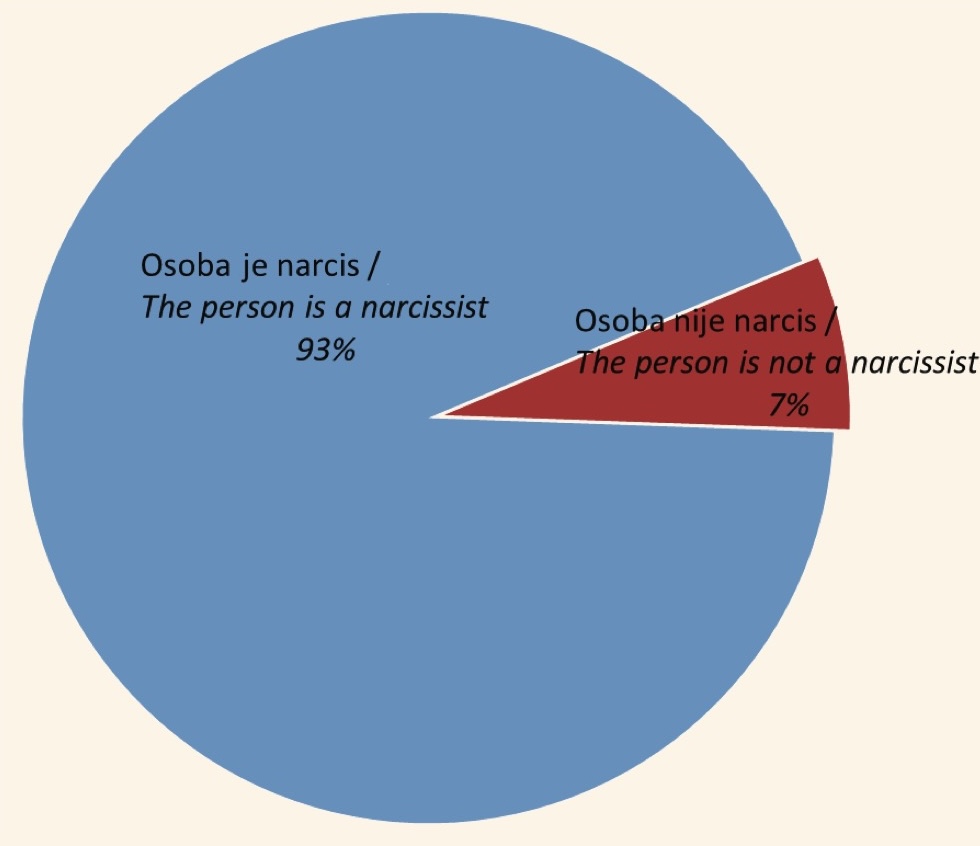
Using the previously described measuring instruments, it was found that out of the total number of respondents, 93.1% belonged to the group of narcissistic personalities, while only 6.9% did not belong to this group (Figure 1). Based on the above, it can be concluded that the basic principles of the sampling process were met rendering the sample relevant for further consideration.
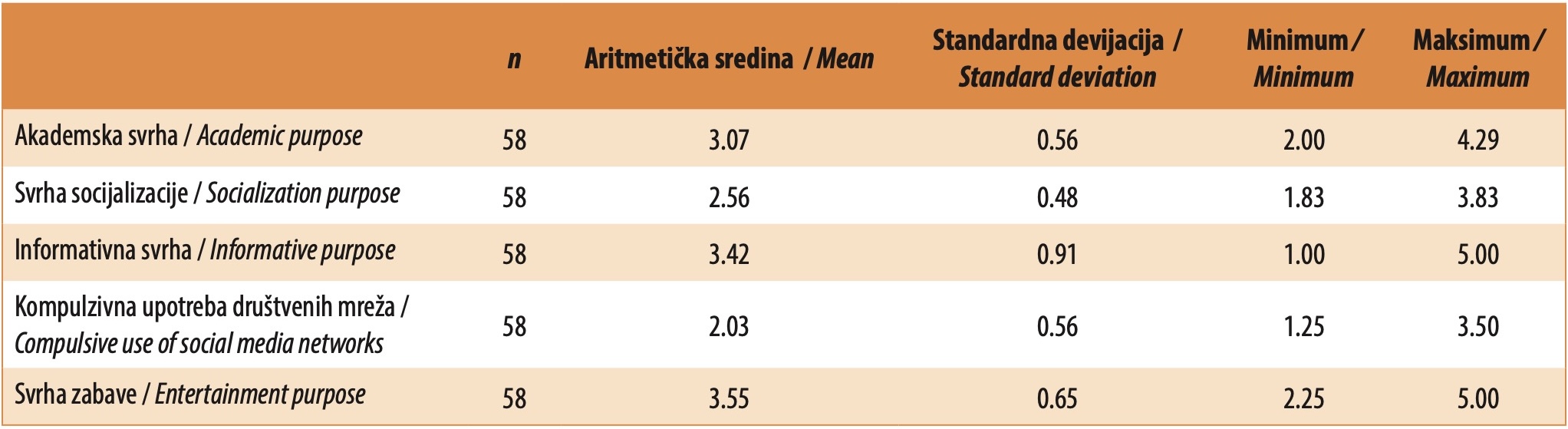
Analysis of Table 2 leads to the conclusion that the largest number of respondents use social media networks for entertainment (3.55 ± 0.65), followed by the purpose of obtaining information (3.42 ± 0.91) and academic purposes (3.07 ± 0.56). Social media networks are used somewhat less frequently for socialization (2.56 ± 0.48), and they are used the least because students feel that they “have to” use them or because they are “compelled” to do so for some reason (2.03 ± 0.56).
In the next segment of this article, Pearson’s linear correlation coefficient was used to examine the degree of correlation between narcissism and each of the purposes of using social media networks. The main purpose of establishing correlations was to show the interrelationship between different purposes of using social media networks and the presence of narcissism in young people.
The analysis of the interrelationship between narcissism and the academic purpose of using social networks (Table 3) showed a very low degree of correlation between these two variables, specifically, it was r = 0.20, with p = 0.132. This correlation is quite small.
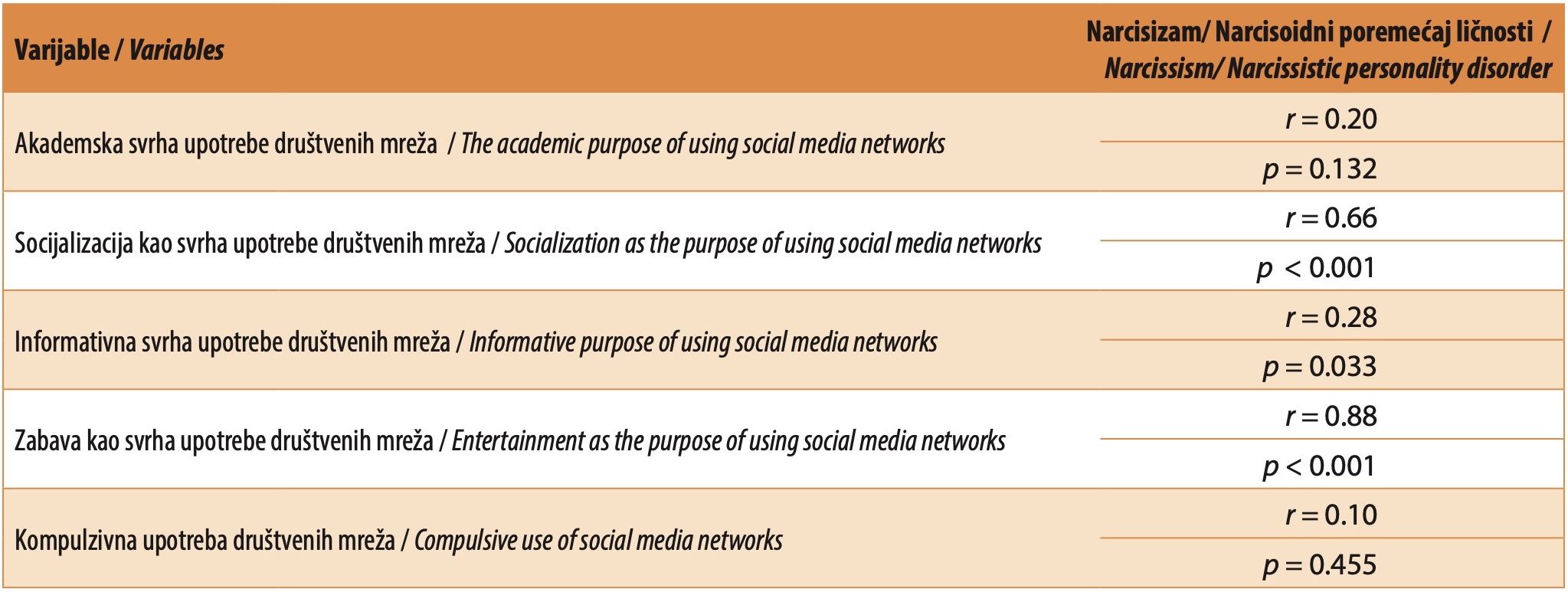
The analysis of the interrelationship between narcissism and socialization as the purpose of using social media networks showed the degree of correlation between these two variables to be r = 0.66, with p < 0.001. This is a moderately strong correlation.
Based on the results of the study, a very weak correlation between narcissism and the informative purpose of using social networks was established, more precisely, the correlation coefficient was r = 0.28, with p = 0.033.
In the analysis of the mutual relationship between narcissism and entertainment as the purpose of using social media networks, the degree of correlation between these two variables was determined to be r = 0.88, with p < 0.001.
The results of the study showed an almost complete absence of correlation between narcissism and compulsive use of social media networks. The correlation coefficient between these two variables was r = 0.10, with p = 0.455.
DISCUSSION
Various previous studies have proven that narcissistic personality disorder is closely related to the use of social media networks. In their study, Casale and Banchi state that there is a significant association between problematic use of the social media network Facebook and narcissistic personality disorder [15]. In their article, the abovementioned authors state that, so far, numerous studies have been published on this very topic. Akkoz and Erbaş state, in their study, that the use of social media networks can cause narcissistic personality disorder [12], and vice versa – people with narcissistic personality disorder can use social media networks for different purposes. The same was noted in our study, where it is stated that there are several different purposes for using social networks, namely: academic purposes, socialization, entertainment, obtaining information, and compulsive use. The use of social media networks for academic purposes by narcissists is present, which was recorded in our study, and was also reported by McCain and Campbell, who stated that narcissists experience cultural enlightenment through the use of social media networks [16].
Based on a case study conducted by Umber et al., it can be concluded that narcissists use social media networks for socialization, which makes them feel better [17]. Such results were confirmed by our study, as well as by the study conducted by Freglette [18].
The study conducted by Goel et al. [19] also noted that narcissists use social media networks for entertainment and obtaining information (as confirmed in the sample analyzed in our study). Paramboukis et al. [20] also confirmed this, with special reference to Instagram as a social media network. Previous studies have not found compulsive use of social media networks in narcissists.
CONCLUSION
People with narcissistic personality disorder definitely use social media in a specific way. This study has demonstrated there are people with narcissistic personality disorder who use social media networks both for academic and informative purposes, but also for entertainment and socialization or out of compulsion. However, an analysis of the correlation between narcissism and the purpose of using social media networks discovered that people with narcissistic personality disorder most often use social media networks for entertainment, as well as for socialization. These individuals rarely use social media networks for informative or academic purposes and may use them out of compulsion. Based on the above, the conclusion is that narcissism initiates entertainment and potentially self-promotion as a form of entertainment on social media networks, as well as networking, as an inseparable part of narcissism. For people with narcissistic personality disorder, social media networks are a source of entertainment and socialization, not a source of information. The study’s main limitations are related to the difficulties in forming a sample and the potential danger of the respondents misunderstanding the questions asked in the questionnaire.
Informations

-
Keywords:
-
Received:
-
Revised:
-
Accepted:
-
Online first:
-
DOI:
-
Cite this article:

Lejla Imamović Lerić
Faculty of Organisation Studies
3 Talcev Street, 8000 Novo Mesto, Slovenia
E-mail:
1. Yakeley J. Current understanding of narcissism and narcissistic personality disorder. BJPsych Advances. 2018 Sep;24(5):305-15. doi:10.1192/bja.2018.20. [CROSSREF]
2. Stranieri G, De Stefano L, Greco AG. Pathological Narcissism. Psychiatr Danub. 2021 Sep;33(Suppl 9):35-40. Dostupno na: https://www.psychiatria-danubina.com/UserDocsImages/pdf/dnb_vol33_noSuppl%209/dnb_vol33_noSuppl%209_35.pdf [HTTP]
3. Ronningstam E. Narcissistic personality disorder: a current review. Curr Psychiatry Rep. 2010 Feb;12(1):68-75. doi: 10.1007/s11920-009-0084-z. [CROSSREF]
4. Campbell WK, Baumeister RF. Narcissistic personality disorder. In: Fisher JE, O’Donohue WT, editors. Practitioner’s guide to evidence-based psychotherapy. New York: Springer; 2006. p. 423-31. doi: 10.1007/978-0-387-28370- 8_42. [CROSSREF]
5. Caligor E, Levy KN, Yeomans FE. Narcissistic personality disorder: diagnostic and clinical challenges. Am J Psychiatry. 2015 May;172(5):415-22. doi: 10.1176/appi.ajp.2014.14060723. [CROSSREF]
6. Edershile EA, Wright AGC. Grandiose and vulnerable narcissistic states in interpersonal situations. Self Identity. 2021;20(2):165-81. doi: 10.1080/15298868.2019.1627241. [CROSSREF]
7. Köse SS, Erbaş O. Personality disorders diagnosis, causes, and treatments. D J Tx Sci. 2020;5(1-2):22-31. doi: 10.5606/dsufnjt.2020.013. [CROSSREF]
8. Long P. Diagnostic and statistical manual of mental disorders, Third edition (DSM-III). 1980:2.
9. Savci M, Turan M, Griffiths MD, Ercengiz M. Histrionic personality, narcissistic personality, and problematic social media use: testing of a new hypothetical model. Int. J. Ment. Health Addict. 2021 Aug;19:986-1004. doi: 10.1007/s11469-019-00139-5. [CROSSREF]
10. Somerville TA. The effect of social media use on narcissistic behavior. McKendree University Online Journal of Undergraduate Research [Internet]. 2015 [cited 2024 Oct 29]. 25. Dostupno na: https://www.mckendree.edu/academics/scholars/somerville-issue-25.pdf [HTTP]
11. Gnambs T, Appel M. Narcissism and social networking behavior: a meta-analysis. J Pers. 2018 Apr;86(2):200-12. doi: 10.1111/jopy.12305. [CROSSREF]
12. Akkoz M, Erbaş O. The relationship between social media use and narcissism. D J Tx Sci 2020;5(1-2):32-8. doi: 10.5606/dsufnjt.2020.014. [CROSSREF]
13. Leung L, Zhang R. Narcissism and social media use by children and adolescents. In Young KS, de Abreu CN, editors. Internet addiction in children and adolescents: Risk factors, assessment, and treatment. New York: Springer; 2017. p. 47-64. doi: 10.1891/9780826133731.0003. [CROSSREF]
14. Gupta S, Bashir L. Social networking usage questionnaire: development and validation in an Indian higher education context. Turk. online j. distance educ. 2018 Oct 1;19(4):214-27. doi: 10.17718/tojde.471918. [CROSSREF]
15. Casale S, Banchi V. Narcissism and problematic social media use: a systematic literature review. Addict Behav Rep. 2020 Jan 28;11:100252. doi: 10.1016/j. abrep.2020.100252. [CROSSREF]
16. McCain J, Campbell K. Narcissism and Social Media Use: A Meta-Analytic Review. Psychol. Pop. Media Cult. 2018;7(3):308-27. doi:10.1037/ppm0000137. [CROSSREF]
17. Umber S, Ali M, Latif MA. Exploring the relationship between digital narcissism, subjective wellbeing, and social media usage: a case study on GCUF students on Facebook and Instagram. Remit Rev. 2023 Jan;9(1):812-36. doi:10.33182/rr.vx9il.24.
18. Freglette C. Predicting narcissism through social media. Caravel Undergraduate Research Journal [Internet]. 2021 [Citirano: 29.10. 2024.]. Dostupno na: https://sc.edu/about/offices_and_divisions/research/news_and_pubs/caravel/archive/2021_spring/2021_narcissism.php [HTTP]
19. Goel M, Mishra R, Kanwar C. Analysing the relation between social media usage and narcissism among young adults: Indian setting. Int. j. Indian psychol. 2023;11(2):2514-20. doi: 10.25215/1102.248.
20. Paramboukis O, Skues J, Wise L. An exploratory study of the relationships between narcissism, self-esteem and Instagram use. Social Networking. 2016 Apr;5(2):82-92. doi:10.4236/sn.2016.52009. [CROSSREF]