


Intracerebral hemorrhage and the use of various types of anticoagulants – Clinical presentation and treatment outcomes
- Special Hospital for Cerebrovascular Diseases “Sveti Sava”, Belgrade, Serbia
- University of Belgrade, Faculty of Medicine, Institute of Pathophysiology, Belgrade, Serbia
- University of Kragujevac, Faculty of Medical Sciences, Kragujevac, Serbia
ABSTRACT
Introduction: Anticoagulant therapy plays a key role in the prevention and treatment of various vascular diseases, but it simultaneously increases the risk of hemorrhagic complications, including intracerebral hemorrhage (ICH). This study aimed to examine the outcomes of patients with ICH based on prior anticoagulant therapy.
Methods: This was a retrospective cohort study involving 37 out of 277 patients with ICH from the hospital registry treated between January and November 2024 at the Special Hospital for Cerebrovascular Diseases “Sveti Sava”. All patients were divided into two groups: those treated with vitamin K antagonists (VKA) or direct oral anticoagulants (NOAC). The treatment outcome of patients at discharge and 90 days after discharge was determined using the modified Rankin Scale (mRS).
Results: In the group of patients previously treated with VKA, the mean mRS score at discharge was 4.6, while in the group previously treated with NOAC therapy, it was 5.1, with no statistically significant difference between the groups (p = 0.442). Additionally, no statistical significance was found in the mRS 90 days after discharge (p = 0.341). In the VKA-ICH group, the mean value was 4.3, while in the other group, it was 4.9. In the first group, the mortality rate was 58%, while in the second group, it was 76%.
Conclusion: Patients with ICH and prior VKA therapy showed no significant differences in treatment outcomes compared to patients with prior NOAC therapy.
INTRODUCTION
According to the latest statistical data, stroke is the second leading cause of death and the third leading cause of death and disability combined [1]. Hemorrhagic stroke accounts for approximately 20% of all strokes, with intracerebral hemorrhage (ICH) being the most common type [2].
The use of oral anticoagulant therapy (OAC) is one of the risk factors for ICH. The prescription rate of OAC is increasing, mainly due to its growing use in the primary and secondary prevention of ischemic stroke in patients with non-valvular atrial fibrillation (AF) [2].
The mortality rate after ICH is around 40% within one month and 54% within one year, despite advances in neurocritical care over the past few decades [2]. The use of anticoagulant medications in these patients is associated with greater hematoma expansion, and consequently with increased disability and mortality rates [3],[4]. Due to limited availability, vitamin K antagonists (VKAs) were widely used in the past. However, over time, alternative options emerged - direct thrombin inhibitors (dabigatran) and factor Xa inhibitors (apixaban, edoxaban, and rivaroxaban), collectively known as non-vitamin K oral anticoagulants (NOACs) [5]. It is well known that VKA use in the context of non-valvular atrial fibrillation doubles the risk of intracranial hemorrhage, even under optimal treatment conditions. In addition to the increased incidence, VKA-associated ICH (VKA-ICH) is linked to larger hematoma volumes, higher mortality, and poorer functional outcomes. NOACs offer similar efficacy in preventing ischemic stroke in patients with non-valvular atrial fibrillation, with approximately half the incidence of ICH compared to warfarin. However, findings remain contradictory regarding outcomes in patients with NOAC-related ICH (NOAC-ICH) compared to those with VKA-ICH [6],[7]. Although NOACs carry a significantly lower risk of ICH, NOAC-ICH is becoming a matter of notable clinical importance due to the widespread and growing prescription of these drugs.
The modified Rankin Scale is an effective, reliable, and simple measure of functional outcome that is widely used in clinical trials of acute stroke [8].
This study aimed to evaluate the outcomes of patients with ICH depending on their prior anticoagulant therapy.
METHODS
This is a retrospective cohort study that included 37 patients from the hospital registry of patients with intracerebral hemorrhage (ICH) treated between January and November 2024 at the Special Hospital for Cerebrovascular Diseases “Sveti Sava,” which contains a total of 277 patients.
Predefined exclusion criteria were: ICH not associated with anticoagulant therapy, subdural and subarachnoid hemorrhage, as well as ICH related to vascular malformations, primary brain tumors, metastases, septic embolisms, and hemorrhagic transformation of ischemic stroke.
Data were collected on age, sex, medical history of previously treated hypertension and diabetes, medications used before hospitalization (including type of anticoagulant therapy), and laboratory findings at admission.
Upon arrival at the emergency department, all patients underwent a non-contrast cranial CT scan, followed by head and neck CT angiography.
Patients were divided into two groups based on the type of anticoagulant therapy – those treated with vitamin K antagonists (VKAs) and those treated with direct oral anticoagulants (NOACs).
Stroke team members assessed patient outcomes at discharge and 90 days post-discharge using the modified Rankin Scale (mRS) and in-hospital mortality.
Data were described as n (%), mean ± standard deviation (as±sd), or median (min–max) depending on the type of variables and distribution normality. The student’s t-test was used for normally distributed data to compare differences between groups, and the Mann-Whitney U test for non-normally distributed data. Categorical variables were analyzed using the chi-square test or Fisher’s exact test, depending on expected frequencies in contingency tables. A p-value < 0.05 was considered statistically significant. Spearman’s rank correlation test was used to examine correlations between variables. All statistical analyses were performed using GraphPad Prism 8 software.
RESULTS
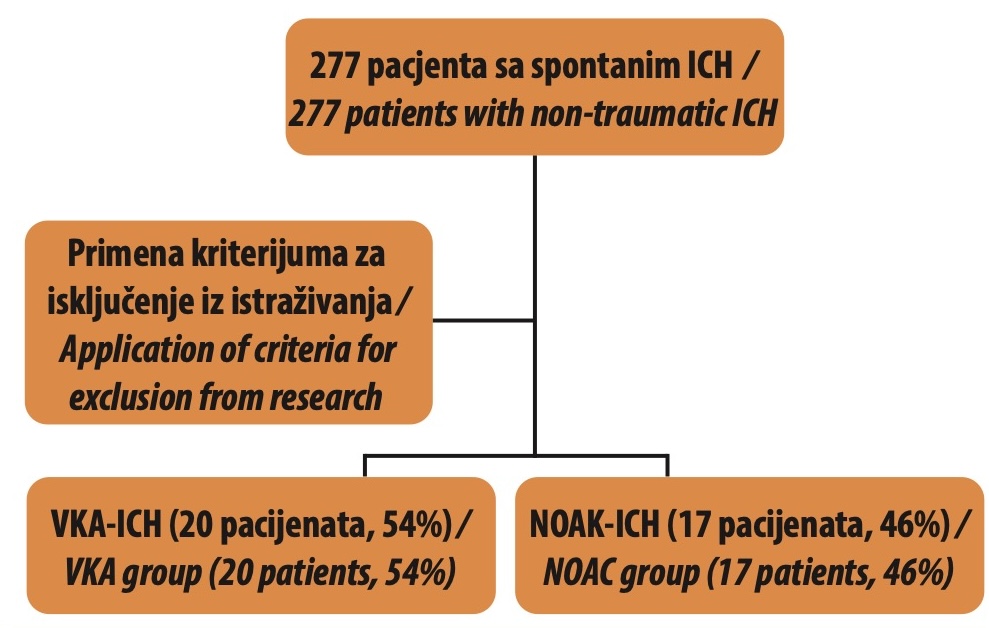
Out of 277 patients with non-traumatic intracerebral hemorrhage (ICH) treated at the Special Hospital for Cerebrovascular Diseases “Sveti Sava” from January to November 2024, a total of 37 patients were included in the study after applying the exclusion criteria. Based on the type of anticoagulant therapy, patients were divided into those previously treated with vitamin K antagonists (VKA-ICH) and those treated with direct oral anticoagulants (NOAC-ICH). The VKA group included 20 patients (54%), while the NOAC group included 17 patients (46%) (Figure 1).
In the VKA-ICH group, there were 11 male patients (55%) and 9 female patients (45%) with an average age of 76.3 years. In the NOAC-ICH group, there were 6 male patients (35%) and 11 female patients (65%) with an average age of 78.1 years (Table 1).

No statistically significant differences were found between the groups in terms of medical history regarding previously treated hypertension (p = 1.000) and diabetes mellitus (p = 0.159) (Table 1).
Among the available laboratory results, inflammation markers were analyzed as potential predictors of poor functional outcome in patients with ICH. No statistically significant differences were found between the groups in CRP levels (p = 0.704), lymphocyte count (p = 0.482), or neutrophil-to-lymphocyte ratio (NLR) (p = 0.104). However, the NOAC-ICH group had significantly higher mean leukocyte counts (p = 0.034) and neutrophil counts (p = 0.030) (Table 2).

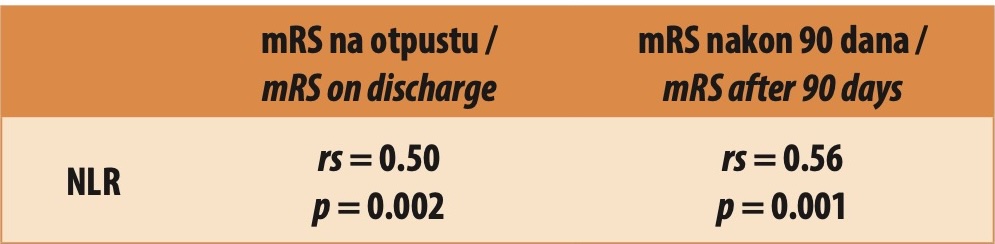
Our study showed a statistically significant positive correlation between NLR and mRS at discharge (p = 0.002) as well as 90 days after discharge (p = 0.001) (Table 3).
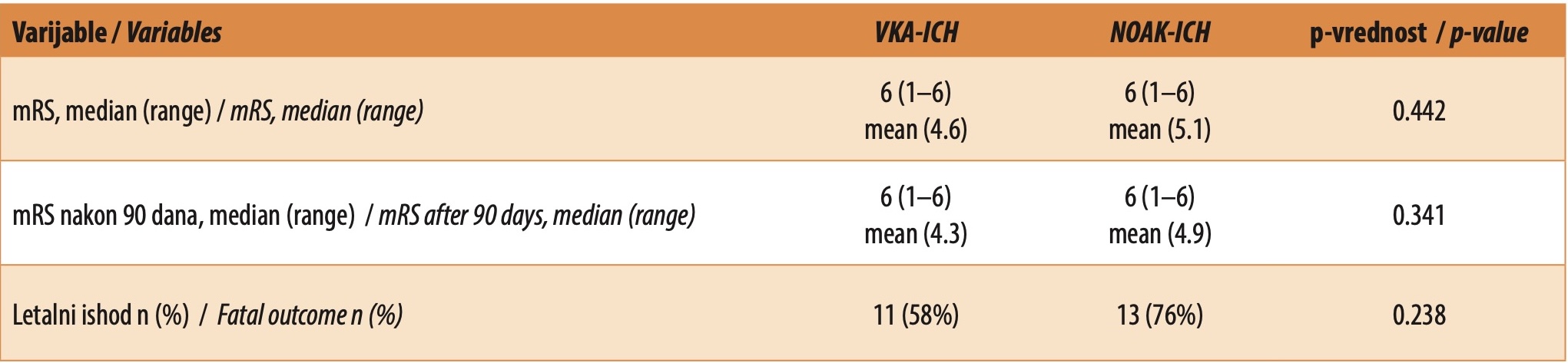
In the VKA-ICH group, the mean mRS score at discharge was 4.6, while in the NOAC-ICH group it was 5.1, with no statistically significant difference between the groups (p = 0.442). Ninety days after discharge, the mean mRS score was 4.3 in the VKA-ICH group and 4.9 in the NOAC-ICH group, also without statistical significance (p = 0.341). There were 11 deaths (58%) in the VKA-ICH group and 13 deaths (76%) in the NOAC-ICH group, again without statistical significance (p = 0.238) (Table 4).
DISCUSSION
Since the introduction of NOACs, several studies have analyzed the differences between VKA-ICH and NOAC-ICH with heterogeneous results.
A study involving 2,483 patients, using data from Riksstroke and the Swedish Stroke Register, found no significant difference in mortality or functional outcome after 90 days between NOAC-ICH and VKA-ICH, which correlates with our study findings [9].
Similar results were obtained in a retrospective observational study that included 182 patients; it concluded that mortality was equally high in patients with NOAC-ICH compared to those on other oral anticoagulants [10].
A meta-analysis including seven observational studies showed that NOAC-ICH was associated with a smaller initial hematoma volume and lower stroke severity (NIHSS) at admission. VKA-ICH and NOAC-ICH had similar functional outcomes at discharge and after a three-month follow-up [11].
Our research aligns with a meta-analysis by Boulouis G. and colleagues, which included 12 studies and 3,875 patients. The differences between NOAC-ICH and VKA-ICH patients were not found regarding overall mortality at discharge, poor functional outcomes at discharge, or three months post-discharge [7].
An international multicenter analysis compared mortality, functional outcome, ICH volume, and hematoma expansion between NOAC-ICH and VKA-ICH. Initial ICH volume, hematoma expansion, 90-day mortality, and functional outcomes were similar in both groups [12].
A retrospective study conducted by Malgorzata Miller and colleagues, analyzing 102 patients with ICH on anticoagulant therapy, showed that NOAC use was not associated with worse functional outcomes after ICH [13].
In certain clinical studies, radiological parameters showed that patients with ICH previously treated with NOACs had smaller hematoma volume and expansion-this was also observed in animal models - which could be partly explained by the different pharmacological properties of these anticoagulant classes [14]. These findings might account for the results of subsequent studies that differ from ours.
A Chinese multicenter clinical study showed that ICH in patients previously treated with factor Xa inhibitors was associated with higher mortality compared to patients not on oral anticoagulants. However, patients on factor Xa inhibitors had better outcomes than those with warfarin-associated ICH [3].
A study involving 161 patients with ICH found that the median mRS score three months after hospitalization was 3 in the NOAC-ICH group, compared to 4 in the VKA-ICH group. This difference is statistically significant and conflicts with the results of our study [14].
Other authors have addressed this topic as well. A study of 196 patients concluded that patients with NOAC-ICH had milder neurological deficits than those with VKA-ICH [15].
Inflammatory mechanisms play an essential role in intracranial hemorrhage and are associated with the development of stroke-associated pneumonia (SAP). The neutrophil-to-lymphocyte ratio (NLR) best predicts SAP and poor discharge outcomes in ICH patients, which correlates with our findings. In this study, significantly higher leukocyte and neutrophil values were observed in the NOAC-ICH group, which may explain the slightly worse outcomes in that group, though without statistical significance [16],[17].
Given the heterogeneous results of these studies, further prospective, multicenter studies are needed to allow for more detailed analysis by anticoagulant type, radiological parameter monitoring, and the impact of reversal agents on patient outcome.
CONCLUSION
Patients with non-traumatic ICH previously treated with VKAs, compared to those previously treated with NOACs, showed no significant differences in treatment outcomes.
Informations

-
Keywords:
-
Received:
-
Revised:
-
Accepted:
-
Online first:
-
DOI:
-
Cite this article:

Ljubica Dimitrijević
Special hospital “Sveti Sava”
2 Nemanjina Street, 11000 Belgrade, Serbia
E-mail:
1. GBD 2019 Stroke Collaborators. Global, regional, and national burden of stroke and its risk factors, 1990-2019: a systematic analysis for the Global Burden of Disease Study 2019. Lancet Neurol. 2021 Oct;20(10):795-820. doi: 10.1016/S1474-4422(21)00252-0. [CROSSREF]
2. Montaño A, Hanley DF, Hemphill JC 3rd. Hemorrhagic stroke. Handb Clin Neurol. 2021; 176:229-48. doi: 10.1016/B978-0-444-64034-5.00019-5. [CROSSREF]
3. Xian Y, Zhang S, Inohara T, Grau-Sepulveda M, Matsouaka RA, Peterson ED, et al. Clinical characteristics and outcomes associated with oral anticoagulant use among patients hospitalized with intracerebral hemorrhage. JAMA Netw Open. 2021 Feb 1;4(2):e2037438. doi: 10.1001/jamanetworkopen.2020.37438. [CROSSREF]
4. Carlsson M, Wilsgaard T, Johnsen SH, Johnsen LH, Løchen ML, Njølstad I, et al. Long-term survival, causes of death, and trends in 5-year mortality after intracerebral hemorrhage: the Tromsø Study. Stroke. 2021 Dec;52(12):3883- 90. doi: 10.1161/STROKEAHA.120.032750. [CROSSREF]
5. Seiffge DJ, Goeldlin MB, Tatlisumak T, Lyrer P, Fischer U, Engelter ST, et al. Meta-analysis of haematoma volume, haematoma expansion and mortality in intracerebral haemorrhage associated with oral anticoagulant use. J Neurol. 2019 Dec;266(12):3126-35. doi: 10.1007/s00415-019-09536-1. [CROSSREF]
6. Tsivgoulis G, Wilson D, Katsanos AH, Sargento-Freitas J, Marques-Matos C, Azevedo E, et al. Neuroimaging and clinical outcomes of oral anticoagulant-associated intracerebral hemorrhage. Ann Neurol. 2018 Nov;84(5):694- 704. doi: 10.1002/ana.25342. [CROSSREF]
7. Boulouis G, Morotti A, Pasi M, Goldstein JN, Gurol ME, Charidimou A. Outcome of intracerebral haemorrhage related to non-vitamin K antagonists oral anticoagulants versus vitamin K antagonists: a comprehensive systematic review and meta-analysis. J Neurol Neurosurg Psychiatry. 2018 Mar;89(3):263-70. doi: 10.1136/jnnp-2017-316631. [CROSSREF]
8. Rebchuk AD, O’Neill ZR, Szefer EK, Hill MD, Field TS. Health utility weighting of the modified Rankin Scale: a systematic review and meta-analysis. JAMA Netw Open. 2020 Apr 1;3(4):e203767. doi: 10.1001/jamanetworkopen.2020.3767. [CROSSREF]
9. Apostolaki-Hansson T, Ullberg T, Norrving B, Petersson J. Prognosis for intracerebral hemorrhage during ongoing oral anticoagulant treatment. Acta Neurol Scand. 2019 May;139(5):415-21. doi: 10.1111/ane.13068. [CROSSREF]
10. von der Brelie C, Doukas A, Naumann R, Dempfle A, Larsen N, Synowitz M, et al. Clinical and radiological course of intracerebral haemorrhage associated with the new non-vitamin K anticoagulants. Acta Neurochir (Wien). 2017 Jan;159(1):101-9. doi: 10.1007/s00701-016-3026-7. [CROSSREF]
11. Siepen BM, Forfang E, Branca M, Drop B, Mueller M, Goeldlin MB, et al. Intracerebral haemorrhage in patients taking different types of oral anticoagulants: a pooled individual patient data analysis from two national stroke registries. Stroke Vasc Neurol. 2024 Dec 30;9(6):640-51. doi: 10.1136/svn2023-002813. [CROSSREF]
12. Wilson D, Seiffge DJ, Traenka C, Basir G, Purrucker JC, Rizos T, et al. Outcome of intracerebral hemorrhage associated with different oral anticoagulants. Neurology. 2017 May 2;88(18):1693-700. doi: 10.1212/WNL.0000000000003886. [CROSSREF]
13. Miller MM, Lowe J, Khan M, Azeem MU, Muehlschlegel S, Jun-O’Connell AH, et al. Clinical and radiological characteristics of vitamin K versus non-vitamin k antagonist oral anticoagulation-related intracerebral hemorrhage. Neurocrit Care. 2019 Aug;31(1):56-65. doi: 10.1007/s12028-019-00671-1. [CROSSREF]
14. Tsivgoulis G, Lioutas VA, Varelas P, Katsanos AH, Goyal N, Mikulik R, et al. Direct oral anticoagulant- vs vitamin K antagonist-related nontraumatic intracerebral hemorrhage. Neurology. 2017 Sep 12;89(11):1142-51. doi: 10.1212/WNL.0000000000004362. [CROSSREF]
15. Wilson D, Charidimou A, Shakeshaft C, Ambler G, White M, Cohen H, et al.; CROMIS-2 collaborators. Volume and functional outcome of intracerebral hemorrhage according to oral anticoagulant type. Neurology. 2016 Jan 26;86(4):360-6. doi: 10.1212/WNL.0000000000002310. [CROSSREF]
16. Wang RH, Wen WX, Jiang ZP, Du ZP, Ma ZH, Lu AL, et al. The clinical value of neutrophil-to-lymphocyte ratio (NLR), systemic immune-inflammation index (SII), platelet-to-lymphocyte ratio (PLR) and systemic inflammation response index (SIRI) for predicting the occurrence and severity of pneumonia in patients with intracerebral hemorrhage. Front Immunol. 2023 Feb 13;14:1115031. doi: 10.3389/fimmu.2023.1115031. [CROSSREF]
17. Zhao G, Gu Y, Wang Z, Chen Y, Xia X. The clinical value of inflammation index in predicting ICU mortality of critically ill patients with intracerebral hemorrhage. Front Public Health. 2024 Aug 2;12:1373585. doi: 10.3389/fpubh.2024.1373585. [CROSSREF]
- Picture 1. Distribution of patients with ICH by group
- Table 1. Sociodemographic and anamnestic data of patients with ICH depending on the group, with no statistically significant difference
- Table 2. Comparative presentation of laboratory markers of inflammation between groups. The values of leukocytes and neutrophils were statistically significantly higher in the NOAK-ICH patient group
- Table 3. Association between neutrophil-to-lymphocyte ratio (NLR) and functional outcome in patients with ICH at discharge and 90 days post-discharge
- Table 4. Patient outcomes with ICH based on the type of prior anticoagulant therapy, without statistical significance