


Laboratory parameters and their relations with disease outcome in patients with non-hodgkin follicular lymphoma – single centre five-year follow-up
- University Clinical Center Kragujevac, Clinic for Hematology, Kragujevac, Serbia
- University of Kragujevac, Faculty of Medical Sciences, Department of Internal Medicine, Kragujevac, Serbia
ABSTRACT
Introduction/Objective: Follicular lymphoma, a subtype of non-Hodgkin lymphoma, is the second most common non-Hodgkin lymphoma and the most frequent indolent lymphoma. Although rare, this disease may exhibit aggressive behavior, a tendency toward complications, as well as resistance to administered therapy and frequent relapses.
This study aimed to analyze laboratory parameters at the time of diagnosis and their association with disease outcome, complications, treatment response, and survival.
Material and methods: A total of 47 patients diagnosed with follicular lymphoma between 2018 and January 2024 were analyzed at our center. Baseline laboratory parameters included complete blood count, hemostasis parameters (PT, aPTT, fibrinogen, D-dimer), and biochemical parameters. During the course of the disease, treatment response to first-line therapy, progression-free survival, and overall survival were evaluated.
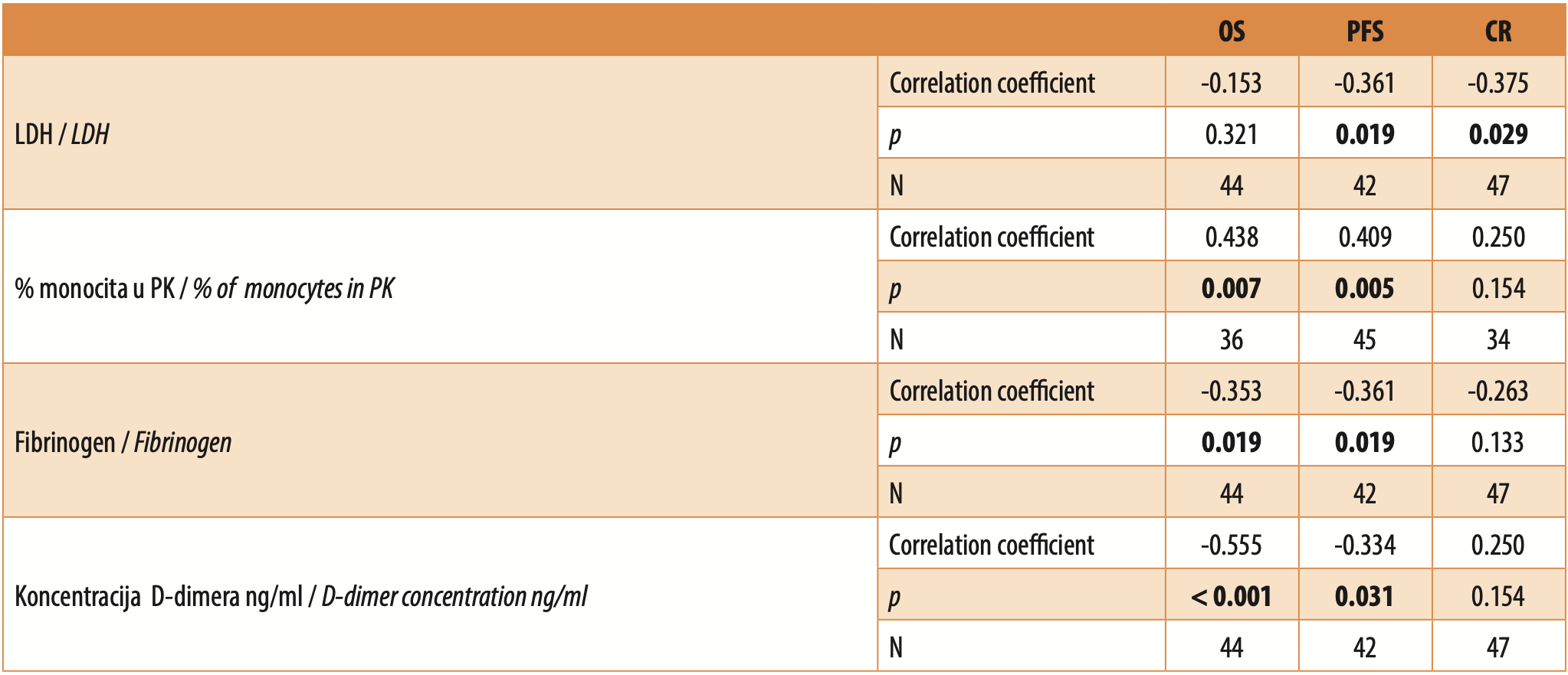
Results: Complete blood count parameters, as well as most biochemical parameters, showed no correlation with disease course. Complete remission was achieved in patients with lower LDH levels (p = 0.029), while overall survival was longer in patients with lower fibrinogen levels (p = 0.019), a higher percentage of monocytes (p = 0.007), and lower D-dimer levels (p < 0.000). Progression-free survival was associated with lower fibrinogen levels (p = 0.019), lower D-dimer levels (p = 0.031), lower LDH levels (p = 0.019), and a higher percentage of peripheral blood monocytes (p = 0.005). Patients with initially elevated D-dimer levels had a PFS of 24.50 ± 4.81 months, whereas those with D-dimer levels within the reference range had a PFS of 36.48 ± 5.99 months (p = 0.015).
Conclusion: In our center’s experience, hemostasis parameters, particularly fibrinogen and D-dimer, showed a significant correlation with disease course.
INTRODUCTION
Lymphomas are malignant diseases of lymphocytes and their progenitors and, depending on their origin, may arise from B lymphocytes, T lymphocytes, or NK lymphocytes. Histologically, they are divided into two major groups: Hodgkin and non-Hodgkin lymphomas, and, according to their clinical course, into aggressive and indolent lymphomas [1].
Indolent lymphomas represent a distinct group of lymphoproliferative diseases that, although classified as malignant, generally have a chronic course. Follicular non-Hodgkin lymphoma (NHL) is the second most common B-cell NHL, accounting for 25% of cases, and is also the most common indolent lymphoma, comprising up to 60% of patients [2].
The estimated incidence of this disease is 2.5 patients per 100,000 population annually. This subtype more frequently affects older individuals, with the majority of newly diagnosed cases occurring between 55 and 75 years of age [3]. Thanks to new therapeutic modalities, the average survival of patients with follicular lymphoma is 15–20 years [4]. Although rare, this disease may demonstrate aggressive behavior, a tendency toward complications, resistance to applied therapy, and frequent relapses. To identify patients at risk of an unfavorable disease course, numerous prognostic and predictive scores have been developed (FLIPI, PRIMA-PI, POD24) [5].
This study aimed to analyze laboratory parameters at diagnosis and their association with disease outcome, therapeutic response, and survival.
MATERIAL AND METHODS
The study was a retrospective analysis of 47 patients treated at the Clinic of Hematology, University Clinical Center Kragujevac, from 2018 to January 2024, with a diagnosis of follicular lymphoma. Laboratory parameters included complete blood count (white blood cell count, leukocyte differential, hemoglobin, platelet count), hemostatic parameters (prothrombin time (PT), activated partial thromboplastin time (aPTT), fibrinogen, D-dimer), as well as biochemical parameters (urea, creatinine, electrolytes, liver function tests, lactate dehydrogenase (LDH), uric acid), all of which ere sampled during the initial patient evaluation at the time of diagnosis and before the initiation of first-line therapy. Patients were subsequently followed and treated according to treatment indications and monitored through regular outpatient visits. During the five-year follow-up period, the following were observed: response to first-line therapy, progression-free survival, and overall survival. Statistical analysis was performed using IBM SPSS 22.0 software. Normality of distribution for continuous variables was tested using the Shapiro-Wilk test due to the sample size being fewer than 50 subjects. For normally distributed data, parametric tests (Independent Samples t-test) were used; for data that deviated from normality, nonparametric tests (Mann– Whitney U test) were applied. To determine correlations between quantitative variables, Pearson’s correlation coefficient was used for normally distributed variables, and Spearman’s coefficient when deviation from normal distribution was present. A p-value of less than 0.05 was considered statistically significant. The study was conducted in full accordance with the principles of the Helsinki Declaration and was approved by the Ethics Committee of the University Clinical Center Kragujevac (Decision No. 1/25-835).
RESULTS
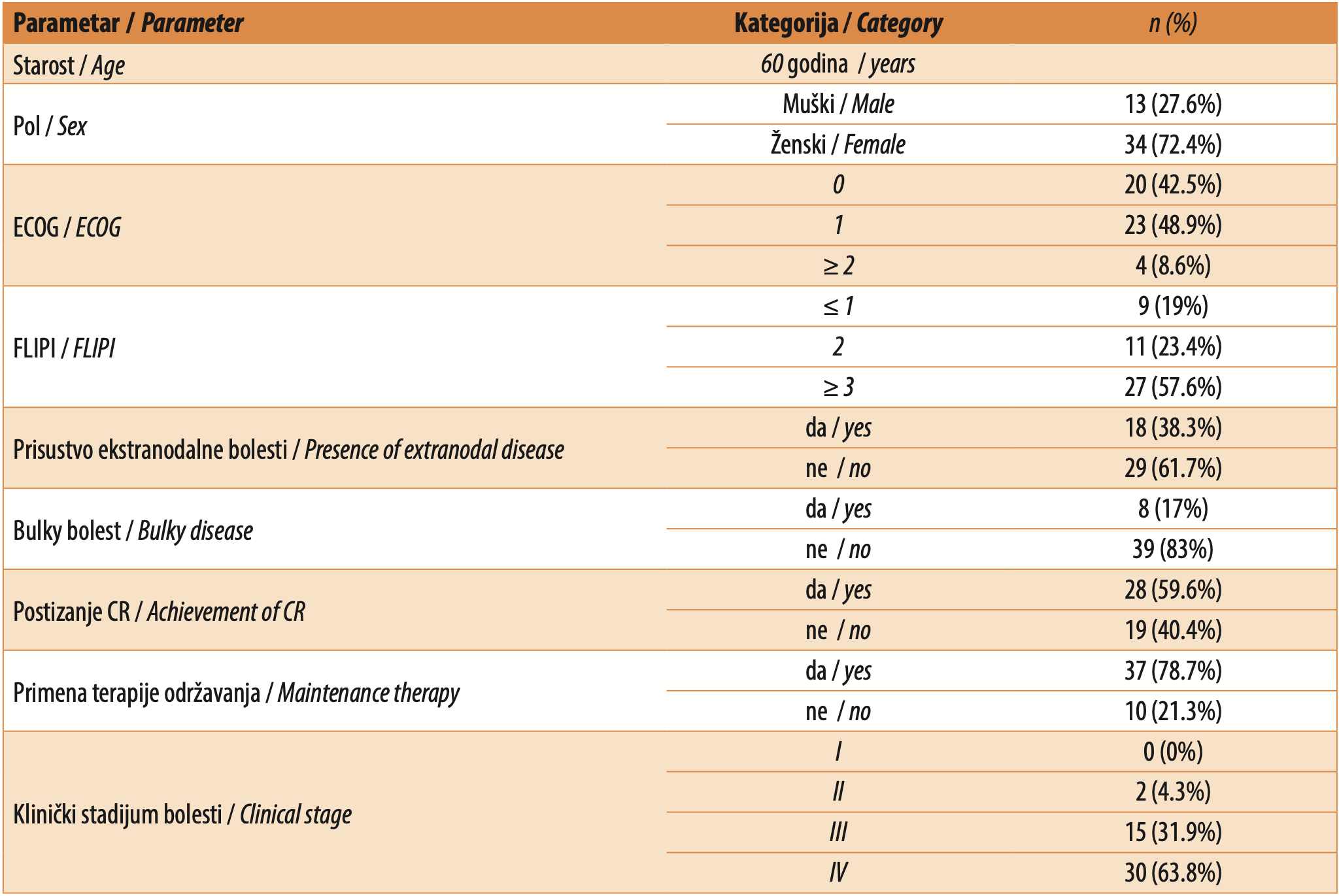
Analysis of the results showed that our patient population was predominantly female (34 women and 13 men) and had a median age of 60 years (32–89). The majority of patients had disseminated and advanced disease at diagnosis, clinical stage III or IV. Descriptive statistics of the studied population are presented in Table 1. According to current guidelines for the treatment of follicular lymphoma, during the observed period, patients were treated with immunochemotherapy according to the R-CHOP protocol (rituximab + cyclophosphamide + doxorubicin + vincristine + prednisolone) in 34.8%, while immunochemotherapy according to the G-CHOP protocol (obinutuzumab + cyclophosphamide + doxorubicin + vincristine + prednisolone) was administered in 65.2% of patients. The average number of administered therapy cycles for both therapeutic options was 7 (3–8). Regarding response to the first applied line of therapy, 25 (53%) patients achieved complete remission, 17 (36%) achieved partial remission, and 5 (11%) had stable disease. In the correlation analysis of hematological and biochemical parameters, most examined parameters did not show a statistically significant correlation with disease course, while, on the other hand, hemostatic parameters, fibrinogen, and D-dimer, as well as individual parameters such as serum lactate dehydrogenase concentration and the percentage of monocytes in peripheral blood, showed significant correlation, as presented in Table 2. Serum LDH concentration in our patient group shows, as indicated by the correlation coefficient, that lower LDH values are associated with longer progression-free survival and a higher probability of achieving complete remission, whereas no correlation with overall survival was observed. The percentage of monocytes positively correlates with time to progression and overall survival, but does not influence the achievement of complete remission. Fibrinogen and D-dimer values show a negative correlation with survival, while they do not influence the achievement of complete remission.
The D-dimer and fibrinogen levels in patients with follicular lymphoma were analyzed separately. Patients who had elevated D-dimer values at diagnosis had shorter progression-free survival, with patients with initially elevated D-dimer values having PFS of 24.50 ± 4.81 months, while those with D-dimer within reference values had PFS of 36.48 ± 5.99 months (p = 0.015). Similar results were observed for fibrinogen levels: patients with fibrinogen within the reference range had PFS of 28.42 ± 3.89 months, whereas those with initially elevated fibrinogen had PFS of 15.91 ± 5.09 months (p = 0.044). D-dimer values and their association with achieving complete remission were also analyzed, and patients who achieved complete remission after first-line therapy had lower D-dimer values (521.12 ± 150.8 ng/ml), while those who did not achieve complete remission had higher values (613.18 ± 156.4 ng/ml), p = 0.054.
DISCUSSION
The development of numerous therapeutic options that have improved the survival of lymphoma patients, as well as the application of personalized medicine, has created a need for a clearer definition of disease prognosis and for the prediction of response to specific therapeutic modalities. In this context, numerous studies in recent years have focused on identifying simple yet precise prognostic models by testing readily available parameters and their correlation with disease course.
The majority of studies in this field have focused on aggressive lymphomas, while only a small number have included low-grade lymphomas. Available literature indicates that, among laboratory parameters in diffuse large B-cell lymphoma (DLBCL), the most reliable are D-dimer levels, LDH levels, and clinical characteristics of both the patient (age, performance status) and the disease (clinical stage, genetic and molecular profile).
Our study showed that among laboratory parameters influencing disease course in follicular lymphoma, the most significant are pre-treatment LDH values, the proportions of monocytes and basophils in the leukocyte differential, and hemostatic parameters, fibrinogen, and D-dimer. The study by Rachmani et al. evaluated D-dimer levels in patients with DLBCL and confirmed that D-dimer levels positively correlate with disease course, with higher pre-treatment values indicating a worse prognosis [6]. Similar results were reported by Huang et al., who correlated D-dimer not only with disease course but also with other adverse prognostic parameters (disease stage, ECOG status, presence of B symptoms, IPI score), as were those of Liu et al. [7],[8]. In the study by Geng et al., laboratory parameters correlated with disease course in DLBCL patients showed that age, disease stage, LDH values, and D-dimer values represent negative prognostic factors in univariate analysis, while in multivariate analysis only LDH remained a negative prognostic factor, although the authors concluded that D-dimer correlates with tumor burden and has greater prognostic value in patients with lower clinical stages [9]. In the study by Bi et al., D-dimer was identified as a prognostic marker in patients with NK/T-cell lymphoma, bringing the prognosis of early-stage patients with high D-dimer levels closer to that of advanced-stage patients, regardless of D-dimer levels [10]. Data on laboratory parameters in patients with indolent lymphomas are scarce, as studies often include all non-Hodgkin lymphomas or provide only rare insights into specific subgroups. In the study by Mazur et al., hemostatic parameters (fibrinogen and D-dimer) were compared with neoangiogenesis parameters (vascular endothelial growth factor (VEGF) and fibroblast growth factor (FGF)), confirming that D-dimer correlates with disease stage, while the fibrinogen/D-dimer ratio correlates with the VEGF/bFGF ratio and contributes to neoangiogenesis in NHL [11]. Regarding studies analyzing fibrinogen levels, one interesting study on a small number of subjects suggests that fibrinogen is a good prognostic parameter, both based on high pre-treatment values as a negative prognostic factor and on changes after the first cycle of therapy, where patients who normalized fibrinogen after the first cycle had better survival compared to those in whom fibrinogen remained elevated [12]. Additional clarification of the significance of fibrinogen levels and the profile of peripheral blood monocytes in NHL patients is provided by the study by Živković et al., which showed that high fibrinogen levels were associated with a negative prognosis, consistent with our findings. In their detailed analysis, tissue factor values were also examined, and differences among lymphoma subtypes (DLBCL, follicular lymphoma, and Hodgkin lymphoma) were confirmed. In all groups, higher tissue factor values were observed with increased classical monocytes, whereas in follicular lymphoma, as a lowgrade lymphoma, there was no increase in intermediate monocytes and, consequently, a lower tendency toward hypercoagulability. In the aforementioned study, the percentage of monocytes in peripheral blood was not analyzed as a separate parameter; instead, individual subgroups were examined by flow cytometry and classified as classical or intermediate monocytes based on pan-monocytic marker expression [13].
CONCLUSION
In our center’s experience, hemostatic parameters, fibrinogen, and D-dimer showed significant correlations with disease course. Limitations of our study include a small sample size and the exclusion of patients diagnosed but not treated during the observed period.
Informations

-
Keywords:
-
Received:
-
Revised:
-
Accepted:
-
Online first:
-
DOI:
-
Cite this article:

Danijela Jovanović
Clinic for Hematology, University
Clinical Center Kragujevac
30 Zmaj Jovina Street, 34000 Kragujevac, Serbia
E-mail:
1. Alaggio R, Amador C, Anagnostopoulos I, Attygalle AD, Araujo IBO, Berti E, et al. The 5th edition of the World Health Organization Classification of Haematolymphoid Tumours: Lymphoid Neoplasms. Leukemia. 2022 Jul;36(7):1720-48. doi: 10.1038/s41375-022-01620-2. [CROSSREF] Erratum in: Leukemia. 2023 Sep;37(9):1944-51. doi: 10.1038/s41375-023-01962-5. [CROSSREF]
2. Campo E, Jaffe ES, Cook JR, Quintanilla-Martinez L, Swerdlow SH, Anderson KC, et al. The International Consensus Classification of Mature Lymphoid Neoplasms: a report from the Clinical Advisory Committee. Blood. 2022 Sep 15;140(11):1229-53. doi: 10.1182/blood.2022015851. [CROSSREF] Erratum in: Blood. 2023 Jan 26;141(4):437. doi: 10.1182/blood.2022019016. [CROSSREF]
3. Cerhan JR. Epidemiology of Follicular Lymphoma. Hematol Oncol Clin North Am. 2020 Aug;34(4):631-46. doi: 10.1016/j.hoc.2020.02.001. [CROSSREF]
4. Hübel K, Ghielmini M, Ladetto M, Gopal AK. Controversies in the Treatment of Follicular Lymphoma. Hemasphere. 2020 Jan 10;4(1):e317. doi: 10.1097/HS9.0000000000000317. [CROSSREF]
5. Cartron G, Trotman J. Time for an individualized approach to first-line management of follicular lymphoma. Haematologica. 2022 Jan 1;107(1):7-18. doi: 10.3324/haematol.2021.278766. [CROSSREF]
6. Rahchamani M, Sedghi M, Hakimi A, Nejatianfar M, Javaheri T, Tavakoli R, et al. Prognostic value of red blood cell distribution width and D-Dimer in diffuse large B-cell lymphoma: Systematic review and meta-analysis. Cancer Rep (Hoboken). 2024 Jan;7(1):e1936. doi: 10.1002/cnr2.1936. [CROSSREF]
7. Huang H, Fan L, Fu D, Lin Q, Shen J. High pretreatment plasma D-dimer levels predict poor survival in patients with diffuse large B-cell lymphoma in the real world. Transl Cancer Res. 2021 Apr;10(4):1723-31. doi: 10.21037/tcr-20-2908. [CROSSREF]
8. Liu B, Li B, Zhou P, Yue W, Wang T, Wang J, et al. Prognostic value of pretreatment plasma D-dimer levels in patients with diffuse large B cell lymphoma (DLBCL). Clin Chim Acta. 2018 Jul;482:191-8. doi: 10.1016/j.cca.2018.04.013. [CROSSREF]
9. Geng YD, Chen YR, Jin J, Wang XD, Zhang S, Li DJ. Prognostic Value of D-Dimer in Patients with Diffuse Large B-cell Lymphoma: A Retrospective Study. Curr Med Sci. 2019 Apr;39(2):222-7. doi: 10.1007/s11596-019-2023-5. [CROSSREF]
10. Bi XW, Wang L, Zhang WW, Sun P, Yan SM, Liu PP, et al. High Pretreatment D-Dimer Levels Correlate with Adverse Clinical Features and Predict Poor Survival in Patients with Natural Killer/T-Cell Lymphoma. PLoS One. 2016 Mar 31;11(3):e0152842. doi: 10.1371/journal.pone.0152842. [CROSSREF]
11. Mazur G, Poreba M, Wrobel T, Poreba R, Pyszel A, Beck B, et al. Correlation between Angiogenic and Coagulation-Fibrinolysis Factors and Stage of Disease in Non Hodgkin’s Lymphoma Patients. Blood. 2005 Nov 16;106(11):4678. doi: 10.1182/blood.V106.11.4678.4678. [CROSSREF]
12. Tarek N, Younes S, Suliman MA, Ibrahim GA. Predictive utility of plasma fibrinogen level in B-cell lymphoma: a single-center cohort study. Egypt. J. Haematol. 2023 Apr-Jun;48(2):155-60. doi: 10.4103/ejh.ejh_67_22. [CROSSREF]
13. Živković E, Mitrović-Ajtić O, Subotički T, Ivanović J, Otašević V, Đikić D, et al. Thromboinflammatory Biomarkers in Lymphomas: Linking Inflammation to Thrombosis Risk. Int J Mol Sci. 2025 Feb 26;26(5):2058. doi: 10.3390/ijms26052058. [CROSSREF]
- Table 1. Descriptive demographic characteristics and disease-related data of the study population
- Table 2. Correlation of hematological parameters, hemostatic parameters, and differential leukocyte count with disease outcome parameters (overall survival (OS), progression-free survival (PFS), achievement of complete response to first-line therapy (CR))