


Prevention and management of vaccine hesitancy
- Mayo Clinic, Department of Pediatric and Adolescent Medicine, Rochester, Minnesota, USA
- Mayo Clinic, Department of Quantitative Health Sciences, Rochester, Minnesota, USA
ABSTRACT
Vaccine hesitancy refers to the delay in accepting or refusing vaccines despite the availability of vaccination services. Well-conducted studies and trials reviewed in this article support methods both to prevent and manage vaccine hesitancy. Clinicians should know which vaccines their patients are due to receive and should use every encounter to address this issue. Research shows clinicians’ recommendations increase vaccine uptake. Recommendations that patients perceive as stronger have a greater effect in increasing vaccine uptake. Using presumptive language to phrase the recommendation is more effective than presenting the vaccine conversationally as an option for the patient. When the patient counters the strong recommendation with hesitancy, the clinician should engage the patient with motivational interviewing, perhaps using a four-step process called the “Four A’s”.
INTRODUCTION
Vaccine hesitancy is the delay in accepting or refusing vaccines despite the availability of vaccination services. It is a complex and context-specific issue varying across time and location. Additionally, vaccine hesitancy is not uniform: parents may accept some vaccines but delay or refuse others. Factors that influence this phenomenon include complacency (a low perceived risk of the disease), convenience (access to immunizations), and confidence (trust in vaccines, healthcare providers, and policymakers). Motivations range from safety concerns and distrust in institutions to misinformation and personal beliefs. This review presents an evidence-based approach for preventing and managing vaccine hesitancy.
MATERIALS AND METHODS
We conducted a focused literature review to identify current trends in global vaccine hesitancy, analyzing research studies on methods to improve vaccine uptake in clinical settings.
Vaccine hesitancy in the 21st century
Immunization has made vaccine-preventable diseases far less common. This success paradoxically eliminated their own apparent need. Furthermore, immunization schedules are complicated and evolving, varying between organizations and medical authorities. Parents often question the need for vaccines, the timing, and the number of immunizations recommended to their children. These questions can lead to misunderstandings, with incomplete and untrue “facts” from unverified sources, further increasing the hesitancy.
The World Health Organization called vaccine hesitancy a global problem in 2019 [1]. The organization highlighted vaccination as one of the most successful and cost-effective public health tools, preventing millions of deaths each year. Vaccine hesitancy was identified as not just a local or ideological problem, but one that could undermine decades of progress in controlling preventable diseases. Vaccine complacency, inconvenience in access, and lack of confidence were the key reasons underlying hesitancy, as found by the organization’s vaccine advisory group. Because vaccination coverage in some communities waned, herd immunity thresholds were not being met, leading to outbreaks of vaccine-preventable illnesses such as measles, which had a 30% rise in cases globally the previous year.
The World Health Organization’s call predated the COVID pandemic [1]. Unfortunately, the pandemic aggravated the issues regarding trust in vaccines and medical organizations. COVID-era misinformation heightened vaccine skepticism – social media platforms and echo chambers amplified false narratives, undermining confidence in routine immunizations. Globally, vaccination gains are stalling: one Lancet study reported stagnation or reversal of routine immunization, even in high-income countries, because of hesitancy, misinformation, and COVID-19 disruptions [2]. Surveys of parents and caregivers found that while overall hesitancy did not dramatically change, trust in vaccine information grew more uncertain during the pandemic, and parental attitudes polarized: some became more accepting, while others became more hesitant [3]. Clinicians themselves reported a “spillover” effect from the pandemic: COVID-19 vaccine skepticism extended to routine vaccines, which again was shaped by media, misinformation, and differing trust in health systems [4].
A clinical strategy to improve vaccine uptake
Physicians should use every clinical encounter to provide immunizations to their patients, not just well visits. Busy families may falter in routine preventive care and may only present for acute visits or when specific health concerns arise with themselves or their family members. Both acute-care and chronic-condition visits are key to maintaining an up-to-date vaccination status. Even if a specialty clinic does not carry vaccines, these visits can be a key opportunity to address any hesitancy the patient may have.
To use any and every clinical encounter for vaccination, the clinician will need to access and review the vaccine records for each patient. Careful review of patient vaccination records transforms a passive system into a proactive one. It ensures each patient encounter is an opportunity to protect against vaccine-preventable diseases and reduces missed opportunities. This also provides a foundation for effective communication and trust-building with patients.
Vaccines have very few contraindications [5]. Furthermore, most contraindications are temporary. Parents will often highlight their child’s acute illness as a barrier to vaccination. Adult patients will question getting a vaccine on top of their presenting concern. In reality, illness is only a precaution, not a contraindication to vaccination, and this only if the illness is acute and moderate to severe. More specifically, acute and not chronic, and moderate or severe and not mild. Moderate illness means that the symptoms interfere with daily activities of living, while the symptoms of severe illness prevent daily activities of living.
Clinicians’ recommendations matter [6],[7],[8],[9],[10], and stronger recommendations are more effective [11]. Studies have found that presumptive language signals a clinician’s strong recommendation [12]. Observational studies [12],[13],[14],[15],[16] and interventional trials [17],[18],[19],[20],[21] support this. Conversational, neutral language, such as: “What are your thoughts about vaccination today?” or “Would you like your child to get vaccines today?” is not recommended. Using presumptive language is recommended instead, such as: “You are due for vaccines today.” or “I recommend your child get the vaccines due today.”
The above-mentioned studies and randomized controlled trials demonstrated a dramatic improvement in vaccine uptake when this type of language is used. Why does it work? Voicing a strong recommendation signals to the patient what should be done and that the alternatives are not prudent options. A strong recommendation utilizes the reason why the patient has sought out an encounter with a physician. The patient is trusting the physician’s assessment and recommendations regarding their acute illness or management of a chronic issue. The physician should build on this trust.
If the parent hesitates despite the physician’s strong recommendation, the doctor should not argue, scold, or attempt to educate. Studies have shown that these approaches usually fail [22],[23],[24] and even backfire [25],[26],[27],[28]. These studies have also shown that educational interventions alone – whether they be public service announcements, billboards, waiting room communications, distributed pamphlets, or proffered links to informational web pages – fail to improve vaccine uptake [22],[23],[24]. Several interventional trials have shown that educational efforts can even backfire and increase the recipients’ resolve NOT to vaccinate [25],[26],[27],[28]. The recommendation is to use evidence-based motivational interviewing instead. Randomized trials have shown that this approach in clinical encounters works in improving vaccine uptake [18],[29],[30],[31],[32]. The same trials indicate that this effort takes even less time than trying to educate the family or using other tactics. Studies support the finding that this interviewing technique can give patients and caregivers more confidence in vaccines overall. Participants in these studies have notably highlighted that motivational interviewing improved their understanding of the need for vaccination and even alleviated doubts and concerns.
Motivational interviewing requires the creation of a safe space where everyone feels comfortable being honest. The physician should be empathetic towards the parent or caregiver, avoid conflict, and be an active listener. They should start by asking the parent to name the single greatest concern or fear they have regarding the recommended vaccine. The parents’ concerns or fears should be validated, rather than berated. It is further recommended to ask open-ended questions, to ask permission before giving information, and to be patient. The physician should also reinforce that they are aware that the parent already has certain knowledge and makes good decisions for the well-being of their child.
A helpful way to address vaccine hesitancy through motivational interviewing in the clinical setting is the “Four A’s” approach [33]. As shown in Figure 1, the “Four A’s” mnemonic refers to four tasks that should be accomplished in a specific order.
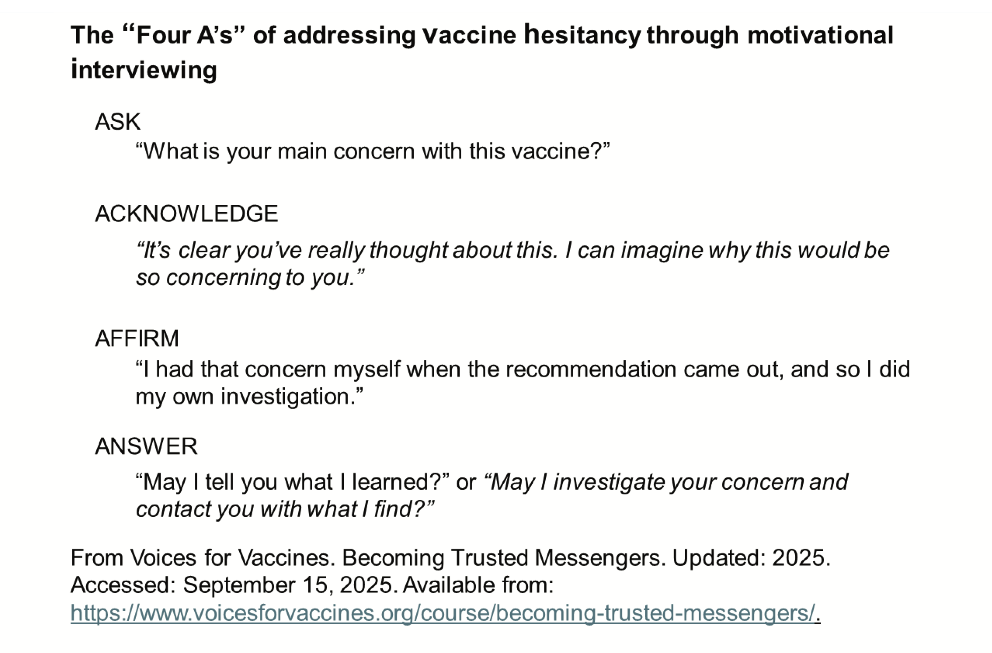
With the first A, the clinician asks. In this way, the clinician encourages the parent/patient to be specific about their concerns regarding the vaccine and name what they are most hesitant about.
e.g., “What is your main concern regarding the vaccine?”
With the second A, the clinician acknowledges. The clinician recognizes that the patient/parent is concerned and ultimately is the decision-maker for their own, i.e., their child’s healthcare, including whether to vaccinate.
e.g., “In the end, it is your decision. You need to want to do this. I am not going to make you do this.”
The clinician should acknowledge that the patient wants to do the right thing.
e.g., “It’s clear you’ve really thought about this. I can imagine why this would be so concerning to you.”
With the third A, the clinician affirms. The clinician affirms that it is okay to have questions.
e.g., “That’s a great question. I heard that as well, so I investigated that.”
Finally, with the fourth A, the clinician answers, but only after obtaining permission to answer. The clinician should ask whether they might share what they have learned.
e.g., “May I tell you what I learned?”
Alternatively, when the clinician is momentarily stumped with a novel concern, they should acknowledge this and offer to investigate it further.
e.g., “May I investigate your concern and contact you with what I find?”
In using these strategies, the clinician focuses on their relationship with the patient. A debate or confrontation is avoided, and respect for the patient is shown. Yes, the individual may stop the clinician at the first A. If this happens, i.e., if after permission is asked the patient declines, the clinician should respect this and stop. There will be future encounters, and the patient’s trust and confidence in the doctor should matter more than completing the remaining A’s at a particular visit. It is just important that the clinician makes the effort. The patient will sense this and respect the clinician for that.
CONCLUSION
While we have made great progress with the development of vaccines and succeeded in controlling many vaccine-preventable diseases, vaccine hesitancy remains a significant threat – one that has been exacerbated through the management of the COVID-19 pandemic. The pandemic disrupted routine vaccination pathways, amplified distrust, and polarized parental attitudes about immunization. It is the burden and responsibility of clinicians to continue protecting patients from vaccine-preventable diseases. Well-evidenced strategies support making strong recommendations with presumptive language to improve vaccine uptake. While evidence clearly shows that educational efforts fail to resolve vaccine hesitancy, data clearly demonstrate that motivational interviewing directed toward vaccine hesitancy improves vaccine uptake.
The “Four A’s” approach to motivational interviewing provides a helpful framework to guide clinicians during a patient encounter efficiently and effectively. Clinicians are critical in preventing and managing vaccine hesitancy because of their relationship with the patient. Through thoughtful, empathetic, and evidence-based communication, we can rebuild trust in vaccines and continue reducing the global burden of preventable illnesses.
AUTHORSHIP
Dr. Jacobson presented the major findings reported in this paper at the 15th Serbian Diaspora Medical Conference on June 12, 2025. Dr. Reis expanded on the details, created the illustrative figure (Figure 1), and provided citations of the published literature.
CURRICULUM VITAE

Christopher A Reis
Christopher A Reis, MD, FAAP, is a general pediatrician at Mayo Clinic Children’s in Rochester, Minnesota. He graduated from the University of Minnesota, Twin Cities with a degree in biology prior to attending medical school at Oakland University William Beaumont School of Medicine. His postgraduate training was completed at Mayo Clinic, including a residency in pediatrics followed by a fellowship in pediatric infectious diseases. His academic interests include vaccine uptake and hesitancy in primary care pediatrics, as well as quality improvement to enhance vaccine administration through system level interventions and medical education.

Robert M Jacobson
Robert M Jacobson, MD, FAAP, is a primary care pediatrician in the Division of Community Pediatric and Adolescent Medicine at Mayo Clinic and holds joint appointments in the Divisions of Pediatric Infectious Diseases and Epidemiology. He serves as the Medical Directors for the adult and child immunization programs at Mayo Clinic in Southeast Minnesota. He also serves as a co-Chair of the AskMayoExpert Knowledge Content Board for Immunizations and Vaccinations. He also conducts research to improve vaccine uptake and has published 280 peer-reviewed publications. He is passionate about evidence-based medicine, population health science, and preventive care including and especially vaccines.
Informations

-
Keywords:
-
Received:
-
Revised:
-
Accepted:
-
Online first:
-
DOI:
-
Cite this article:

Robert M. Jacobson
Desk Ba3b, Mayo Clinic
200 First Street Southwest, Rochester, Minnesota 55905-0001
E-mail:
1. World Health Organization. Ten Threats to Global Health in 2019. [Internet]. Pristupljeno: 15. 9. 2025. Dostupno: https://www.who.int/news-room/spotlight/ten-threats-to-global-health-in-2019 [HTTP]
2. Shet A, Carr K, Danovaro-Holliday MC, Sodha SV, Prosperi C, Wunderlich J, et al. Impact of the SARS-CoV-2 pandemic on routine immunisation services: evidence of disruption and recovery from 170 countries and territories. Lancet Glob Health. 2022 Feb;10(2):e186-e194. doi: 10.1016/S2214-109X(21)00512-X. [CROSSREF]
3. Higgins DM, Moss A, Blackwell S, O’Leary ST. The COVID-19 Pandemic and Parental Attitudes Toward Routine Childhood Vaccines. Pediatrics. 2023 Nov 1;152(5):e2023062927. doi: 10.1542/peds.2023-062927. [CROSSREF]
4. Gurfinkel D, Tietbohl C, Clark E, Saville A, Albertin C, O’Leary ST, et al. Perceived Effects of COVID-19 on Vaccine Hesitancy and Clinician Discussion: A Qualitative Study. Pediatrics. 2024 Oct 1;154(4):e2024066819. doi: 10.1542/peds.2024-066819. [CROSSREF]
5. Centers for Disease Control and Prevention. Contraindications and Precautions. [Internet]. Pristupljeno: 9. 9. 2025. Dostupno: https://www.cdc.gov/vaccines/hcp/imz-best-practices/contraindications-precautions.html [HTTP]
6. Nowalk MP, Lin CJ, Zimmerman RK, Ko FS, Hoberman A, Zoffel L, et al. Changes in parents’ perceptions of infant influenza vaccination over two years. J Natl Med Assoc. 2007 Jun;99(6):636-41.
7. Guerry SL, De Rosa CJ, Markowitz LE, Walker S, Liddon N, Kerndt PR, et al. Human papillomavirus vaccine initiation among adolescent girls in highrisk communities. Vaccine. 2011 Mar 9;29(12):2235-41. doi: 10.1016/j.vaccine.2011.01.052. [CROSSREF]
8. Darden PM, Thompson DM, Roberts JR, Hale JJ, Pope C, Naifeh M, et al. Reasons for not vaccinating adolescents: National Immunization Survey of Teens, 2008-2010. Pediatrics. 2013 Apr;131(4):645-51. doi: 10.1542/peds.2012-2384. [CROSSREF]
9. Darden PM, Jacobson RM. Impact of a physician recommendation. Hum Vaccin Immunother. 2014;10(9):2632-5. doi: 10.4161/hv.29020. [CROSSREF]
10. Caldwell AC, Madden CA, Thompson DM, Garbe MC, Roberts JR, Jacobson RM, et al. The impact of provider recommendation on human papillomavirus vaccine and other adolescent vaccines. Hum Vaccin Immunother. 2021 Apr 3;17(4):1059-1067. doi: 10.1080/21645515.2020.1817713. [CROSSREF]
11. Rosenthal SL, Weiss TW, Zimet GD, Ma L, Good MB, Vichnin MD. Predictors of HPV vaccine uptake among women aged 19-26: importance of a physician’s recommendation. Vaccine. 2011 Jan 29;29(5):890-5. doi: 10.1016/j.vaccine.2009.12.063. [CROSSREF]
12. Opel DJ, Heritage J, Taylor JA, Mangione-Smith R, Salas HS, Devere V, et al. The architecture of provider-parent vaccine discussions at health supervision visits. Pediatrics. 2013 Dec;132(6):1037-46. doi: 10.1542/peds.2013-2037. [CROSSREF]
13. Opel DJ, Mangione-Smith R, Robinson JD, Heritage J, DeVere V, Salas HS, et al. The Influence of Provider Communication Behaviors on Parental Vaccine Acceptance and Visit Experience. Am J Public Health. 2015 Oct;105(10):1998- 2004. doi: 10.2105/AJPH.2014.302425. [CROSSREF]
14. Sturm L, Donahue K, Kasting M, Kulkarni A, Brewer NT, Zimet GD. Pediatrician-Parent Conversations About Human Papillomavirus Vaccination: An Analysis of Audio Recordings. J Adolesc Health. 2017 Aug;61(2):246-251. doi: 10.1016/j.jadohealth.2017.02.006. [CROSSREF]
15. Hofstetter AM, Robinson JD, Lepere K, Cunningham M, Etsekson N, Opel DJ. Clinician-parent discussions about influenza vaccination of children and their association with vaccine acceptance. Vaccine. 2017 May 9;35(20):2709- 2715. doi: 10.1016/j.vaccine.2017.03.077. [CROSSREF]
16. Opel DJ, Zhou C, Robinson JD, Henrikson N, Lepere K, Mangione-Smith R, et al. Impact of Childhood Vaccine Discussion Format Over Time on Immunization Status. Acad Pediatr. 2018 May-Jun;18(4):430-436. doi: 10.1016/j.acap.2017.12.009. [CROSSREF]
17. Brewer NT, Hall ME, Malo TL, Gilkey MB, Quinn B, Lathren C. Announcements Versus Conversations to Improve HPV Vaccination Coverage: A Randomized Trial. Pediatrics. 2017 Jan;139(1):e20161764. doi: 10.1542/peds.2016-1764. [CROSSREF]
18. Dempsey AF, Pyrznawoski J, Lockhart S, Barnard J, Campagna EJ, Garrett K, et al. Effect of a Health Care Professional Communication Training Intervention on Adolescent Human Papillomavirus Vaccination: A Cluster Randomized Clinical Trial. JAMA Pediatr. 2018 May 7;172(5):e180016. doi: 10.1001/jamapediatrics.2018.0016. [CROSSREF]
19. Malo TL, Hall ME, Brewer NT, Lathren CR, Gilkey MB. Why is announcement training more effective than conversation training for introducing HPV vaccination? A theory-based investigation. Implement Sci. 2018 Apr 19;13(1):57. doi: 10.1186/s13012-018-0743-8. [CROSSREF]
20. Dempsey AF, Pyrzanowski J, Campagna EJ, Lockhart S, O’Leary ST. Parent report of provider HPV vaccine communication strategies used during a randomized, controlled trial of a provider communication intervention. Vaccine. 2019 Feb 28;37(10):1307-1312. doi: 10.1016/j.vaccine.2019.01.051. [CROSSREF]
21. Hofstetter AM, Opel DJ, Stockwell MS, Hsu C, Zhou C, Mangione-Smith RM, et al. Associations Between Health Care Professional Communication Practices and Influenza Vaccination of Hospitalized Children. Acad Pediatr. 2021 SepOct;21(7):1142-1150. doi: 10.1016/j.acap.2021.06.014. [CROSSREF]
22. Briss PA, Rodewald LE, Hinman AR, Shefer AM, Strikas RA, Bernier RR, et al. Reviews of evidence regarding interventions to improve vaccination coverage in children, adolescents, and adults. The Task Force on Community Preventive Services. Am J Prev Med. 2000 Jan;18(1 Suppl):97-140. doi: 10.1016/s0749-3797(99)00118-x. [CROSSREF]
23. Hinman AR, Briss PA, Carande-Kulis VG, Bernier RR. Recommendations regarding interventions to improve vaccination coverage in children, adolescents, and adults. Am J Prev Med. Jan 2000;18(1):92-96.
24. Fu LY, Bonhomme LA, Cooper SC, Joseph JG, Zimet GD. Educational interventions to increase HPV vaccination acceptance: a systematic review. Vaccine. 2014 Apr 7;32(17):1901-20. doi: 10.1016/j.vaccine.2014.01.091. [CROSSREF]
25. Nyhan B, Reifler J, Richey S, Freed GL. Effective messages in vaccine promotion: a randomized trial. Pediatrics. 2014 Apr;133(4):e835-42. doi: 10.1542/peds.2013-2365. [CROSSREF]
26. Nyhan B, Reifler J. Does correcting myths about the flu vaccine work? An experimental evaluation of the effects of corrective information. Vaccine. 2015 Jan 9;33(3):459-64. doi: 10.1016/j.vaccine.2014.11.017. [CROSSREF]
27. Pluviano S, Watt C, Della Sala S. Misinformation lingers in memory: Failure of three pro-vaccination strategies. PLoS One. 2017 Jul 27;12(7):e0181640. doi: 10.1371/journal.pone.0181640. [CROSSREF]
28. Reddinger JL, Levine D, Charness G. Can targeted messages reduce COVID-19 vaccination hesitancy? A randomized trial. Prev Med Rep. 2022 Oct;29:101903. doi: 10.1016/j.pmedr.2022.101903. [CROSSREF]
29. Cole JW, M H Chen A, McGuire K, Berman S, Gardner J, Teegala Y. Motivational interviewing and vaccine acceptance in children: The MOTIVE study. Vaccine. 2022 Mar 15;40(12):1846-1854. doi: 10.1016/j.vaccine.2022.01.058. [CROSSREF] Erratum in: Vaccine. 2022 May 31;40(25):3482. doi: 10.1016/j.vaccine.2022.04.084. [CROSSREF]
30. Berenbrok LA, Gessler C, Kirisci L, Herrera-Restrepo O, Coley KC. Impact of pharmacist motivational interviewing on hepatitis B vaccination in adults with diabetes. J Am Pharm Assoc (2003). 2023 Jan-Feb;63(1):66-73.e1. doi: 10.1016/j.japh.2022.08.013. [CROSSREF]
31. Chan DNS, Choi KC, Lee PPK, So WKW. The Effects of Motivational Interviewing on Promoting Human Papillomavirus Vaccination Initiation and Completion Among South Asian Mother/Daughter Dyads: A Pilot Randomised Controlled Trial. Int J Behav Med. 2025 Aug;32(4):574-585. doi: 10.1007/s12529-025-10349-y. [CROSSREF]
32. Opel DJ, Robinson JD, Zhou C, Colborn K, Spielvogle H, Furniss A, et al. Tiered Clinician Vaccine Communication Strategy to Improve Childhood Vaccine Uptake: A Cluster Randomized Clinical Trial. JAMA Netw Open. 2025 Apr 1;8(4):e257814. doi: 10.1001/jamanetworkopen.2025.7814. [CROSSREF]
33. Voices for Vaccines. Becoming Trusted Messengers. Updated 2025. [Internet]. Pristupljeno: 15. 9. 2025. Dostupno: https://www.voicesforvaccines.org/course/becoming-trusted-messengers/ [HTTP]