


Prevalence and sociodemographic inequalities in developing type 2 diabetes multimorbidities in Serbia
- University of Belgrade, Faculty of Medicine, Institute of Social Medicine, Belgrade, Serbia
- University of Belgrade, Faculty of Medicine, School of Public Health and Health Management, Belgrade, Serbia
- King’s College London, Department of Population Health Sciences, London SE1 1UL, United Kingdom
- University of Belgrade, Computer Center, Belgrade, Serbia
- ** DiaDEM Project lead
ABSTRACT
Introduction: The number of people living with diabetes is increasing worldwide, with the majority of those affected residing in low- and middle-income countries. Type 2 diabetes mellitus (T2DM) is often associated with the co-occurrence of one or more long-term conditions (LTCs), which might be affected by patients’ socioeconomic characteristics, however, to what extent, it is as yet unknown in Serbia. Therefore, we have aimed to examine the prevalence and impact of sociodemographic factors on T2DM multimorbidity in Serbia.
Materials and methods: Secondary data analysis of the Serbian National Health Surveys 2013 and 2019 was conducted in a population older than 45 years. Multivariate analyses were used to investigate relative risk ratios with 95% confidence intervals and corresponding predicted probabilities between the sociodemographic profiles of participants in different disease groups (with/without T2DM and one or more LTCs).
Results: The prevalence of T2DM comorbidity and multimorbidity was 8.8% and 29.5%, respectively. Most often, T2DM co-occurred with stroke, myocardial infarction, and liver cirrhosis. Multimorbidity was associated with older age, the female gender, lower level of education, and lower income. The biggest gender gap was identified in the predicted probabilities for having T2DM and two or more LTCs among the subjects with the lowest level of education (women: p = 0.333 vs. men: p = 0.208) and in the lowest income quintile (women: p = 0.366 vs. men: p = 0.236), while the gender gap was not identified among those with at least a bachelor’s degree (women: p = 0.258 vs. men: p = 0.260).
Conclusion: A comprehensive approach to identifying and subgrouping populations based on their risk of LTCs yields valuable insights that can facilitate early detection and disease management.
INTRODUCTION
The number of people living with diabetes is increasing worldwide and is predicted to reach 745 million in the next two decades [1], of whom the majority reside in low- and middle-income countries (LMICs) [2]. The breakthroughs in diabetes management have led to a significant rise in patient survival rates. However, they have also resulted in a higher prevalence of multiple long-term conditions often associated with diabetes, a phenomenon commonly referred to as multimorbidity [1].
Multimorbidity is defined as the co-occurrence of at least two chronic conditions in one patient [3]. This growing trend of multimorbidity poses a considerable challenge for healthcare providers and policymakers as it can lead to complex health issues and greater demands for healthcare services. The effects of multimorbidity among patients with diabetes on the quality of life, the use of medication, overall access to health services, and healthcare costs have been described in literature. Therefore, it is crucial to address this phenomenon with an integrated and coordinated approach, to ensure optimal patient outcomes and effective management of healthcare resources. However, current healthcare systems are better equipped to deal with a single disease [3],[4].
Well-known complications of diabetes are kidney disease, coronary heart disease, peripheral vascular disease, and cerebrovascular disease, but other illnesses not commonly associated with this disease can occur as comorbidities in diabetes. These illnesses include mental health conditions like schizophrenia and depression, as well as tuberculosis, fatty liver disease, obstructive sleep apnea, dementia, and osteoarthritis [1],[5],[6].
Many LMICs are experiencing an epidemiological transition, with a rise in non-communicable diseases such as type 2 diabetes mellitus (T2DM), hypertension, cardiovascular disease, and cancer in a relatively younger population than in high-income countries (HICs). It is estimated that there is a higher burden of depression and tuberculosis with diabetes in LMICs, as compared to HICs, reflecting lower availability of resources and funding, especially for mental health [5]. Additionally, environmental factors, poverty, and limited social infrastructure, among other confounding factors, also influence the development of multimorbidity in LMICs [3]. Healthcare utilization is also more complicated in LMICs as the differences in access to healthcare influence entire families [3].
The prevalence of chronic non-communicable diseases has been increasing in Serbia since the beginning of the 21st century, and these illnesses account for almost two-thirds of the burden of diseases in the country [6]. The prevalence of diabetes has increased from 5.3%, in 2006, to 8.3%, in 2019 [7],[8]. The prevalence of multimorbidity in a general population-based study in Serbia was 30.2% [6]. No studies, to date, have examined diabetes-associated multimorbidity in Serbia.
The current good clinical practice guidelines within the country are single-disease-centered, as is common in many countries [6]. This presents a significant obstacle for healthcare practitioners treating patients with multimorbidity. Consequently, there is a need to improve current knowledge to accommodate the management of patients with multimorbidity in Serbia.
This study aims to examine the prevalence and impact of sociodemographic factors of T2DM multimorbidity in Serbia.
MATERIALS AND METHODS
Study design and sample
A cross-sectional study was conducted to investigate the multimorbidity of T2DM in Serbia. In this study, we applied secondary analysis of data from the two most recent National Health Surveys (NHS), on a nationally representative sample. The surveys were conducted in 2013 and 2019, at the request of the Ministry of Health of the Republic of Serbia. Anonymized NHS electronic datasets were obtained upon ethical approval from the Institute of Public Health of Serbia, which carried out the 2013 NHS [9], while in 2019, the NHS was conducted by the Statistical Office of the Republic of Serbia in cooperation with the Institute of Public Health of Serbia [8].
Datasets contain data from a stratified two-stage representative sample of the population of Serbia, as per NHS methodology [8],[9]. Both samples provide statistically reliable estimates at the national level and the levels of four geographical regions of Serbia (Vojvodina, Belgrade, Šumadija and Western Serbia, and Southern and Eastern Serbia). Census enumeration areas (groups of households) were selected randomly with probability proportional to size and defined as primary sample units. In the households (6,500 in 2013 [9] and 5,114 in 2019 [9]), defined as second-stage sample units, 15,999 respondents in 2013 and 15,621 respondents in 2019 were interviewed.
The population of interest in our study included adults aged 45 years and older (n = 8,749, in 2013, and n = 8,081, in 2019) suffering from diabetes mellitus type 2 (n = 1,144, in 2013, and n = 1,075, in 2019). Details on the sampling methods were published elsewhere [8],[9].
NHS instruments
The National Health Surveys utilized the European Health Interview Survey (EHIS) methodology for creating survey instruments and variable datasets [8],[9]. Therefore, the NHS datasets provide information on self-reported sociodemographic characteristics and health measures, obtained from face-to-face interviews using a standardized questionnaire for adults 15+, while information on BMI (height, weight) and blood pressure was gathered with anthropometric and blood pressure measurements, respectively. All interviews and measurements were carried out at the respondent’s home by field researchers.
Written informed consent was obtained from all participants and the study was approved by the Ethics Review Board of the Institute of Public Health of Serbia (Decision number 5996/1, October 1, 2013, for the 2013 NHS, and 7703/1, December 8, 2021, for the 2019 NHS).
Study variables
The study had two types of variables: independent (input variables) and dependent variables (which are the outcome of variables of interest). Input variables were sociodemographic variables and limitations in practicing daily activities due to health problems. The study outcome variables were self-reported T2DM and other chronic diseases or long-term conditions.
Sociodemographic variables included the age of the respondent (categorized into the following three age groups: 45-54, 55-64, 65+ years), gender (male and female), marital status (four categories: married or living with a partner, never married or cohabited, widowed, and separated), education (categorized in the following way: no or incomplete elementary education, elementary education or vocational training, secondary education, and bachelor’s degree or higher), and the wealth index as a proxy measure of the standard of living of the household (the respondents were classified into five socioeconomic groups or quintiles: the first quintile – top 20%, i.e., the richest category of respondents, the second quintile – the category of respondents that are well-off, the third quintile – respondents belonging to the middle class, the fourth quintile – respondents belonging to the poorer class, and the fifth quintile – the poorest category of respondents). Variables included in the wealth index calculation were related to the respondents’ assets (number of bedrooms per household member, the predominantly used flooring material, the main material used in constructing the roof and walls of the house, the type of main drinking water source, type of sanitation, the energy source used for heating, possessing a color TV, mobile phone, refrigerator, PC, washing machine, dishwasher, air conditioning, central heating, a car and having Internet access). The calculation of the wealth index for each respondent was described in detail elsewhere [10].
Limitations in carrying out daily activities due to health problems were categorized as: no limitations, moderate limitations, and serious limitations.
The study outcome variable was self-reported T2DM with or without comorbidity/multimorbidity in an individual, where the presence of T2DM plus one other chronic disease or long-term condition (LTC) was categorized as diabetes comorbidity, while the co-occurrence of T2DM with two or more other chronic diseases or LTCs was categorized as diabetes multimorbidity.
Self-reported data on the presence of chronic diseases/conditions were obtained with the following yes/no question: “Have you had any of the following diseases or conditions in the previous 12 months?”. The 16 chronic diseases/conditions listed include diabetes mellitus, bronchial asthma (including allergic asthma), chronic bronchitis, chronic obstructive pulmonary disease, emphysema, myocardial infarction (MI) or longterm consequences of myocardial infarction, coronary heart disease or angina pectoris, hypertension, stroke or long-term consequences of stroke, arthrosis (excluding arthritis), liver cirrhosis, kidney disease, depression, cancer, hyperlipidemia (high cholesterol level), pain (reformulated in one variable as lower back pain or cervical back pain), allergies, and urinary incontinence.
For the purposes of this analysis, the acronym ‘any LTC’ applied to any other chronic disease and LTC, and the outcome variable was categorized into the following three groups: Group 1 – ‘No T2DM or any LTC’, Group 2 – ‘T2DM + 1 LTC’, and Group 3 – ‘T2DM + ≥ 2 LTCs’.
Statistical analysis
Data were analyzed using descriptive statistics and multivariate analysis. The sample was stratified by reported T2DM and other long-term conditions into the following three groups: ‘No T2DM or any LTC’, ‘T2DM + 1 LTC’, and ‘T2DM + ≥ 2 LTCs’. The frequency and percentage distributions of sociodemographic factors and reported limitations were presented across these groups.
The multivariate analysis was used to investigate associations between the sociodemographic/limitations profiles of participants in Group 1 (‘No T2DM or any LTC’), Group 2 (‘T2DM + 1 LTC’), and Group 3 (‘T2DM + ≥ 2 LTCs’), and the presence of T2DM with or without other LTCs. The model compared the risk of each outcome (T2DM + 1 LTC or T2DM + ≥ 2 LTCs) with that of participants with no T2DM or any LTC across sociodemographic/physical limitation variables. Furthermore, we examined how two variables – sociodemographic/ limitations due to health problems, interacted to impact the outcome of interest (interactions of age and gender, age and education, age and income, age and civil status, age and limitations, gender and education, gender and income, gender and civil status, gender and limitations). Relative risk (RRs) were presented with the lower and upper levels of 95% confidence intervals. Predicted probabilities of the three outcome groups: ‘No T2DM or any LTC’, ‘T2DM + 1 LTC’, and ‘T2DM + ≥ 2 LTCs’, by gender and age, gender and education level, and gender and income quintiles, were calculated using multivariate regression model.
We report risk ratios (RRs) and a 95% confidence interval (CI). The model was fitted using Stata (Version 18.0).
RESULTS
The total prevalence of T2DM comorbidity was 8.8% (512/5,788), while the prevalence of T2DM multimorbidity was 29.5% (1,707/5,788). Table 1 shows the profile of participants aged ≥ 45 years, from two national surveys, 2013 and 2019, stratified by reported T2DM and any other LTC into the following three groups: ‘No T2DM or any LTC’, ‘T2DM + 1 LTC’, and ‘T2DM + ≥ 2 LTCs’
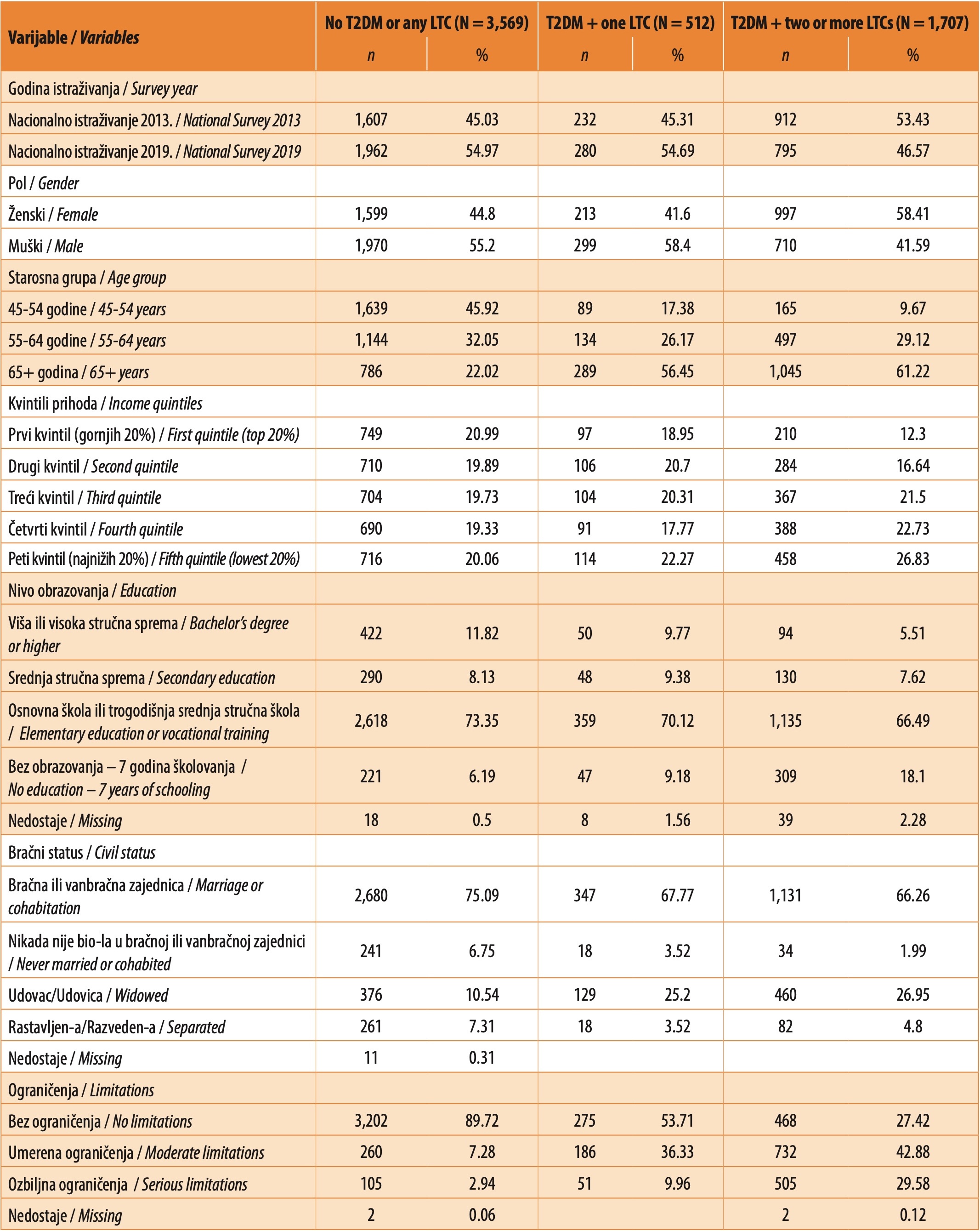
The frequency and percentage distributions by sociodemographic factors and reported limitations are presented in Table 1. The percentage distributions of T2DM + 1 LTC or T2DM + ≥ 2LTCs, as compared to subjects without any LTC, reflected disparities by sociodemographic factors. The percentage of male participants was higher in the T2DM + 1 LTC group, while there were more female participants in the T2DM + ≥ 2 LTCs group. In both the T2DM + 1 LTC group and the T2DM + ≥ 2 LTCs group, the majority of participants were aged 65+ years, with 0-7 years of education, with elementary education or vocational training, widowed (especially for the T2DM + ≥ 2 LTCs group), while the minority were from the most affluent income quintile. Compared to participants without T2DM or any LTC, people in the T2DM + 1 LTC and T2DM + ≥ 2 LTCs groups reported more moderate or serious limitations in daily activities due to health problems.
A bar graph (Figure 1) shows the percentage of participants with and without T2DM among those with other LTCs. The grey bars show that a high percentage of people with any of the LTCs listed also had T2DM. The highest prevalence of T2DM was noted among participants with liver cirrhosis – 36.5% of them had T2DM. The second highest prevalence of T2DM was registered in MI patients – 26% of participants with MI also had T2DM.

Table 2 presents the risk ratio (RR), comparing the risk of T2DM +1 LTC or T2DM + ≥2 LTCs with subjects without T2DM and no LTCs, across the categories of sociodemographic factors and limitations due to health. Reported risks of T2DM + 1 LTC almost did not change in 2019, as compared to the 2013 survey, but the risk of T2DM + ≥ 2LTCs was 29% lower in the 2019 survey, compared to the group with no T2DM or any LTC. The univariable analysis showed that there was a significant relative risk of having T2DM and 1 LTC in age groups older than 55 years (RR = 2.16, 95% CI: 1.63 – 2,85; and 6.77, 95% CI: 5.26 – 8.72, respectively), in subjects with 0-7 years of education (RR = 1.80, 95% CI: 1.17 – 2.76), in people who are widowed (RR = 2.65, 95% CI: 2.11 – 3.33), and in those who have moderate or serious limitations (RR = 8.33, 95% CI: 6.65 – 10.4 and 5.66, 95% CI: 3.96 – 8.08, respectively).
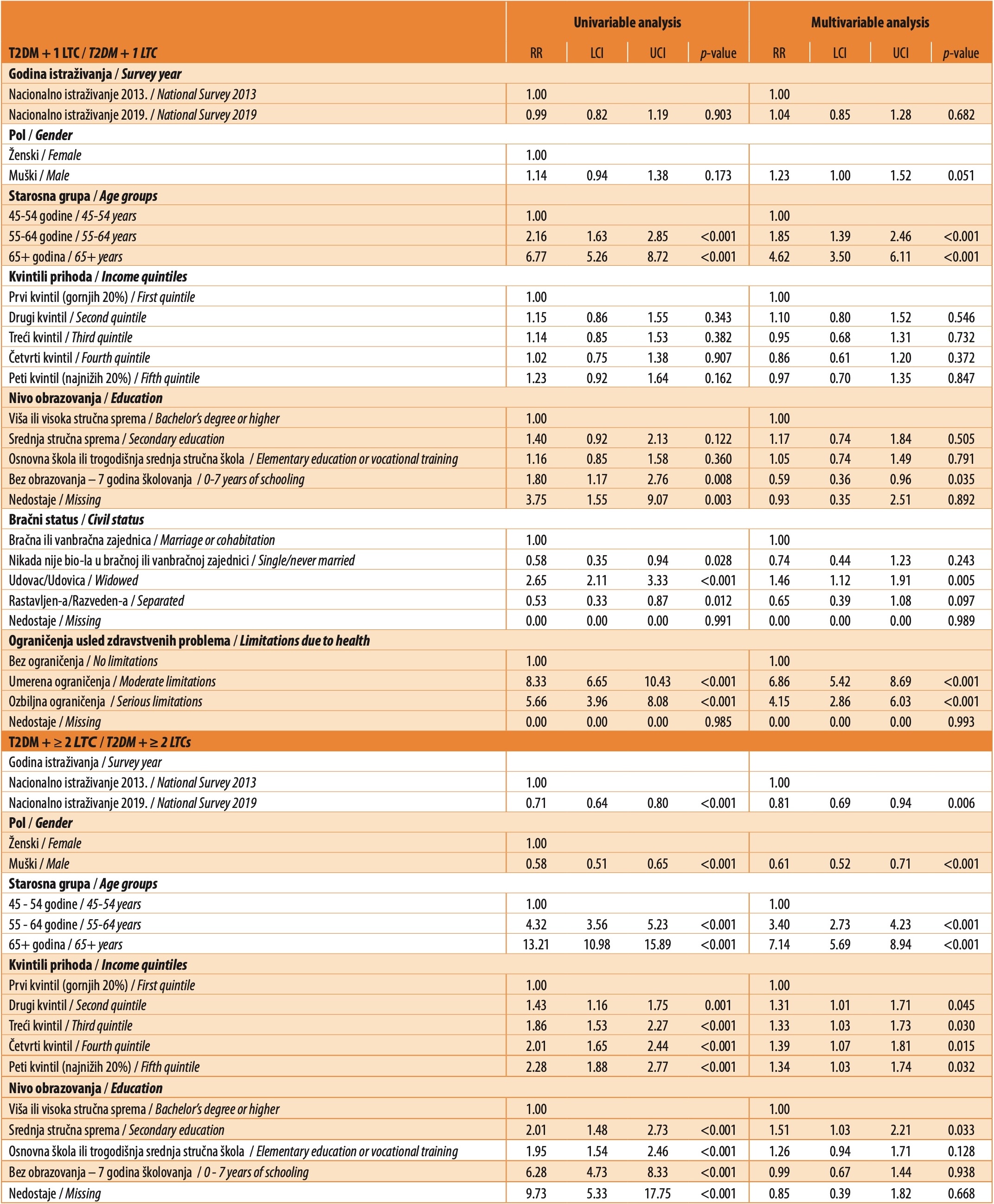
The multivariable analysis showed the association between the T2DM +1 LTC and the 55-64 years age group (RR = 1.85, 95% CI: 1.39 – 2.46), the age 65+ years (RR = 4.62, 95% CI: 3.50 – 6.11), having 0-7 years of education (RR = 0.59, 95% CI: 0.36 – 0.96), being widowed (RR = 1.46, 95% CI: 1.12 – 1.91), and having moderate limitations (RR = 6.86, 95% CI: 5.42 – 8 69) or serious limitations (RR = 4.15, 95% CI: 2.86 – 6.03) due to health. The multivariable analysis showed the association between T2DM + ≥ 2 LTCs and the 2019 survey (RR = 0.81, 95% CI: 0.69 – 0.94), male participants (RR = 0.61, 95% CI: 0.52 – 0.71), being 55-64 years old (RR = 3.40, 95% CI: 2.73 – 4.23), or 65+ years old (RR = 7.14, 95% CI: 5.69 – 8.94), being in the second (RR = 1.31, 95% CI: 1.01 – 1.71), third (RR = 1.33, 95% CI: 1.03 – 1.73), fourth (RR = 1.39, 95% CI: 1.07 – 1.81), or fifth income quintile (RR = 1.34, 95% CI: 1.03 – 1.74), having secondary level education (RR = 1.51, 95% CI: 1.03 – 2.21), being single or having never married (RR = 0.47, 95% CI: 0.30 – 0.73), and having moderate (RR = 14.0, 95% CI: 11.6 – 16.8) or serious limitations due to health (RR = 22.0, 95% CI: 17.2 – 28.3). The results of the univariable and multivariable analyses are presented in Table 2.
DISCUSSION
Main findings
In this study, we investigated the prevalence and sociodemographic characteristics of T2DM and comorbidities and multimorbidities in the Republic of Serbia population-based data, collected in two periods: year 2013 and year 2019. To the best of our knowledge, this is the first study to thoroughly explore the prevalence and the differences in sociodemographic characteristics of patients with T2DM with one or two or more long-term conditions The visual presentation of predicted probabilities, derived from multivariate analyses provided some insight into the relationships between T2DM, comorbidities and multimorbidities, stratified by sociodemographic characteristics.
We found that the prevalence of T2DM comorbidity was 8.8%, and the prevalence of T2DM multimorbidity was 29.5%. This finding is in line with the well-established understanding that T2DM patients have a high risk of co-occurring health conditions, most commonly hypertension, lipid disorders, coronary heart disease, microvascular conditions, and mental health disorders, especially depression [11]. In our study, the prevalence of T2DM among patients with other health conditions was the highest in patients with liver cirrhosis (36%), followed by those with myocardial infarction, stroke, and high cholesterol, with around one-quarter of these patients having T2DM. The clustering of these illnesses and T2DM can significantly increase the risks associated with these conditions and increase the need for healthcare utilization [12].
It is known that sociodemographic factors which have the strongest association with multimorbidity are age and socioeconomic status and this finding is consistent across several studies conducted in LMICs [13],[14]. Multimorbidity prevalence increases worldwide in the population aged 65+ years, and especially in those over the age of 75 [11]. Among patients with T2DM, older than 65 years, who have had their illness for more than ten years, there is a higher prevalence of multimorbidity and end-organ complications, such as myocardial infarction and end-stage renal disease [11]. Similarly, in our study, the age group 55-64 years was associated with an increased risk of both T2DM comorbidity and T2DM multimorbidity. In the multivariable analysis, participants in this age group had an 85% increase in the risk of comorbidity and a 340% increase in the risk of T2DM multimorbidity. The likelihood in the older age group (above the age of 65 years) was even more pronounced, with a 462% increase in the risk of T2DM comorbidity and a 714% increase in the risk of T2DM multimorbidity.
Some studies have shown the association between the female gender and multimorbidity [15],[16], but this was not evident among Canadian seniors, particularly in the population group with the highest prevalence of multimorbidity (above the age of 65 years) [17]. We did not find an association between gender and T2DM comorbidity; however, there was a higher risk of T2DM multimorbidity among the female participants. Arguably, women do tend to have a higher likelihood of visiting their general practitioner and, therefore, more frequently establish diagnoses of chronic health conditions [15], but there seems to be a higher likelihood of women having a comorbid mental health disorder, as well [15].
As to socioeconomic status, our results indicate that people in the lower income quintiles had a higher RR for developing multimorbidity which is in line with a large English cohort study where the most disadvantaged socioeconomic class was linearly associated with an increased likelihood of multimorbidity [15]. Additionally, in a study conducted in Spain, an increasing deprivation level was strongly associated with an increasing percentage of patients with T2DM and a higher number of concurrent illnesses [18].
In our study, subjects with secondary education had a 51% increase in the risk of T2DM multimorbidity (p = 0.033), as compared to those with a bachelor’s degree education level or higher, but there were no significant differences in RR between multimorbidity and lower educational levels. However, this lack of association may stem from the differences in sample sizes across education categories. These results are congruent with those from a recently conducted study in Serbia [19] indicating that individuals with a lower level of education are more prone to develop multimorbidity. In a study by Bender et al. [20], an association was found between a lower level of education and the risk of developing both complications and comorbidities, in patients with T2DM.
The association between moderate and severe limitations in daily activities and T2DM comorbidities and multimorbidities was also confirmed in our study, which is in keeping with a study by Jie et al. [21] that showed T2DM as a factor associated with limitations in daily living, especially among those above the age of 65 years.
Study limitations
The limitations of this study include the fact that the data on chronic conditions were self-reported rather than diagnosed, and did not consider important factors like disease burden and severity. Due to this methodology, we have not examined the population living in care homes and other residential facilities or hospitals, which has contributed to the underestimation of our data. Due to the cross-sectional design, no causal inferences to the diverse etiologic pathways of T2DM-related comorbidity or multimorbidity were possible, which can be meaningful for clinical applications.
Implications
This study allows for the descriptive characterization of T2DM comorbidity and multimorbidity in Serbia, encompassing a wide spectrum of conditions that may strain healthcare systems. While this analytical approach offers valuable insights in identifying population groups with higher probabilities of having one or more long-term conditions, enhancing clinical and public health practices requires specific guidelines that would help to identify and treat these patients in a timely fashion.
Furthermore, additional research is needed to explore other metabolic, behavioral, and environmental risk factors linked to comorbidity and multimorbidity in T2DM, along with an analysis of population-level temporal trends. Such investigations are vital for facilitating clinical service delivery and public health planning. By shedding light on the etiology of the disease, this research can inform the development of effective preventive and therapeutic interventions. Hence, conducting comprehensive studies to explore these factors is imperative for advancing our understanding of T2DM epidemiology and its implications for population health.
CONCLUSION
Identifying and subgrouping populations according to their risk of LTCs, using a comprehensive approach that considers sociodemographic determinants of health, could be highly informative for improving current practices in early detection and management of disease. This study has significant potential to facilitate the timely delivery of appropriate treatment and regular check-ups, ultimately contributing to better health outcomes and an increased quality of life in the long run.
APPENDIX
Interactions
Age and gender
No significant interaction was registered for the outcome ‘T2DM + 1 LTC’ vs. the outcome ‘No LTC’. The introduction of the interaction indicates an increased RR among men aged 45-54 years with T2DM + 1 LTC, as compared to those with no LTC.
There was a significant interaction for the outcome ‘T2DM + ≥ 2 LTCs’ vs. the outcome ‘No LTCs’. In summary, the risk of T2DM + ≥ 2 LTCs over ‘No LTCs’ for men, was no different from that of the women in the age group 45-54 years (RR = 0.95 (0.67, 1.37); p-value = 0.816), while men had a lower risk at the age of 55- 64 and 65+ years. The risk for women was significantly higher at an older age.
The patterns shown for the main effects of age remained the same, indicating an increased risk of T2DM + 1 LTC and T2DM + ≥ 2 LTCs, with an increase in age.
Age and income
While the interaction was not significant, the main effects support a significantly increased risk of T2DM + 1 LTC and T2DM + ≥ 2 LTCs with an increase in age among the affluent individuals (top 20% income quintile).
Age and education
While the interaction was not significant, the main effects support a significantly increased risk of T2DM + 1 LTC over ‘No LTCs’, among those aged 65+ years, with a bachelor’s degree or higher (RR = 6.33 (2.82, 14.22)), as compared to those aged 45-54 years, as well as an increased risk of T2DM + ≥ 2 LTCs over ‘No LTCs’, among those aged 54-64 years and 65+ years (RR = 4.53 (1.92, 10.65) and 12.94 (5.74, 29.16) respectively), as compared to those aged 45-54 years.
Age and civil status
Overall, the interaction was not significant, and no differences in the risk of T2DM + 1 LTC across civil status groups were found. However, the introduction of the interaction revealed that the risk of T2DM + 1 LTC over ‘No LTCs’, among the subjects aged 55-64 years and 65+, was higher, as compared to those aged 45-54 years, in the married or cohabiting group. The RRs were 1.87 (1.35, 2.58) and 5.13 (3.75, 7.01), with a p-value < 0.001 for both. Similar patterns were noted for T2DM + ≥ 2 LTCs over ‘No LTCs’, indicating a slightly reduced risk of T2DM + 1 LTC and T2DM + ≥ 2 LTCs, for the married or cohabiting group.
Age and health limitations
The interaction of age with health limitations was not significant. The introduction of the interaction suggests a significantly increased risk of T2DM + 1 LTC over ‘No LTCs’, with increased age, for the subgroup with mild or no limitations. In the group aged 45-54 years, higher risks were noted among those with moderate and serious health limitations, as compared to those who had no or mild limitations, which is similar to what was found in the full sample, on average, without considering interactions. Similar patterns were noted for the risk of T2DM + ≥ 2 LTCs over ‘No LTCs’.
Gender and income
There was an interaction between gender and income quintiles, but not at all the income levels. To summarize the main features of this interaction, there was a higher risk of T2DM + 1 LTC over ‘No LTCs’ in women in the second (20% – 40%) and the fifth (lowest, 80% – 100%) income quintiles, as compared to those in the first (top 20%) quintile; the RRs were 1.73 (1.04, 2.88), with a p-value = 0.035, and 1.83 (1.09, 3.07), with the p-value = 0.022, respectively. In the first income quintile, men were at higher risk than women; the RR was 2.43 (1.50, 3.94).
For the risk of T2DM + ≥ 2 LTCs over ‘No LTCs’, no differences between men and women were found among those in the top income quintile (top 20%). There was a significantly higher risk for women in the second to fifth quintiles, as compared to those in the first quintile; the RRs were 1.64 (1.13, 2.40), 1.81 (1.25, 2.61), 1.89 (1.31, 2.75), and 2.40 (1.66, 3.46), respectively, and the p-value was < 0.01, for each.
Gender and education
There was no significant interaction, but the introduction of the interaction indicates a higher risk of T2DM + 1 LTC in men, as compared to women, among the subjects with a bachelor’s degree or higher level of education (RR = 2.54 (1.23, 5.27); p-value = 0.012). A higher degree of risk was noted for women of all other education levels, but this was not significant.
For the risk of T2DM + ≥ 2 LTCs, no differences between men and women were found. However, a significantly higher risk for women at all education levels, as compared to those with a bachelor’s degree and higher, was registered. The RRs were, as follows: secondary education, 2.03 (1.10, 3.74), p-value = 0.023; elementary education or vocational training, 1.99 (1.24, 3.19), p-value = 0.005; and 0-7 years of education, 1.85 (1.07, 3.20), p-value = 0.027.
Gender and civil status
The interactions reveal a slightly higher risk of T2DM + 1 LTC over ‘No LTCs’, for men, as compared to women in the married and/or cohabiting group (RR = 1.36 (1.05, 1.75), p-value = 0.018). The risk of T2DM + ≥ 2 LTCs, as compared to ‘No LTCs’, was lower in men in comparison with women belonging to this civil status group (RR = 0.65 (0.54, 1.49), p-value < 0.01).
Gender and health limitations
No interactions between gender and health limitations regarding the risk of T2DM + 1 LTC over ‘No LTCs’, and no differences between men and women were noted. For T2DM + ≥ 2 LTCs, on the other hand, men had a lower risk, as compared to women in the group with no or with mild limitations (RR = 0.70 (0.57, 0.86), p-value = 0.001. Women with moderate or serious limitations had a significantly higher risk of T2DM + ≥ 2 LTCs, compared to those with no or mild limitations; RRs were 17.15 (13.22, 22.23); p-value < 0.001,and 25.94 (17.72, 37.99); p-value < 0.001,for the two high-risk groups, respectively.
Informations

-
Keywords:
-
Received:
-
Revised:
-
Accepted:
-
Online first:
-
DOI:
-
Cite this article:

Jovana Todorović
University of Belgrade, Faculty of Medicine, Institute of Social Medicine
15 Dr Subotića Street, 11000 Belgrade, Serbia
E-mail:
1. Key global findings 2021. [Internet]. 2021. [pristupljeno: 20 June 2024]. Dostupno na: https://diabetesatlas.org/ [HTTP]
2. Seewoodhary J, Benavides RV, Silveira A. Tropical medicine and diabetes: an integrative paradigm. Practical Diabetes. 2022; 39(5): 40–43. https://doi.org/10.1002/pdi.2420. [CROSSREF]
3. Skou ST, Mair FS, Fortin M, Guthrie B, Nunes BP, Miranda JJ, et al. Multimorbidity. Nat Rev Dis Primers. 2022 Jul; 8(1). https://doi.org/10.1038/s41572-022-00376-4. [CROSSREF]
4. Guthrie B, Payne K, Alderson P, McMurdo MET, Mercer SW. Adapting clinical guidelines to take account of multimorbidity. BMJ. 2012 Oct; 345: e6341. https://doi.org/10.1136/bmj.e6341. [CROSSREF]
5. Lam AA, Lepe A, Wild SH, Jackson C. Diabetes comorbidities in low-and middle-income countries: An umbrella review. Journal of Global Health. 2021 Jul;11:04040. https://doi.org/10.7189/jogh.11.04040. [CROSSREF]
6. Jovic D, Vukovic D, Marinkovic J. Prevalence and patterns of multi-morbidity in Serbian adults: A cross-sectional study. PLoS ONE. 2016 Feb; 11(2):1–14. https://doi.org/10.1371/journal.pone.0148646. [CROSSREF]
7. Institut za javno zdravlje Srbije. Istraživanje zdravlja stanovnika Republike Srbije 2006. Beograd: Institut za javno zdravlje Srbije “Dr Milan Jovanovic Batut” 2007. [Internet]. Dostupno na: https://www.batut.org.rs/download/publikacije/Finalni%20izvestaj%202006.pdf [HTTP]
8. Republički zavod za statistiku Republike Srbije. Istraživanje zdravlja stanovništva Srbije 2019. Beograd: Republički zavod za statistiku Republike Srbije, 2021. [Internet]. Dostupno na: https://publikacije.stat.gov.rs/G2021/pdf/G20216003.pdf [HTTP]
9. Ministarstvo zdravlja Republike Srbije. Rezultati istraživanja zdravlja stanovništva Srbije 2013. Beograd: Ministarstvo zdravlja Republike Srbije, 2014. [Internet]. Dostupno na: https://batut.org.rs/download/publikacije/IstrazivanjeZdravljaStanovnistvaRS2013.pdf [HTTP]
10. Janković J, Simić S, Marinković J. Inequalities that hurt: demographic, socio-economic and health status inequalities in the utilization of health services in Serbia. Eur J Public Health. 2010 Aug;20(4):389-96. doi: 10.1093/ eurpub/ckp189. [CROSSREF]
11. Cicek M, Buckley J, Pearson-Stuttard J, Gregg EW. Characterizing Multimorbidity from Type 2 Diabetes: Insights from Clustering Approaches. Endocrinol Metab Clin North Am. 2021 Sep;50(3):531-558. doi: 10.1016/j. ecl.2021.05.012. [CROSSREF]
12. Khan A, Uddin S, Srinivasan U. Comorbidity network for chronic disease: A novel approach to understand type 2 diabetes progression. Int J Med Inform. 2018 Jul;115:1-9. doi: 10.1016/j.ijmedinf.2018.04.001. [CROSSREF]
13. Singh K, Patel SA, Biswas S, Shivashankar R, Kondal D, Ajay VS, et al. Multimorbidity in South Asian adults: prevalence, risk factors and mortality. J Public Health (Oxf). 2019 Mar 1;41(1):80-89. doi: 10.1093/pubmed/fdy017. [CROSSREF]
14. Afshar S, Roderick PJ, Kowal P, Dimitrov BD, Hill AG. Global Patterns of Multimorbidity: A Comparison of 28 Countries Using the World Health Surveys In: Springer, Cham; 2017:381–402. [CROSSREF]
15. Nowakowska M, Zghebi SS, Ashcroft DM, Buchan I, Chew-Graham C, Holt T, et al. The comorbidity burden of type 2 diabetes mellitus: patterns, clusters and predictions from a large English primary care cohort. BMC Med. 2019 Jul 25;17(1):145. doi: 10.1186/s12916-019-1373-y. [CROSSREF]
16. Seng JJB, Kwan YH, Lee VSY, Tan CS, Zainudin SB, Thumboo J, et al. Differential Health Care Use, Diabetes-Related Complications, and Mortality Among Five Unique Classes of Patients With Type 2 Diabetes in Singapore: A Latent Class Analysis of 71,125 Patients. Diabetes Care. 2020 May;43(5):1048-1056. doi: 10.2337/dc19-2519. [CROSSREF]
17. Gruneir A, Markle-Reid M, Fisher K, Reimer H, Ma X, Ploeg J. Comorbidity Burden and Health Services Use in Community-Living Older Adults with Diabetes Mellitus: A Retrospective Cohort Study. Can J Diabetes. 2016 Feb;40(1):35-42. doi: 10.1016/j.jcjd.2015.09.002. [CROSSREF]
18. Alonso-Morán E, Orueta JF, Esteban JI, Axpe JM, González ML, Polanco NT, et al. Multimorbidity in people with type 2 diabetes in the Basque Country (Spain): Prevalence, comorbidity clusters and comparison with other chronic patients. Eur J Intern Med. 2015 Apr;26(3):197-202. doi: 10.1016/j. ejim.2015.02.005. [CROSSREF]
19. Jankovic J, Mirkovic M, Jovic-Vranes A, Santric-Milicevic M, Terzic-Supic Z. Association between non-communicable disease multimorbidity and health care utilization in a middle-income country: population-based study. Public Health. 2018 Feb;155:35-42. doi: 10.1016/j.puhe.2017.11.014. [CROSSREF]
20. Bender AM, Vrangbæk K, Lange T, Brønnum-Hansen H, Andersen I. Joint effects of educational attainment, type 2 diabetes and coexisting morbidity on disability pension: results from a longitudinal, nationwide, register-based study. Diabetologia. 2021 Dec;64(12):2762-2772. doi: 10.1007/s00125- 021-05559-4. [CROSSREF]
21. Jie JH, Li D, Jia LN, Chen Y, Yang Y, Zheng B, et al. Activities of daily living and its influencing factors for older people with type 2 diabetes mellitus in urban communities of Fuzhou, China. Front Public Health. 2022 Sep 26;10:948533. doi: 10.3389/fpubh.2022.948533. [CROSSREF]
- Table 1. Sample profile by T2DM status and presence of other long-term conditions
- Figure 1. The total prevalence of T2DM in people with other long-term conditions in Serbia, NHS 2013 and 2019
- Table 2. Comparison of the profiles of three groups of people: Group 1 (‘No T2DM or any LTC’), Group 2 (‘T2DM and one LTC’), and Group 3 (‘T2DM and ≥ 2 LTCs’), based on a multivariate model, with Group 1 as the reference group