


Primary lymph node plasmacytoma – a rare clinical entity
- University Clinical Center Kragujevac, Clinic for Hematology, Kragujevac, Serbia
- University of Kragujevac, Faculty of Medical Sciences, Department of Internal Medicine, Kragujevac, Serbia
ABSTRACT
Introduction: Extramedullary plasmacytoma localized in the region of the head and neck represents less than 1% of tumors found in that region. Primary solitary localization of plasmacytoma in the lymph node, as the only manifestation of plasmacytoma, is rare, with less than 50 cases reported so far.
Case report: A 58-year-old man came to the physician because of a painless swollen lymph node in the neck, afebrile, reporting no night sweats or weight loss. He was treated with broad-spectrum antibiotics for 10 days, but his health status did not change. A complete blood count (CBC) was performed, and normal test results were obtained. The patient tested negative for biohumoral inflammatory syndrome. The ultrasound examination of the neck showed a lymph gland, 30 mm x 15 mm in size. The patient was referred to a maxillofacial surgeon; total lymph node extirpation was performed, and the excised node was sent for histopathological analysis. The following pathohistological finding was obtained: diffuse infiltration by plasmacytoid tumor cells stronlgly positive for: OCT2, BOB1, CD38, MUM1, lambda, CD31, VIM, and CD79 alpha; negative for kappa; positive for Ki67 in 30%. The conclusion of the pathohistological examination was lambda positive plasmacytoma. Bone biopsy showed the following: plasmocytes 4%. The findings of multi-slice computed tomography (MSCT) of the thorax, abdomen, and lesser pelvis were normal. Radiographic imaging of the skeleton also showed normal findings. The M protein, in both serum and urine, was negative. Virology tests showed that the patient was HBsAg positive, while he was HCV and HIV negative. Local radiation therapy was indicated along with active antiviral therapy.
Conclusion: Each case of lymphadenopathy demands a serious and thorough approach to be established by the clinician. The question is whether an infection caused by the Hepatitis B virus may have served as a trigger for the development of plasmacytoma.
INTRODUCTION
Multiple myeloma accounts for about 1% of all malignant neoplasms. Its incidence increases with age and reaches its maximum in people in their sixties [1],[2],[3],[4]. It is the second most common hematological malignancy after lymphoma, accounting for 10% of the total number of patients with malignant hematological diseases, and with a frequency of 47% it is the most common bone tumor [5],[6],[7]. Unlike myeloma, extramedullary plasmacytoma can also be localized in soft tissues, throughout the body, affecting the upper segments of the respiratory system, the pharynx, the nasal region – sinuses, the larynx, the gastrointestinal tract, the breasts, and even the brain. Diagnosis is established by tumor biopsy. Radiological findings of the skeleton are normal in patients with plasmacytoma. They also have normal bone marrow biopsy findings.
Extramedullary plasmacytoma located in the region of the head and neck accounts for less than 1% of all tumors in that region [8]. Involvement of the lymphatic gland alone, as the only manifestation of plasmacytoma, is extremely rare – less than 50 cases have been reported so far [9],[10]. The diagnosis of primary plasmacytoma in a lymph node, as an extramedullary localization, is extremely rare. Nevertheless, about 15% of plasmacytomas located in the upper portion of the respiratory tract can metastasize to the lymph nodes of the neck. Also, advanced-stage multiple myeloma can, in almost 40% of cases, metastasize to the lymph nodes. Two-thirds of plasmacytoma sufferers are men between the ages of 39 and 76 years, and plasmacytoma often affects the glands of the cervical region. Survival in patients with lymph node involvement is similar to other extramedullary plasmacytomas that have not progressed to multiple myeloma [9]. Primary lymph node plasmacytoma is a rare hematological neoplasm manifesting as an enlarged cervical lymph node, without other plasma cell dyscrasias [10].
CASE REPORT
A 58-year-old man came to the doctor because of an enlarged palpable tumefaction on the right side of the neck but without a lesion on the skin above the growth. The physical examination revealed a palpable swelling – a lymph gland, hard in consistency, painless, located behind the sternocleidomastoid muscle, in the upper third. The patient had no fever, sweating, or weight loss. A broad-spectrum antibiotic was prescribed to be taken orally for 10 days, but there was no change.
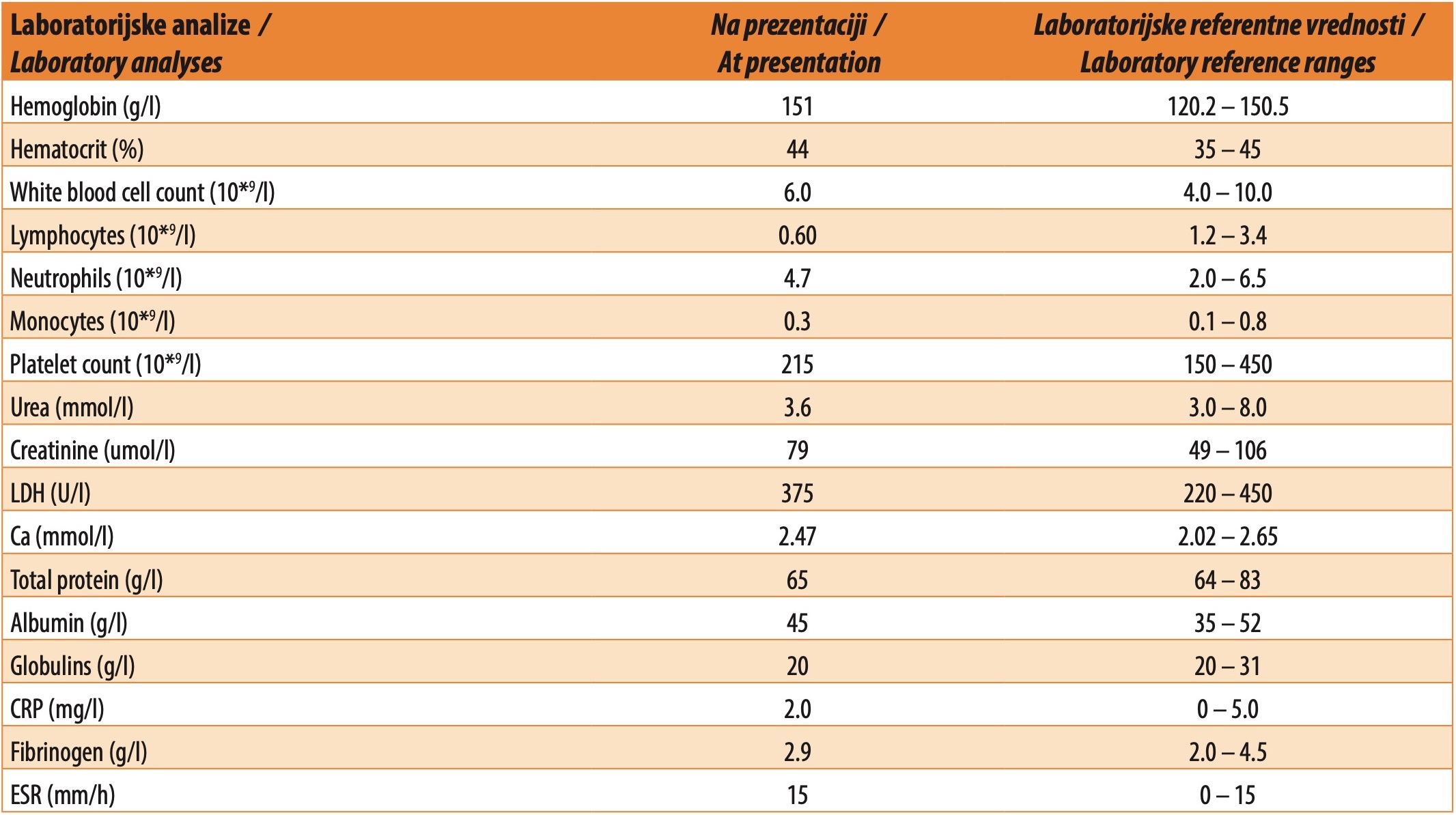
As the swelling did not decrease, laboratory analyses were performed. The complete blood count was within the reference range, as were the biochemical analyses. The patient tested negative for biohumoral inflammatory syndrome. An ultrasound examination of the neck showed an enlarged lymph gland, 30 mm x 15 mm in diameter. The patient was referred to maxillofacial surgery, where the gland was completely excised and sent for histopathological analysis. The pathohistological finding described a diffuse infiltration of plasmacytoid tumor cells strongly positive for the following: OCT2, BOB1, CD38, MUM1, lambda, CD31, VIM, CD79 alpha, and negative for kappa, while Ki67 positivity was present in 30% of cells. Pathohistologically, morphologically, and immunohistochemically, a diagnosis of lambda-type plasmacytoma was established.
Upon hospitalization at the Clinic for Hematology, the patient’s blood was sampled and the results of all the tests were within the reference ranges (Table 1). Additional diagnostics was performed – multislice scan (MSCT) of the chest, abdomen, and pelvis, which did not establish the existence of organomegaly or detect enlarged lymph nodes (Figure 1).
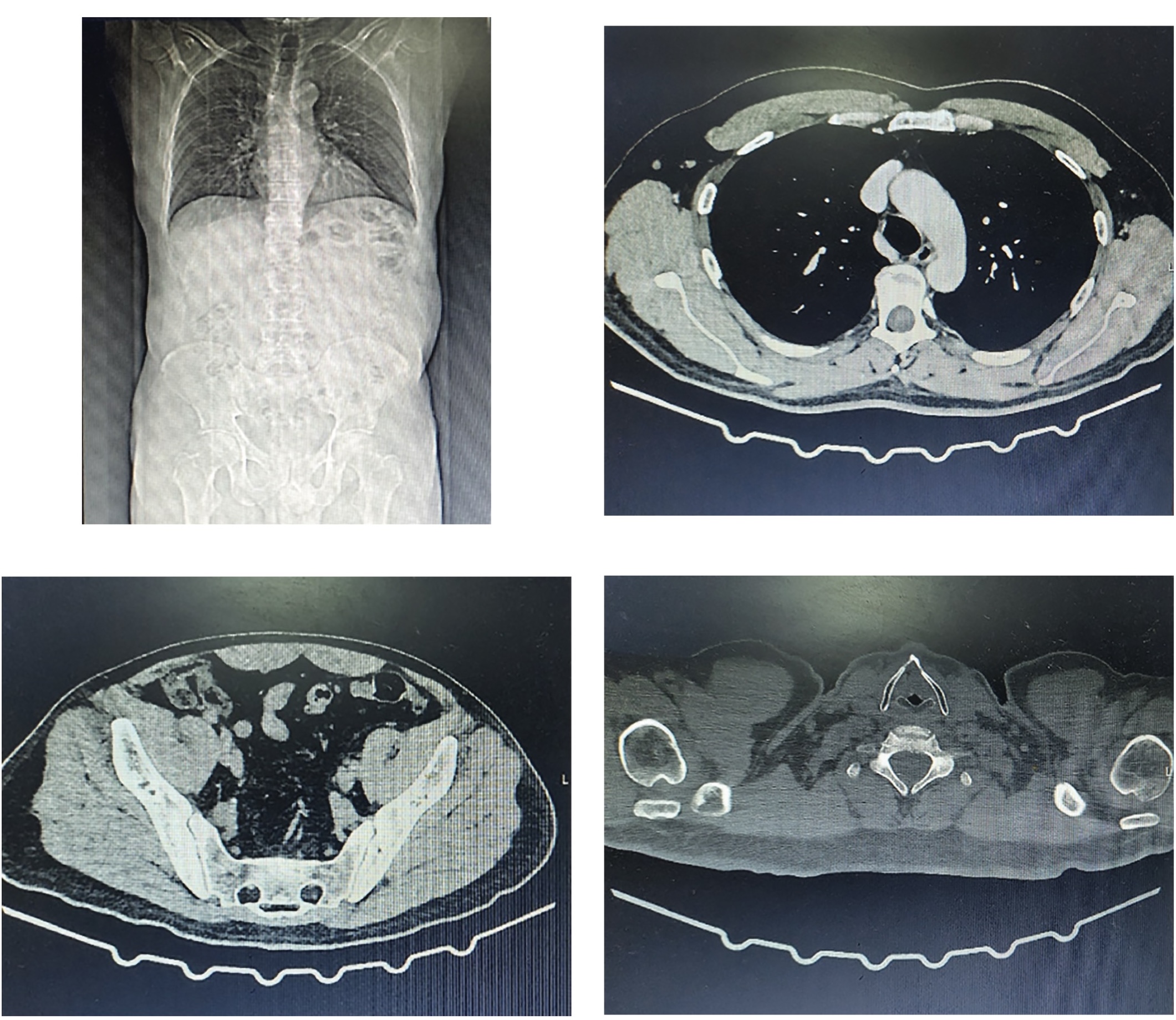
Protein electrophoresis did not detect the presence of the M protein in serum or urine. A beta 2 microglobulin level of 1.8 g/l (normal value: up to 2.4 g/l) was measured, which is within the reference range. Bone biopsy and bone marrow aspiration determined the presence of 4% plasma cells.
Virology tests established the existence of chronic viral hepatitis B; HBsAg positive (78.58 S/CO), HBeAg negative (0.587 S/CO), HBe At positive (0.11 S/CO), HBc IgG positive (11.82 S/CO), HBc IgM negative (0.06 S/CO), HBs At negative (1.13 S/CO), while HCV At (0.06 S/CO) and HIV At were negative (0.88 S/CO). The infectious disease specialist started the patient on antiviral therapy (tenofovir) to prevent the reactivation of the infection.
An X-ray of the entire skeleton did not establish the presence of osteolytic lesions. A definitive diagnosis was established – solitary plasmacytoma of a lymph node in the cervical region. Involved-field radiotherapy (IFRT) of the right cervical region was prescribed along with active treatment by an infectious disease specialist.
DISCUSSION
Extramedullary plasmacytoma is a rare form of plasmacytic dyscrasia that accounts for 1.6% to 4% of all plasma cell tumors [11],[12]. Extramedullary localization of plasmacytoma can be initially identified in any organ, as a primary tumor or a systemic metastasis of multiple myeloma. The most common localization is in the bones, and it accounts for about 40% of all extramedullary localizations, while the CRAB criteria for the diagnosis of multiple myeloma are absent; infiltration in the bone marrow is less than 10% of monoclonal plasma cells, there are no osteolytic lesions in the skeleton, there are no monoclonal light chains in the serum and urine [13]. As a solid tumor, extramedullary plasmacytoma most often affects the upper respiratory tract, including the nasal region, sinuses, oropharynx, salivary glands, and larynx – as many as 80% of plasmacytoma cases presented in literature belong to this region, followed by the gastrointestinal and urogenital tracts, the skin, and lungs [14],[15],[16],[17].
Primary plasmacytoma in a lymph node is particularly rare. It is primarily localized only in the lymph node, without evident proliferation of plasma cells in any other location and without the presence of any lymphoma component in the patient [18].
The patient presented in our article had an enlarged solitary lymph node, with immunohistochemically proven monoclonal plasma cells in the node, no lesions in the skeletal system, no bone marrow infiltration by pathological monoclonal plasma cells, no lymphadenopathy in other locations, and no lesions in other organs. No lymphoma component of the disease was recorded.
Solitary extramedullary plasmacytoma is a highly radiosensitive tumor. The success of treatment with local radiotherapy (RT) is reflected in a good response in 80% – 100% of cases. The optimal dose is 40-50 Gy in 20 fractions.
Surgical biopsy is used for diagnosis, but radical surgery is not usually indicated for treatment, because the tumor is radiosensitive and radiotherapy is curative in the majority of patients [8],[18]. In our patient, the lymph node was 30 mm x 15 mm in diameter and was completely surgically excised.
Plasmacytoma, primarily in the lymph node, may also present with disseminated lymphadenopathy, but it rarely progresses to multiple myeloma. Survival in patients with plasmacytoma is significantly longer than in patients with multiple myeloma [9]. Certainly, in the presented patient, one gland was diseased in isolation – a solitary plasmacytoma, which was surgically removed, after which local radiotherapy was applied. Future regular follow-up of the patient is required.
CONCLUSION
Every case of lymphadenopathy requires a serious approach on the part of the physician, and whether HBV infection was the trigger for the formation of plasmacytoma remains to be considered.
Informations

-
Keywords:
-
Received:
-
Revised:
-
Accepted:
-
Online first:
-
DOI:
-
Cite this article:

Snežana Sretenović
Clinic for Hematology, University Clinical Center Kragujevac, Kragujevac, Serbia
30 Zmaj Jovina Street, 34000 Kragujevac, Serbia
E-mail:
1. Guedes A, Becker RG, Teixeira LEM. Multiple Myeloma (Part 1) – Update on epidemiology, diagnostic criteria, systemic treatment and prognosis. Rev Bras Ortop (Sao Paulo). 2023 Jun 29;58(3):361-7. doi: 10.1055/s-0043- 1770149. [CROSSREF]
2. Silva ROP, Brandão KMA, Pinto PVM, Faria RMD, Clementino NCD, Silva CMF, et al. Mieloma múltiplo: características clínicas e laboratoriais ao diagnóstico e estudo prognóstico. Rev Bras Hematol Hemoter. 2009;31(02):63-8. doi: 10.1590/S1516-84842009005000013. [CROSSREF]
3. Ponte FM, Garcia Filho RJ, Hadler MB, Korukian M, Ishihara HY. Avaliação do tratamento ortopédico no mieloma múltiplo. Rev Bras Ortop. 2002;37(05):162-70.
4. Rajkumar SV. Multiple myeloma: 2020 update on diagnosis, risk-stratification and management. Am J Hematol. 2020 May;95(5):548-67. doi: 10.1002/ ajh.25791. [CROSSREF]
5. American Cancer Society [Internet]. Atlanta American Cancer Society; c2020. About multiple myeloma [Accessed: 12. 3. 2020.]. Available from: https://www.cancer.org/cancer/multiple-myeloma/about/what-is-multiple-myeloma.html [HTTP]
6. Sucro LV, Silva JCML, Gehlen GW, Eldin JFS, Amaral GA, Santana MAP. Mieloma múltiplo: diagnóstico e tratamento. Rev Med Minas Gerais 2009;19(01):58-62.
7. Guedes A, Becker RG, Teixeira LEM. Multiple Myeloma (Part 2) - Update on the approach to bone disease. Rev Bras Ortop (Sao Paulo). 2023 Jun 29;58(3):368-7. doi: 10.1055/s-0043-1770150. [CROSSREF]
8. Batsakis JG, Medeiros JL, Luna MA, El-Naggar AK. Plasma cell dyscrasias and the head and neck. Ann Diagn Pathol. 2002 Apr;6(2):129-40. doi: 10.1053/adpa.2002.33458. [CROSSREF]
9. Menke DM, Horny HP, Griesser H, Tiemann M, Katzmann JA, Kaiserling E, et al. Primary lymph node plasmacytomas (plasmacytic lymphomas). Am J Clin Pathol. 2001 Jan;115(1):119-26. doi: 10.1309/L2GR-PCFM-G4A3-GHDW. [CROSSREF]
10. Lim YH, Park SK, Oh HS, Choi JH, Ahn MJ, Lee YY, et al. A case of primary plasmacytoma of lymph nodes. Korean J Intern Med. 2005 Jun;20(2):183-6. doi: 10.3904/kjim.2005.20.2.183. [CROSSREF]
11. Woodruff RK, Whittle JM, Malpas JS. Solitary plasmacytoma. I: Extramedullary soft tissue plasmacytoma. Cancer. 1979 Jun;43(6):2340-3. doi: 10.1002/1097-0142(197906)43:63.0.co;2-m. [CROSSREF]
12. Pantelidou D, Tsatalas C, Margaritis D, Karayiannakis AJ, Kaloutsi V, Spanoudakis E, et al. Extramedullary plasmacytoma: report of two cases with uncommon presentation. Ann Hematol. 2005 Mar;84(3):188-91. doi: 10.1007/ s00277-004-0854-y. [CROSSREF]
13. Alfar R, Al-Shatti M, Alomari Z, Bater R, Rahal R, Abdel-Razeq R, et al. Primary extra-medullary plasmacytoma with lymph node involvement, lymphoma mimicry: a case report and review of the literature. Med Case Rep. 2022;8(6):230. doi: 10.36648/2471-8041.8.6.230.
14. Gerry D, Lentsch EJ. Epidemiologic evidence of superior outcomes for extramedullary plasmacytoma of the head and neck. Otolaryngol Head Neck Surg. 2013 Jun;148(6):974-81. doi: 10.1177/0194599813481334. [CROSSREF]
15. Alexiou C, Kau RJ, Dietzfelbinger H, Kremer M, Spiess JC, Schratzenstaller B, et al. Extramedullary plasmacytoma: tumor occurrence and therapeutic concepts. Cancer. 1999 Jun 1;85(11):2305-14. doi: 10.1002/(SICI)1097-0142(19990601)85:113.0.CO;2-3. [CROSSREF]
16. Wiltshaw E. The natural history of extramedullary plasmacytoma and its relation to solitary myeloma of bone and myelomatosis. Medicine (Baltimore). 1976 May;55(3):217-38. doi: 10.1097/00005792-197605000-00002. [CROSSREF]
17. Galieni P, Cavo M, Pulsoni A, Avvisati G, Bigazzi C, Neri S, et al. Clinical outcome of extramedullary plasmacytoma. Haematologica. 2000 Jan;85(1):47-51.
18. Soutar R, Lucraft H, Jackson G, Reece A, Bird J, Low E, et al; Guidelines Working Group of the UK Myeloma Forum; British Committee for Standards in Haematology; British Society for Haematology. Guidelines on the diagnosis and management of solitary plasmacytoma of bone and solitary extramedullary plasmacytoma. Br J Haematol. 2004 Mar;124(6):717-26. doi: 10.1111/j.1365-2141.2004.04834.x. [CROSSREF]