


Clinical manifestations associated with the presence of antiphospholipid antibodies
- University Clinical Center of Serbia, Clinic for Hematology, Belgrade, Serbia
- University of Belgrade, Faculty of Medicine, Belgrade, Serbia
ABSTRACT
Antiphospholipid antibodies (aPL antibodies) are a heterogeneous group of autoantibodies that target anionic phospholipids or phospholipid-binding proteins. They can be associated with numerous clinical manifestations in almost all areas of clinical medicine, but antiphospholipid syndrome (APS) is the most precisely defined entity. The most common clinical manifestations of aPL are thrombosis in any part of the circulation, as well as pregnancy complications in the form of miscarriage or premature birth due to preeclampsia, eclampsia, or placental insufficiency. According to the modified Sapporo classification of 2006, thrombosis and/or pregnancy complications represent the clinical criteria for diagnosing APS. However, in approximately a quarter of patients with APS, additional clinical manifestations are present, which are not accepted as criteria for APS. Interestingly, these manifestations can be associated with aPL antibodies even in the absence of thrombosis or pregnancy morbidity, i.e., without the presence of the criteria for definitive APS. Recognizing non-criteria manifestations is highly significant because it can draw attention to the possible presence of aPL antibodies and indicate the presence of APS or the risk of its occurrence. The latest classification was published in 2023 by the American College of Rheumatology/European Alliance of Rheumatology Associations (ACR/EULAR). It expanded the list of clinical criteria for the recognition of antiphospholipid syndrome. This classification demonstrates higher specificity but lesser sensitivity in recognizing APS than earlier criteria. At present, the application of the ACR/EULAR criteria is primarily intended for research purposes, i.e., selecting study subjects, rather than for diagnosing APS in everyday clinical practice.
INTRODUCTION
Disruption in the immune system regulation and abnormal production of autoantibodies can cause many autoimmune diseases. Autoantibodies directed against specific antigens are usually associated with a typical clinical presentation such as the rheumatoid factor in rheumatoid arthritis. On the other hand, the presence of antiphospholipid antibodies is expressed through numerous and heterogeneous clinical manifestations. The strongest association of aPL antibodies has been proven with the occurrence of thrombosis or the development of complications in pregnancy, but these antibodies can also be found in a whole series of other diseases in whose pathogenesis these antibodies have a less clear role [1]. There is almost no area of clinical medicine without any diseases or disorders that are manifestations of the presence of aPL antibodies. However, despite their role in the pathogenesis of some of the most common diseases, the importance of aPL antibodies is rather underestimated in everyday practice. For example, although these antibodies can be found in 10% of heart attack patients, testing for aPL antibodies is often not included in routine practice even in younger patients with coronary artery thrombosis [2].
It is particularly important to note that aPL antibodies most often present a persistent risk for the occurrence or progression of the diseases with which they are associated. Therefore, it is important to understand the clinical manifestations of aPL antibodies in order to diagnose their presence as early as possible and treat the disease they cause.
ANTIPHOSPHOLIPID ANTIBODIES
Antiphospholipid antibodies is an umbrella term for a heterogeneous group of autoantibodies that target anionic phospholipids or phospholipid-binding proteins [3]. They can be transient and persistent. Transient antibodies most often appear in acute viral infections disappearing within several weeks, and they generally do not lead to clinical manifestations [4]. On the other hand, persistent aPL antibodies associated with clinical manifestations may occur as an independent (primary) phenomenon or may accompany autoimmune or other chronic diseases.
Numerous studies have definitively documented that the presence of anticardiolipin antibodies (aCL antibodies) – class IgG and class IgM, anti-beta 2 glycoprotein I antibodies (anti-β2GPI antibodies) – class IgG and class IgM, and the lupus anticoagulant (LAC) was significantly associated with a higher risk of thrombosis or complications during pregnancy. Therefore, the presence of at least one of these antibodies is a necessary laboratory criterion for the diagnosis of antiphospholipid syndrome [5]. Antiphospholipid antibodies can also target at least 20 other phospholipids or phospholipid-binding proteins, such as phosphatidylserine, protein C, protein S, annexin II, annexin V, thrombomodulin, and other. For these aPL antibodies, no definitive association with clinical manifestations has been proven, therefore it is not recommended to test for them in regular clinical practice [5].
The laboratory methodology for proving antiphospholipid antibodies includes two basic groups of tests: LAC detection is based on functional coagulation assays, while aCL antibodies and anti-β2GPI antibodies are detected with the enzyme-linked immunosorbent assay (ELISA) or other immunoassays based on the principle of antibodies binding to cardiolipin or β2GPI, in the solid phase. These methods detect heterogeneous populations of aPL antibodies targeting different antigens – in immunoassays, these are cardiolipin or β2GPI, and in the case of the lupus anticoagulant, the antigens are phospholipid-binding proteins such as β2GPIor prothrombin [6]. Recent studies have shown that the clinical manifestation of the presence of aPL antibodies significantly depends on their profile. The development of thrombosis or pregnancy complications correlates most strongly with the concurrent presence of aCL antibodies, anti β2GPI antibodies and LAC (so-called triple positivity) [7]. It has been shown that antibodies targeting the D1 domain in the β2GPImolecule have the greatest potential to lead to clinical manifestations of the antiphospholipid syndrome [8].
The presence of aPL antibodies can manifest in four basic ways: as the presence of asymptomatic antibodies, as APS, as catastrophic APS, as well as in the form of clinical manifestations that are not covered by the criteria for the classification of the antiphospholipid syndrome.
ASYMPTOMATIC PRESENCE OF APL ANTIBODIES
Interestingly, the presence of aPL antibodies can be proven in approximately 1% – 5% of people in the general population, with the frequency of positive findings increasing among the elderly, as well as in people with autoimmune diseases, chronic infections, and malignancies [9]. No correlation was observed between the titer and type of antiphospholipid antibodies and the presence of clinical manifestations in asymptomatic individuals [10].
ANTIPHOSPHOLIPID SYNDROME
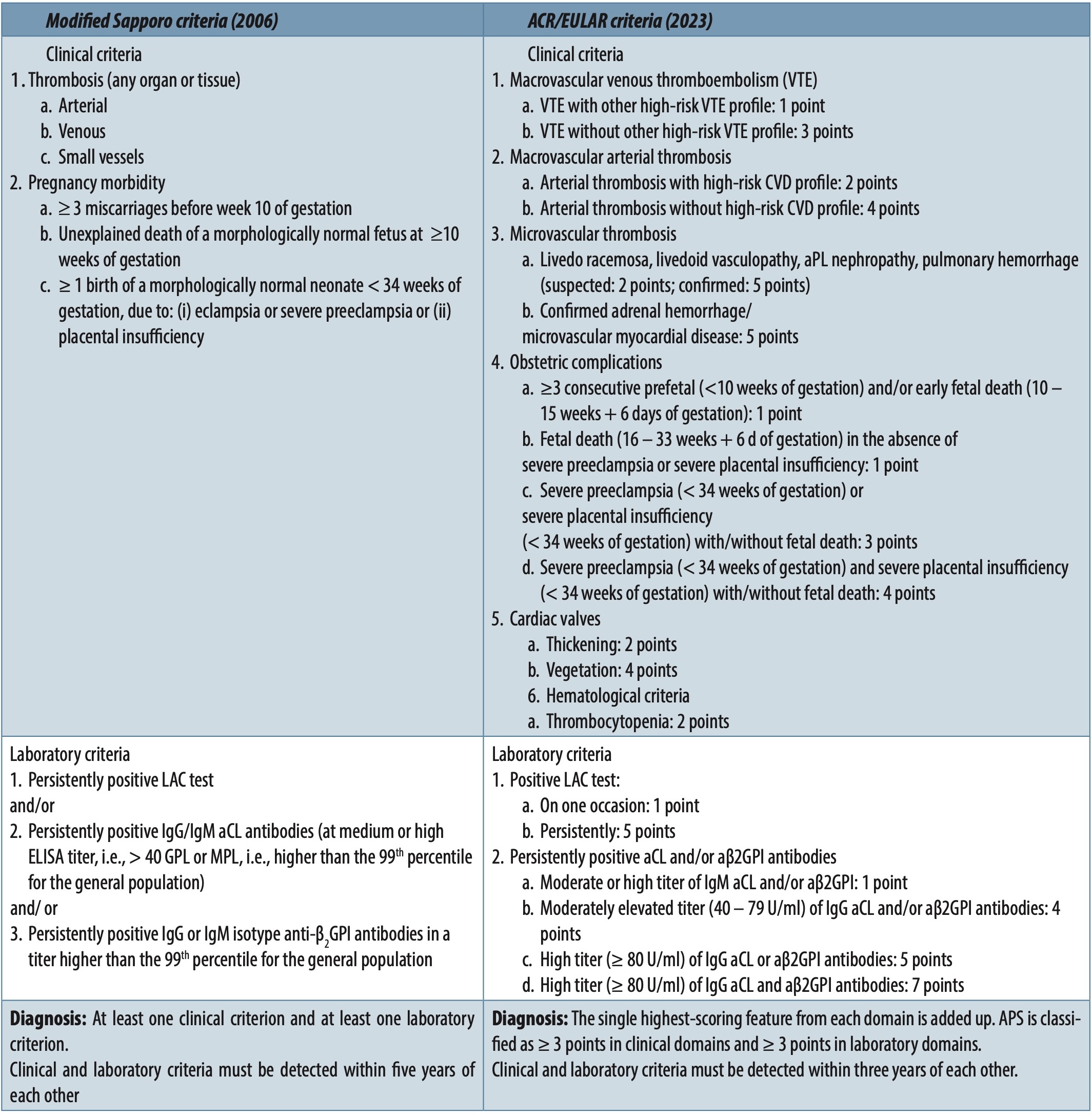
Antiphospholipid syndrome is a systemic autoimmune disease characterized by the persistent presence of aPL antibodies, on the one hand, or proven thrombosis in any part of the circulatory system and/or pregnancy pathology, on the other. The first criteria for the classification of the antiphospholipid syndrome, i.e., the Sapporo criteria, were published in 1999. They were revised in 2006 (the Sydney criteria) [11],[5]. Interestingly, according to the revised classification, numerous clinical manifestations that are known to be often associated with the presence of aPL antibodies are not included in the criteria for the recognition of definite APS. However, the classification criteria recently published by the ACR/EULAR expand the spectrum of clinical manifestations that are considered to be manifestations of the antiphospholipid syndrome [12].
According to the ACR/EULAR criteria, six clinical domains (vein thrombosis, arterial thrombosis, thrombosis in the microcirculation, obstetric complications, heart valve changes, and hematological manifestations) and two laboratory domains are scored. As compared to the modified Sapporo classification, wherein all criteria carry the same weight, in the ACR/ EULAR classification, the criteria are ranked according to significance based on specificity for the presence of APS. Thus, for example, in the obstetric criteria, the occurrence of ≥ 3 consecutive pregnancy losses before week 10 of gestation is scored with one point and is less significant than severe placental insufficiency before week 34 of gestation, which is scored with four points. A definitive diagnosis is obtained by summing up the points of individual clinical and laboratory criteria, whereby at least three clinical and three laboratory points are necessary for a definitive diagnosis of APS. The primary goal of the ACR/EULAR classification is to improve the specificity in detecting APS, in order to form more homogeneous groups of patients for clinical studies. However, in this way, the sensitivity in recognizing APS is significantly reduced, i.e., the probability of not recognizing the disease in an individual patient increases. Table 1 compares the criteria for detecting APS according to the revised Sapporo and the new ACR/EULAR classification.
THROMBOSIS OF LARGE BLOOD VESSELS
Unlike congenital thrombophilia, thrombosis associated with aPL antibodies can occur in any part of the circulatory system, i.e., in the veins and arteries, and as microvascular thrombosis. Deep vein thrombosis of the lower extremities, with or without pulmonary embolism, is the most typical clinical manifestation of the antiphospholipid syndrome. In one meta-analysis, it was shown that the presence of aPL antibodies can be detected in approximately 10% of patients with deep vein thrombosis [13]. Patients with thrombosis and aPL antibodies are at high risk of thrombosis recurrence after anticoagulant therapy is discontinued. The mortality in such patients was shown to be significantly higher, as compared to people with thrombosis but without aPL antibodies, during a four-year follow-up [14].
Cerebral infarction and transient ischemic attack (TIA) are the most common manifestations of arterial thrombosis in patients with APS [15]. The association between cerebral infarction and the presence of aPL antibodies is stronger in younger people than in older people, and it is possible that ethnic factors also play an important role, whereby cerebral infarction is especially common in patients of Asian descent. In a Japanese study, 61% of patients with APL syndrome presented with cerebral infarction. It should be noted that cerebral infarction or transient ischemic attack can also be the consequence of embolization originating from malformed aortic or mitral valves, which is not a rare finding in patients with aPL antibodies.
Myocardial infarction is not a common manifestation of the antiphospholipid syndrome. In a recent study, the presence of aPL antibodies was found in 11% of a total of 805 consecutive patients younger than 75 years who had suffered their first myocardial infarction and in 1% of a total of 805 healthy individuals [16]. In addition, it has been shown that the presence of antiphospholipid antibodies increases the risk of recurrent ischemic events in patients with coronary disease [17].
PREGNANCY PATHOLOGY
Complications in pregnancy are a frequent manifestation of the presence of aPL antibodies in women of reproductive age. The most common but least specific obstetric manifestation is repeated pregnancy loss before week ten of gestation. Later fetal losses as well as placental insufficiency causing delivery before week 34 of pregnancy strongly indicate the presence of aPL antibodies. In women with aPL antibodies, there is an increased risk of placental abruption and the development of HELLP syndrome (Hemolysis, Elevated Liver enzyme levels, and Low Platelet levels).
Interestingly, a significant number of women with aPL antibodies show a marked tendency towards obstetric complications without manifesting a tendency to thrombosis, so some authors use the terms “obstetric APL syndrome” and “thrombotic APL syndrome”, but there are still no clear pathophysiological criteria for this categorization [18].
THROMBOSIS IN THE MICROCIRCULATION
Small blood vessel thrombosis in various organs occurs in approximately 12% of patients with APS and is less common than arterial and venous thrombosis [19]. It is most often proven with pathohistological examination and is the dominant finding in patients with catastrophic antiphospholipid syndrome. It can manifest in many organs, but the skin and kidneys are most often affected. In the skin, microthrombosis can occur as livedoid vasculopathy, superficial gangrene, subacute nodules, or ecchymosis. In the heart and brain, microthrombosis can result in microthrombi and microinfarcts, while, in the lungs, it can result in alveolar hemorrhage or acute respiratory distress syndrome. Microthrombosis in the kidneys manifests as acute renal failure, hypertension, or thrombotic microangiopathy. Infarctions of the intestine, liver, spleen, or pancreas can be manifestations of small blood vessel thrombosis in these organs. Thrombus formation can also occur in the small vessels of the retina with signs of retinal vasculopathy.
SKIN LESIONS IN PATIENTS WITH APL ANTIBODIES
In patients with aPL antibodies, the skin is often affected. Livedo reticularis is the most common skin change in patients with APS and is present in approximately 24% of patients with this disease. This is why its presence should always raise suspicion of APS. However, due to low specificity, livedo reticularis is not included in the clinical criteria of APS according to the new ACR/ EULAR classification [15]. In some patients, aPL antibodies are associated with leg ulcers, gangrene of the distal parts of the fingers, and pseudovasculitis. Interestingly, the presence of aPL antibodies can be found in approximately 50% of patients with the so-called Sneddon syndrome, which implies the existence of livedo racemosa-type skin changes and repeated TIA or brain infarction. Livedo racemosa is morphologically similar to livedo reticularis and is a purple, symmetrical, net pattern on the skin of the trunk that does not disappear when the skin is warmed up. In a significant percentage of patients with the Sneddon syndrome, arterial hypertension and valvular heart defects are also present [20].
CARDIOLOGICAL MANIFESTATIONS
Malformations of heart valves, in terms of valve thickening, valve dysfunction, or the presence of vegetation can be found in approximately 14% of patients with APS [15]. In patients with systemic lupus erythematosus (SEL) and antiphospholipid antibodies, valve pathology is more common than in patients without SEL. In the latest ACR/EULAR classification, heart valve malformations are included as clinical criteria for recognizing APS.
HEMATOLOGICAL MANIFESTATIONS
Thrombocytopenia is the most common hematological finding in patients with APS, which, due to its non-specificity, was not recognized as a criterion in the revised Sapporo classification. A platelet count below 100 x 109 /L is present in approximately 30% of patients with APS, with a higher frequency of thrombocytopenia in patients with secondary APS than in those with primary APS. Thrombocytopenia is most often moderate with a platelet count of 50 - 100 x 109 /L. Interestingly, the presence of aPL antibodies can be demonstrated in approximately 40% of patients with primary immune thrombocytopenia, without other criteria for APS [15]. Autoimmune hemolytic anemia can be found in about 10% of patients with APS. The finding of non-immunological hemolytic anemia in patients with APS may indicate mechanical hemolysis as a part of catastrophic antiphospholipid syndrome.
RENAL MANIFESTATIONS
Renal manifestations, in the form of nephropathy accompanying APS, are mainly the result of thrombotic microangiopathy. They most often manifest as arterial hypertension, nephrotic syndrome, or, more commonly, subnephrotic proteinuria and renal insufficiency. Hyperplasia and fibrosis of the intima, focal cortical atrophy, and occlusion of small arteries are observed during pathohistological examination [21].
CENTRAL NERVOUS SYSTEM MANIFESTATIONS
In addition to transient ischemic attack, cerebral infarction, and cerebral venous thrombosis, which are included in the classification criteria of both the revised Sapporo and ACR/EULAE classifications, the presence of antiphospholipid antibodies may be associated with epilepsy, migraine, and chorea. Rare manifestations include amaurosis fugax and transverse myelitis [12].
CATASTROPHIC ANTIPHOSPHOLIPID SYNDROME
Acute exacerbation of the prothrombotic state in the blood with the appearance of microthrombosis in multiple organs in patients with aPL antibodies is called catastrophic APS. It occurs in approximately 1% of patients with APS and is most often triggered by an infection, surgical or other invasive procedures, or discontinuation of anticoagulant therapy. Catastrophic APS is characterized by rapidly occurring failure of multiple organs, with the lung function being the one most commonly compromised (24% of patients), followed by the central nervous system (18% of patients), and the kidneys (18% of patients) [22]. Catastrophic APS is a life-threatening condition and, despite the administration of therapy, mortality in this disease is still around 30%.
CONCLUSION
Antiphospholipid antibodies are associated with a wide range of clinical manifestations in almost all medical fields. Various forms of thrombosis and the development of complications in pregnancy are the most typical manifestations and represent clinical criteria for determining the presence of antiphospholipid syndrome in persons with aPL antibodies. On the other hand, the association of aPL antibodies with numerous other clinical manifestations that do not represent official criteria in the classification of APS is not always clear and consistent. However, recognizing these manifestations is still of great significance because it draws attention to the possible presence of aPL antibodies and indicates the need for a detailed analysis of the presence of other laboratory and clinical criteria proving the existence of antiphospholipid syndrome. Although the latest classification of APS recommended by ACR/EULAR adopted additional clinical criteria that did not exist in the previous classification, it should be noted that all currently valid recommendations for the treatment of APS were made based on the previous criteria, i.e., the revised Sapporo criteria. Therefore, the ACR/EULAR classification criteria, which are primarily intended for the selection of patients in clinical studies, should not as yet be used in the diagnosis of antiphospholipid syndrome in individual patients in daily practice.
ABBREVIATIONS AND ACRONYMS
aPL antibodies – antiphospholipid antibodies
APS – antiphospholipid syndrome
ACR/EULAR – American College of Rheumatology/European Alliance of Associations for Rheumatology
SEL – systemic lupus erythematosus
LAC – lupus anticoagulant
ELISA – enzyme-linked immunosorbent assay
aCL antibodies – anticardiolipin antibodies
β2GPI – beta 2 glycoprotein I
HELLP syndrome – Hemolysis, Elevated Liver enzyme levels, and Low Platelet levels
TIA – transient ischemic attack
Informations

-
Keywords:
-
Received:
-
Revised:
-
Accepted:
-
Online first:
-
DOI:
-
Cite this article:

Predrag Miljić
Clinic for Hematology, University Clinical Center of Serbia
2 Koste Todorovića Street, 11000 Belgrade, Serbia
E-mail:
1. Levine JS, Branch DW, Rauch J. The antiphospholipid syndrome. N Engl J Med. 2002 Mar 7;346(10):752-63. doi: 10.1056/NEJMra002974. [CROSSREF]
2. Svenungsson E, Antovic A. The antiphospholipid syndrome - often overlooked cause of vascular occlusions? J Intern Med. 2020 Apr;287(4):349-372. doi: 10.1111/joim.13022. [CROSSREF]
3. Devreese K, Hoylaerts MF. Laboratory diagnosis of the antiphospholipid syndrome: a plethora of obstacles to overcome. Eur J Haematol. 2009 Jul;83(1):1- 16. doi: 10.1111/j.1600-0609.2009.01243.x. [CROSSREF]
4. Uthman IW, Gharavi AE. Viral infections and antiphospholipid antibodies. Semin Arthritis Rheum. 2002 Feb;31(4):256-63. doi: 10.1053/sarh.2002.28303. [CROSSREF]
5. Miyakis S, Lockshin MD, Atsumi T, Branch DW, Brey RL, Cervera R, et al. International consensus statement on an update of the classification criteria for definite antiphospholipid syndrome (APS). J Thromb Haemost. 2006 Feb;4(2):295-306. doi: 10.1111/j.1538-7836.2006.01753.x. [CROSSREF]
6. Devreese K, Hoylaerts MF. Challenges in the diagnosis of the antiphospholipid syndrome. Clin Chem. 2010 Jun;56(6):930-40. doi: 10.1373/clinchem.2009.133678. [CROSSREF]
7. Pengo V, Ruffatti A, Legnani C, Testa S, Fierro T, Marongiu F, et al. Incidence of a first thromboembolic event in asymptomatic carriers of high-risk antiphospholipid antibody profile: a multicenter prospective study. Blood. 2011 Oct 27;118(17):4714-8. doi: 10.1182/blood-2011-03-340232. [CROSSREF]
8. Pengo V, Ruffatti A, Tonello M, Cuffaro S, Banzato A, Bison E, et al. Antiphospholipid syndrome: antibodies to Domain 1 of β2-glycoprotein 1 correctly classify patients at risk. J Thromb Haemost. 2015 May;13(5):782-7. doi: 10.1111/ jth.12865. [CROSSREF]
9. Petri M. Epidemiology of the antiphospholipid antibody syndrome. J Autoimmun. 2000 Sep;15(2):145-51. doi: 10.1006/jaut.2000.0409. [CROSSREF]
10. Meroni PL, Mari D, Monti D, Coppola R, Capri M, Salvioli S, et al. Anti-beta 2 glycoprotein I antibodies in centenarians. Exp Gerontol. 2004 Oct;39(10):1459-65. doi: 10.1016/j.exger.2004.08.003. [CROSSREF]
11. Wilson WA, Gharavi AE, Koike T, Lockshin MD, Branch DW, Piette JC, et al. International consensus statement on preliminary classification criteria for definite antiphospholipid syndrome: report of an international workshop. Arthritis Rheum. 1999 Jul;42(7):1309-11. doi: 10.1002/1529-0131(199907)42:73.0.CO;2-F. [CROSSREF]
12. Barbhaiya M, Zuily S, Naden R, Hendry A, Manneville F, Amigo MC, et al.; ACR/ EULAR APS Classification Criteria Collaborators. The 2023 ACR/EULAR Antiphospholipid Syndrome Classification Criteria. Arthritis Rheumatol. 2023 Oct;75(10):1687-1702. doi: 10.1002/art.42624. [CROSSREF]
13. Andreoli L, Chighizola CB, Banzato A, Pons-Estel GJ, Ramire de Jesus G, Erkan D. Estimated frequency of antiphospholipid antibodies in patients with pregnancy morbidity, stroke, myocardial infarction, and deep vein thrombosis: a critical review of the literature. Arthritis Care Res (Hoboken). 2013 Nov;65(11):1869-73. doi: 10.1002/acr.22066. [CROSSREF]
14. Schulman S, Svenungsson E, Granqvist S. Anticardiolipin antibodies predict early recurrence of thromboembolism and death among patients with venous thromboembolism following anticoagulant therapy. Duration of Anticoagulation Study Group. Am J Med. 1998 Apr;104(4):332-8. doi: 10.1016/ s0002-9343(98)00060-6. [CROSSREF]
15. Cervera R, Piette JC, Font J, Khamashta MA, Shoenfeld Y, Camps MT, et al.; Euro-Phospholipid Project Group. Antiphospholipid syndrome: clinical and immunologic manifestations and patterns of disease expression in a cohort of 1,000 patients. Arthritis Rheum. 2002 Apr;46(4):1019-27. doi: 10.1002/ art.10187. [CROSSREF]
16. Grosso G, Sippl N, Kjellström B, Amara K, de Faire U, Elvin K, et al. Antiphospholipid Antibodies in Patients With Myocardial Infarction. Ann Intern Med. 2019 Feb 19;170(4):277-280. doi: 10.7326/M18-2130. [CROSSREF]
17. Pastori D, Bucci T, Triggiani M, Ames PRJ, Parrotto S, Violi F, et al. Immunoglobulin G (IgG) anticardiolipin antibodies and recurrent cardiovascular events. A systematic review and Bayesian meta-regression analysis. Autoimmun Rev. 2019 May;18(5):519-525. doi: 10.1016/j.autrev.2019.03.005. [CROSSREF]
18. Di Simone N, Luigi MP, Marco D, Fiorella DN, Silvia D, Clara DM, et al. Pregnancies complicated with antiphospholipid syndrome: the pathogenic mechanism of antiphospholipid antibodies: a review of the literature. Ann N Y Acad Sci. 2007 Jun;1108:505-14. doi: 10.1196/annals.1422.054. [CROSSREF]
19. Sevim E, Zisa D, Andrade D, Sciascia S, Pengo V, Tektonidou MG, et al.; APS ACTION Investigators. Characteristics of Patients With Antiphospholipid Antibody Positivity in the APS ACTION International Clinical Database and Repository. Arthritis Care Res (Hoboken). 2022 Feb;74(2):324-335. doi: 10.1002/ acr.24468. [CROSSREF]
20. Samanta D, Cobb S, Arya K. Sneddon Syndrome: A Comprehensive Overview. J Stroke Cerebrovasc Dis. 2019 Aug;28(8):2098-2108. doi: 10.1016/j.jstrokecerebrovasdis.2019.05.013. [CROSSREF]
21. Bienaimé F, Legendre C, Terzi F, Canaud G. Antiphospholipid syndrome and kidney disease. Kidney Int. 2017 Jan;91(1):34-44. doi: 10.1016/j. kint.2016.06.026. [CROSSREF]
22. Cervera R, Bucciarelli S, Plasín MA, Gómez-Puerta JA, Plaza J, Pons-Estel G, et al.; Catastrophic Antiphospholipid Syndrome (CAPS) Registry Project Group (European Forum On Antiphospholipid Antibodies). Catastrophic antiphospholipid syndrome (CAPS): descriptive analysis of a series of 280 patients from the “CAPS Registry”. J Autoimmun. 2009 May-Jun;32(3-4):240-5. doi: 10.1016/j.jaut.2009.02.008. [CROSSREF]
- INTRODUCTION
- ANTIPHOSPHOLIPID ANTIBODIES
- ASYMPTOMATIC PRESENCE OF APL ANTIBODIES
- ANTIPHOSPHOLIPID SYNDROME
- THROMBOSIS OF LARGE BLOOD VESSELS
- PREGNANCY PATHOLOGY
- THROMBOSIS IN THE MICROCIRCULATION
- SKIN LESIONS IN PATIENTS WITH APL ANTIBODIES
- CARDIOLOGICAL MANIFESTATIONS
- HEMATOLOGICAL MANIFESTATIONS
- RENAL MANIFESTATIONS
- CENTRAL NERVOUS SYSTEM MANIFESTATIONS
- CATASTROPHIC ANTIPHOSPHOLIPID SYNDROME
- CONCLUSION
- ABBREVIATIONS AND ACRONYMS