


Drug-induced thrombocytopenia
- University Clinical Center of Serbia, Clinic for Hematology, Belgrade, Serbia
- University of Belgrade,Faculty of Medicine, Belgrade, Serbia
ABSTRACT
Drugs could cause thrombocytopenia, mostly in hospitalized patients. The incidence of this adverse reaction to medicines is around 10/1,000,000 inhabitants/ year. Depending on the pathophysiological mechanism, drug-induced thrombocytopenia can be classified into immune and non-immune. Drugs such as cytostatics, linezolid, ganciclovir, valacyclovir, aspirin, and vancomycin can induce a non-immune form of thrombocytopenia. They achieve this by exerting direct cytotoxic effects on megakaryocytes and platelets, or through proapoptotic mechanisms that affect platelets. On the other hand, the immune form is caused by drug-specific antibodies, which, in the presence of the drug or its metabolite, bind to platelet antigens, leading to accelerated destruction of platelets. Apart from this classic form of drug-induced immune thrombocytopenia (DITP), which is characterized by the acute onset of severe thrombocytopenia (nadir platelet counts < 20 x 109 /L) and bleeding, special forms such as heparin-induced thrombocytopenia (HIT), thrombocytopenia caused by the use of immune checkpoint inhibitors, and vaccine-induced thrombotic thrombocytopenia (VITT) are identified. HIT is the most common DITP in which nadir platelet count is usually around 60x109 /L and the clinical presentation is dominated by thrombosis (venous and less often arterial). Conversely, VITT is characterized by the onset of thrombosis and thrombocytopenia between 4 and 30 days after the administration of adenoviral vector vaccines. The mortality in this form of LITP ranges between 25% and 60%.
INTRODUCTION
Medications are a frequent cause of thrombocytopenia, particularly among hospitalized patients. Thrombocytopenia has been associated with the use of over 300 different medications, a list of which is available at “Platelets on the web” (https://www.ouhsc.edu/ platelets/ditp.html) [1]. The incidence of drug-induced thrombocytopenia is estimated at 10 cases per 1,000,000 people per year and is significantly higher in adults than in children [1]. It is believed that in intensive care units as many as 25% of patients have some form of drug-induced thrombocytopenia [2]. Drug-induced thrombocytopenia can be classified into immune and non-immune types based on its underlying mechanism [3],[4],[5].
NON-IMMUNE DRUG-INDUCED THROMBOCYTOPENIA
Drugs like cytostatics, linezolid, ganciclovir, valacyclovir, aspirin, and vancomycin can cause thrombocytopenia either through pro-apoptotic mechanisms affecting platelets or by direct cytotoxic effects on megakaryocytes and platelets [1],[3],[4]. Thrombocytopenia associated with linezolid typically occurs when the drug is administered for more than two weeks or when its blood concentrations are high. This condition results from dose-dependent, reversible myelosuppression, with thrombocytopoiesis being the most affected [6]. Conversely, cytostatics like oxaliplatin and irinotecan can cause thrombocytopenia not only through non-immune mechanisms but also via immune-mediated pathways [7],[8].
IMMUNE DRUG-INDUCED THROMBOCYTOPENIA
Drug-induced immune thrombocytopenia (DITP) is mediated by drug-specific IgG antibodies (rarely IgA or IgM), which non-covalently bind to platelet antigens via their Fab region in the presence of the drug or its metabolites. This binding accelerates platelet destruction through complement activation and/or phagocytosis. Additionally, glycoprotein (GP) complexes like GPIIb/IIIa and GPIb/IX are the most common platelet antigens involved in the classic form of drug-induced immune thrombocytopenia (DITP) (Figure 1A). Depending on the binding mechanism, there are six types of antibodies (Table 1) [4].
 4])" width="2136" height="1363">
 3])" width="2121" height="2113">
Besides heparin, which is the most frequent cause of DITP, other common causative agents include acetaminophen, abciximab, amiodarone, ampicillin, amlodipine, co-trimoxazole, carbamazepine, chlorpropamide, drospirenone, digitalis, gentamicin, eptifibatide, danazol, moxonidine, ethambutol, diclofenac, tirofiban, haloperidol, efalizumab, irinotecan, ibuprofen, piperacillin, gold preparations, phenytoin, triamterene/ hydrochlorothiazide, naproxen, hydrochlorothiazide, oxaliplatin, interferon alfa, methyldopa, nalidixic acid, quinine, quinidine, rifampin, ranitidine, sulfisoxazole, simvastatin, valproic acid, and vancomycin [4],[9]. Along with medications, certain foods, beverages, and herbal preparations can also cause DITP [10].
The onset of thrombocytopenia typically occurs within one to three days after starting the drug if it has been used before, or within 7 to 15 days if the drug is being administered for the first time [1]. Exceptions include GPIIb/IIIa antagonists (such as abciximab, tirofiban, and eptifibatide), which can cause thrombocytopenia within hours or even minutes after starting therapy [4]. However, DITP can occur even after discontinuing the drug or persist for an extended period. Examples include therapy with gold, alemtuzumab, and immune checkpoint inhibitors [4]. In a Phase 2 clinical study evaluating the efficacy and safety of alemtuzumab for treating relapsing-remitting multiple sclerosis, thrombocytopenia was observed in 6 out of 216 patients. This condition emerged 1 to 15 months after the last dose of the drug and was effectively managed with standard treatment for primary immune thrombocytopenia (ITP) [11]. It is of interest to note that cases of drug-induced immune thrombocytopenia (DITP) have also been reported long after the drug was introduced—such as five months after starting dabigatran in a patient with atrial fibrillation [12], or even ten years after beginning interferon beta-1a treatment in a patient with multiple sclerosis [13]. Conversely, the incidence of DITP associated with checkpoint blockers ranges from 0.2% to 2.8%. Severe or fatal cases are extremely rare. Most of the reported cases were associated by nivolumab and pembrolizumab. It is believed that this condition arises from the recovery of T lymphocytes during immunotherapy, which leads to the formation of autoantibodies against platelet antigens, similar to what occurs in immune thrombocytopenia (ITP) [14] (Figure1B).
CLINICAL PRESENTATION OF DRUG-INDUCED THROMBOCYTOPENIA
In drug-induced immune thrombocytopenia (DITP), thrombocytopenia typically presents acutely and can be severe, with nadir platelet counts dropping below 20 × 109 /L and potentially leading to life-threatening bleeding [1],[3],[4]. Studies have shown that 67% of patients with DITP experience bleeding, with 9% of these cases being classified as massive bleeding. Additionally, 0.8% of patients may experience fatal outcomes [15]. In heparin-induced thrombocytopenia (HIT), the lowest nadir platelet count typically reaches around 60 × 109 /L, with counts below 20 × 109 /L being rare. Instead of bleeding, HIT is primarily characterized by thromboses [16]. Life-threatening thromboses also occur in vaccine-induced thrombotic thrombocytopenia (VITT). In DITP, symptoms such as fever, hypotension, syncope, nausea, and vomiting may also occur [3],[4].
EVALUATION OF THE LIKELIHOOD OF DRUGINDUCED THROMBOCYTOPENIA
Figure 2 illustrates the algorithm for estimating the likelihood of DITP. Since specific diagnostic tests or biomarkers for drug-induced thrombocytopenia (DITP) are not routinely available, the initial step in managing DITP is to identify a suspected drug as the cause. The suspected drug should be promptly discontinued and replaced with an alternative medication of a different chemical structure. If the patient is taking multiple medications introduced simultaneously, it is advisable to adjust the entire therapy regimen [4]. Since platelet count recovery typically occurs within an average of 7 days (range: 1-15 days), and if hemorrhagic symptoms are present, the use of corticosteroids, intravenous immunoglobulins, and therapeutic plasma exchange is recommended. Platelet transfusion should be considered only in cases of severe bleeding. However, an increase in platelet count is typically expected only after the causative agent of DITP or its metabolite has been cleared from the body, which usually occurs after 4-5 half-lives of the drug. Platelet transfusion will be ineffective as long as the drug or its metabolites remain present in the patient’s plasma [4]. On the other hand, if checkpoint blockers are the cause of DITP, dose adjustments based on platelet counts should follow the guidelines provided by the American Society of Clinical Oncology [17],[18]. In the differential diagnosis of DITP, it is important to consider immune thrombocytopenia (ITP), thrombocytopenia due to sepsis, disseminated intravascular coagulation (DIC), thrombotic thrombocytopenic purpura (TTP), and post-transfusion purpura [4]. The patient should be advised to avoid the suspected drug for life.
 4])" width="2123" height="2694">
HEPARIN-INDUCED THROMBOCYTOPENIA
HIT is an acquired prothrombotic disorder triggered by the use of heparin, whether unfractionated or low molecular weight. The incidence of HIT with low molecular weight heparin is about ten times lower compared to unfractionated heparin [16]. The pathophysiological mechanism of HIT involves the formation of antibodies, typically of the IgG class, against an immunogenic complex composed of platelet factor 4 (PF4) and heparin. The binding of this ternary complex to platelets results in their accelerated clearance, leading to thrombocytopenia. Simultaneously, it triggers platelet activation and aggregation, as well as thrombin generation. Simultaneous activation of endothelial cells and monocytes, along with the expression of tissue factor on their surfaces, further enhances thrombin generation (Figure 1C). HIT typically occurs 5-10 days after starting heparin therapy, but it can develop much earlier in patients who have received heparin within the previous three months. Rarely, HIT can also occur after stopping heparin [16],[19]. In 5-10% of patients with HIT who develop disseminated intravascular coagulation (DIC), thrombocytopenia may be more severe, with platelet counts dropping below 20 × 109 /L [16]. In addition to a 50% reduction in the highest recorded platelet count before starting heparin, 20-50% of patients may develop venous, and less frequently arterial, thrombosis within the following 30 days. HIT can also present with painful erythematous and necrotic skin changes, particularly at injection sites, as well as intracardiac thrombi and mesenteric infarcts. Symptoms such as fever, facial erythema, and transient amnesia can occur within 30 minutes after administering an intravenous bolus of heparin [16]. Merely suspending heparin in patients with HIT is inadequate; alternative anticoagulant therapy must be implemented. At the same time, severe thrombocytopenia is not a contraindication for using alternative anticoagulant therapy in HIT [16].
APPROACH TO A PATIENT WITH SUSPECTED HIT
If a patient on heparin therapy develops thrombocytopenia, the likelihood of HIT is assessed using the 4Ts score (Table 2) [16],[19].
 16])" width="2132" height="1711">
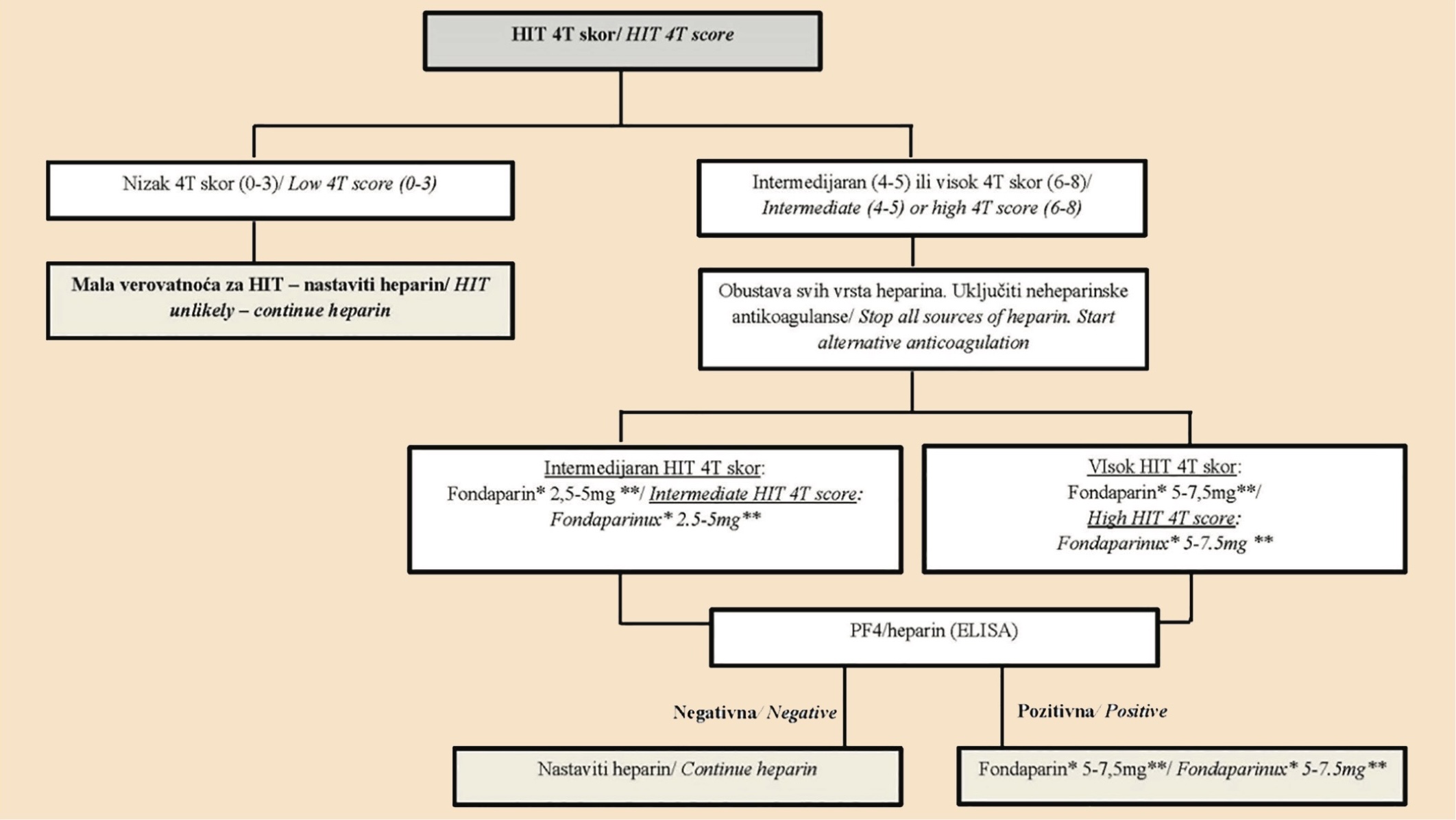
This scoring system has a moderate positive predictive value and a high negative predictive value. On the other hand, laboratory confirmation of HIT relies on detecting antibodies specific to the PF4-heparin complex. Several enzyme-linked immunosorbent assay (ELISA) tests are routinely used and have a high negative predictive value, making them effective for ruling out HIT. However, due to their low specificity, a positive test result has limited value in confirming the clinical suspicion of HIT. The approach to a patient with suspected HIT is outlined in Figure 3.
 16])" width="2124" height="1196">
If the 4Ts score is ≤ 3, the probability of HIT is considered low, so discontinuing heparin is not necessary. However, if the score is intermediate or high (≥ 4), all forms of heparin should be stopped, which includes removing venous lines and discontinuing the use of extracorporeal membrane oxygenators. In such cases, non-heparin anticoagulants (NHAs) should be introduced. It is also important to measure the titer of anti-heparin antibodies. If anti-heparin antibodies are absent, NHAs should be discontinued, and heparin administration can be resumed. If the test is positive, continue treatment with NHA [16],[19]. The choice of NHA depends on both the specific characteristics and availability of each NHA and the individual patient’s clinical condition [16].
Warfarin and other oral anticoagulants are not used in the treatment of patients with active HIT. In cases of HIT with deep vein thrombosis, particularly with an INR value > 4, there is a risk of limb gangrene due to reduced levels of protein C and elevated thrombin-antithrombin complexes. However, these drugs can be used in clinically stable patients whose thrombin generation is controlled with NHA and whose platelet count has normalized [16]. If a patient with HIT develops thrombosis, anticoagulant therapy should be continued for at least three months. Conversely, if the patient’s HIT resolves without thrombosis, treatment should be continued for four weeks [16],[19]. A patient who has been diagnosed with HIT should avoid re-exposure to heparin, unless under the supervision of a specialized medical team [20].
VACCINE-INDUCED THROMBOTIC THROMBOCYTOPENIA
VITT is characterized by the onset of thrombosis and thrombocytopenia occurring 4 to 30 days after administration of an adenoviral vector vaccine. The frequency of VITT is approximately 2.5 to 38 cases per million doses administered for the first dose of the ChAdOx1 nCoV-19 vaccine and about 1.9 cases per million for the second dose [21]. Conversely, the frequency of VITT with the Ad26.CoV2.S vaccine has been reported as 3.5 cases per million doses administered [22]. The development of VITT is believed to be primarily triggered by the generation of IgG antibodies against platelet factor 4 (PF4). This occurs due to the formation of a neoantigen on PF4 when it binds to the vaccine component. Namely, the anti-PF4 antibodies bind to PF4 on the surface of platelets, leading to platelet activation and the release of procoagulant substances (Figure 1D). Approximately two weeks after vaccination, bleeding may occur due to severe thrombocytopenia and thrombosis, commonly affecting the cerebral venous sinuses and often preceded by intense headaches. It has been proven that anti-PF4 antibodiespersist in the body of VITT patients even 12 to 15 months after vaccination [23]. Intracranial bleeding occurs in about 30% of patients, and it is often fatal. Mortality in VITT ranges from 20-60% [24],[25]. Clinically, VITT closely resembles HIT, the only difference being that the patient has not previously been exposed to heparin. In the treatment of VITT, non-heparin anticoagulants, intravenous immunoglobulins, and corticosteroids are used if the platelet count is < 50 × 109 /L. Platelet transfusions should be avoided due to the risk of exacerbating thrombosis.
Informations

-
Keywords:
-
Received:
-
Revised:
-
Accepted:
-
Online first:
-
DOI:
-
Cite this article:

Nada Suvajdžić-Vuković
Clinic for Hematology, University Clinical Center of Serbia
2 Dr Koste Todorovića Street, 11000 Belgrade, Serbia
E-mail:
1. Bakchoul T, Marini I. Drug-associated thrombocytopenia. Hematology Am Soc Hematol Educ Program. 2018;2018(1):576-83. doi: 10.1182/asheducation-2018.1.576. [CROSSREF]
2. Priziola JL, Smythe MA, Dager WE. Drug-induced thrombocytopenia in critically ill patients. Crit Care Med. 2010;38(6 Suppl):S145-54. doi: 10.1097/ CCM.0b013e3181de0b88. [CROSSREF]
3. Marini I, Uzun G, Jamal K, Bakchoul T. Treatment of drug-induced immune thrombocytopenias. Haematologica. 2022;107(6):1264-77 doi: 10.3324/haematol.2021.279484. [CROSSREF]
4. Arnold DM, Cuker A. Drug-induced immune thrombocytopenia. UpToDate. Waltham: UpToDate Inc. 2023. [Cited 2024 June 26].
5. Suvajdžić-Vuković N. Trombocitopenija i trombocitoza. U: Konsultativna hematologija. Antić D, Krstovski N, urednici. Beograd: Medicinski fakultet Univerziteta u Beogradu; 2023. str. 26-39.
6. Gerson SL, Kaplan SL, Bruss JB, Le V, Arellano FM, Hafkin B, et al. Hematologic effects of linezolid: summary of clinical experience. Antimicrob Agents Chemother. 2002;46(8):2723-6. doi: 10.1128/AAC.46.8.2723-2726.2002. [CROSSREF]
7. Curtis BR, Kaliszewski J, Marques MB, Saif MW, Nabelle L, Blank J, et al. Immune-mediated thrombocytopenia resulting from sensitivity to oxaliplatin. Am J Hematol. 2006;81(3):193-8. doi: 10.1002/ajh.20516. [CROSSREF]
8. Mirtsching BC, George JN, Aster RH, Curtis BR. Irinotecan-induced immune thrombocytopenia. Am J Med Sci. 2014;347(2):167-9. doi: 10.1097/ MAJ.0000000000000243. [CROSSREF]
9. Cvetković Z, Suvajdžić-Vuković N, Todorović Z, Panić M, Nešković A. Simvastatin and amlodipine induced thrombocytopenia in the same patient: double trouble and a literature review. J Clin Pharm Ther. 2013;38(3):246-8. doi: 10.1111/jcpt.12051. [CROSSREF]
10. Royer DJ, George JN, Terrell DR. Thrombocytopenia as an adverse effect of complementary and alternative medicines, herbal remedies, nutritional supplements, foods, and beverages. Eur J Haematol. 2010;84(5):421-9 doi: 10.1111/j.1600-0609.2010.01415.x. [CROSSREF]
11. Cuker A, Coles AJ, Sullivan H, Fox E, Goldberg M, Oyuela P, et al. A distinctive form of immune thrombocytopenia in a phase 2 study of alemtuzumab for the treatment of relapsing-remitting multiple sclerosis. Blood. 2011;118(24):6299-305. doi: 10.1182/blood-2011-08-371138. [CROSSREF]
12. Korać B, Juranec S, Delalić Đ, Prkačin I. Drug – induced immune thrombocytopenia - a case report. Med Jad. 2024;54:53–7. doi:10.57140/mj.54.1.8. [CROSSREF]
13. Cisarovsky C, Théaudin M, Bart PA, Stalder G, Alberio L. Severe Late-Onset Drug-Induced immune thrombocytopenia following IFN β-1a treatment: a case report of a 52-year-old woman with relapse-remitting multiple sclerosis. Case Rep Hematol. 2022;2022:2767031. doi: 10.1155/2022/2767031. [CROSSREF]
14. Moore DC, Elmes JB, Arnall JR, Strassel SA, Patel JN. PD-1/PD-L1 inhibitor-induced immune thrombocytopenia: A pharmacovigilance study and systematic review. Int Immunopharmacol. 2024;129:111606. doi: 10.1016/j. intimp.2024. [CROSSREF]
15. George JN, Raskob GE, Shah SR, Rizvi MA, Hamilton SA, Osborne S, et al. Drug-induced thrombocytopenia: a systematic review of published case reports. Ann Intern Med. 1998;129(11):886-90. doi: 10.7326/0003-4819-129- 11_part_1-199812010-00009. [CROSSREF]
16. Crowther M, Pishko A. Management of heparin-induced thrombocytopenia. In: UpToDate. Leung LLK, editor. Wolters Kluwer. [Cited 2024 June 28].
17. Schneider BJ, Naidoo J, Santomasso BD, Lacchetti C, Adkins S, Anadkat M, et al. Management of immune-related adverse events in patients treated with immune checkpoint inhibitor therapy: ASCO Guideline Update. J Clin Oncol. 2021;39(36):4073-4126. doi: 10.1200/JCO.21.01440. [CROSSREF]
18. Brahmer JR, Lacchetti C, Schneider BJ, Atkins MB, Brassil KJ, Caterino JM, et al. Management of immune-related adverse events in patients treated with immune checkpoint inhibitor therapy: American society of clinical oncology clinical practice guideline. J Clin Oncol. 2018;36(17):1714-68. doi: 10.1200/ JCO.2017.77.6385 [CROSSREF]
19. Arachchillage DJ, Thachil J, Anderson JAM, Baker P, Poles A, Kitchen S, et al. Diagnosis and management of heparin-induced thrombocytopenia: Third edition. Br J Haematol. 2024;204(2):459–475. https://doi.org/10.1111/bjh.19180 [CROSSREF]
20. Mitrović M, Pantić N. Thrombocytopenia and COVID-19: Differential diagnosis and therapy. Serbian Journal of the Medical Chamber. 2022;3(1):87-99. doi: 10.5937/smclk3-35382 [CROSSREF]
21. Faghihi H, Mottaghi-Dastjerdi N, Sharifzadeh M, Rahimi Kakavandi N. ChAdOx1 nCoV-19 vaccine and thrombosis with thrombocytopenia syndrome among adults: A systematic review. Adv Pharm Bull. 2023;13(4):723-35. doi: 10.34172/apb.2023.081 [CROSSREF]
22. Zidan A, Noureldin A, Kumar SA, Elsebaie A, Othman M. COVID-19 vaccine-associated immune thrombosis and thrombocytopenia (VITT): Diagnostic discrepancies and global implications. Semin Thromb Hemost. 2023;49(1):9- 14. doi: 10.1055/s-0042-1759684. [CROSSREF]
23. Lotti E, Gori AM, Berteotti M, Rogolino A, Cesari F, Poli D, et al. Natural history of anti-PF4 antibodies in patients with vaccine-induced immune thrombocytopenia and thrombosis. Blood Transfus. 2024;22(3):246-252. doi: 10.2450/BloodTransfus.
24. Elberry MH, Abdelgawad HAH, Hamdallah A, Abdella WS, Ahmed AS, Ghaith HS, et al. A systematic review of vaccine-induced thrombotic thrombocytopenia in individuals who received COVID-19 adenoviral-vector-based vaccines. J Thromb Thrombolysis. 2022;53(4):798-823. doi: 10.1007/s11239-021- 02626-w. [CROSSREF]
25. Cvetković M, Pantić N, Virijević M, Pravdić Z, Sabljić N, Mitrović M, et al. Relapse of Evans syndrome following BNT162b2 (Pfizer-BioNTech) COVID-19 vaccine: case report and literature review. J Infect Dev Ctries. 2023;17(6):800-4. doi: 10.3855/jidc.17719. [CROSSREF]
- INTRODUCTION
- NON-IMMUNE DRUG-INDUCED THROMBOCYTOPENIA
- IMMUNE DRUG-INDUCED THROMBOCYTOPENIA
- CLINICAL PRESENTATION OF DRUG-INDUCED THROMBOCYTOPENIA
- EVALUATION OF THE LIKELIHOOD OF DRUGINDUCED THROMBOCYTOPENIA
- HEPARIN-INDUCED THROMBOCYTOPENIA
- APPROACH TO A PATIENT WITH SUSPECTED HIT
- VACCINE-INDUCED THROMBOTIC THROMBOCYTOPENIA
- Table 1. Drug-induced immune thrombocytopenia–mechanisms (adapted from Arnold DM, Cuker A. [4])
- Figure 1. Schematic representation of the pathophysiology of A. Druginduced thrombocytopenia (DITP) - classic; B. Immune-checkpoint inhibitor (ICI) induced thrombocytopenia; C. Heparin-induced thrombocytopenia (HIT); D. Vaccine-induced immune thrombotic thrombocytopenia (VITT). (Adapted from Marini et al. [3])
- Figure 2. Diagnostic approach and management of a patient with new-onset thrombocytopenia in whom drug-induced immune thrombocytopenia (DITP) is suspected (adapted from Arnold DM, Cuker A. [4])
- Table 2. 4Ts score for heparin-induced thrombocytopenia (HIT) (adapted from Crowther M, Pishko A. [16])
- Figure 3. SHIT protocol (adapted from Crowther M, Pishko A. [16])