


Coexistence of polycythemia vera and multiple myeloma: a case report
- University Clinical Center Kragujevac, Clinic for Hematology, Kragujevac, Serbia
ABSTRACT
Introduction: Polycythemia vera (PV) is a chronic myeloproliferative neoplasm characterized by the clonal proliferation of erythroid, myeloid, and megakaryocytic lineages, most commonly associated with the JAK2 V617F mutation. Multiple myeloma (MM), on the other hand, is a malignant plasma cell neoplasm characterized by clonal proliferation of plasma cells in the bone marrow and the secretion of monoclonal immunoglobulin. The coexistence of PV and MM in the same patient is extremely rare, as these disorders originate from distinct hematopoietic lineages.
Case report: We report the case of a patient with long-standing PV who subsequently developed MM, highlighting the diagnostic and therapeutic challenges of this unusual association.
Conclusion: The prognosis of patients with concomitant hematologic malignancies depends on the type and aggressiveness of the diseases, the clinical stage at the time of detection, and the adequacy of the therapeutic approach. This case highlights the importance of avoiding automatic attribution of new clinical symptoms to a pre-existing diagnosis. A broad differential diagnosis should always be maintained, with each new symptom evaluated individually, allowing for early recognition of additional hematologic pathology and timely initiation of appropriate treatment.
INTRODUCTION
Polycythemia vera (PV) is a myeloproliferative neoplasm distinguished by clonal erythrocytosis. Other features include leukocytosis, thrombocytosis, splenomegaly, pruritus, constitutional symptoms, microcirculatory disturbances, and an increased risk of thrombosis and progression to myelofibrosis (post-PV MF) or acute myeloid leukemia (AML) [1]. Over 95% of patients possess a JAK2 gene mutation, which helps differentiate PV from secondary erythrocytosis causes [2]. Mutations in the JAK2 kinase lead to signaling abnormalities that cause uncontrolled proliferation of erythroid progenitors. The substitution of valine with phenylalanine at position 617 of the JAK2 gene (JAK2V617F) results in constitutive activation of cytokine receptors, regardless of erythropoietin presence [3]. Besides JAK2 mutations, a smaller percentage of patients may have mutations in the TET2, DNMT3A, and ASXL1 genes, contributing to clinical heterogeneity and the risk of disease progression [4]. The clinical course of PV is chronic and slowly progressive, with major complications including thromboembolic events, transformation to post-polycythemic myelofibrosis, and acute myeloid leukemia. Significant progress has been made in developing new therapeutic approaches for patients with polycythemia vera [5],[3]. The standard treatment includes therapeutic venesection and cytoreductive therapy (hydroxyurea) [5].
Multiple myeloma (MM), on the other hand, is a malignant plasma cell disorder characterized by clonal proliferation of plasma cells within the bone marrow, leading to excessive production of monoclonal immunoglobulins (M protein), osteolytic lesions, anemia, renal impairment, and immunodeficiency [6]. Multiple myeloma accounts for approximately 10% of hematologic malignancies and represents the second most common hematologic malignancy after lymphoma [7]. The disease most commonly affects individuals older than 60 years and has a significant impact on morbidity and mortality. Genetic abnormalities, the bone marrow microenvironment, and dysregulation of signaling pathways that stimulate plasma cell survival and proliferation play a crucial role in the pathogenesis of MM [8],[9].
Polycythemia vera and multiple myeloma are chronic hematologic malignancies originating from different hematopoietic lineages–myeloid and lymphoid–which makes their coexistence in a single patient an unusual and clinically intriguing phenomenon. Despite their different origins, both diseases may share common risk factors, including exposure to ionizing radiation, chronic stimulation of hematopoietic cells, and accumulation of somatic mutations during aging [1],[6],[10]. The simultaneous or sequential occurrence of PV and MM is rare, with only a limited number of cases reported in the literature. The exact mechanisms underlying this association remain unclear [10]. This report presents a rare case of a patient initially diagnosed with polycythemia vera who subsequently developed multiple myeloma.
Our aim is to contribute to the literature on this unusual coexistence and to discuss possible pathogenetic mechanisms and clinical implications.
CASE REPORT
A 54-year-old patient was diagnosed with polycythemia vera in 2010 after a hematologic evaluation that included a bone marrow biopsy. Since diagnosis, treatment involved acetylsalicylic acid (ASA) with occasional therapeutic phlebotomy as needed to manage hematocrit levels. After five years, hydroxyurea (Litalir®) was added to the treatment plan. The disease remained clinically stable for 15 years with regular hematologic follow-up, and the patient was asymptomatic. Past medical history included arterial hypertension and multiple sclerosis, which was reported to be in remission, with no ongoing therapy besides regular neurological follow-up. In July of this year, during a routine follow-up visit, the patient reported noticing blood in the stool (hemoglobin level at that time was 120 g/L). He was referred to a gastroenterologist, and a complete diagnostic workup was performed, confirming hemorrhoids. One month later, during a scheduled follow-up, a further drop in hemoglobin to 80 g/L was observed, along with abnormalities in immunological parameters (IgG: 158.29 g/L, IgM: 0.22 g/L, C3: 0.08 g/L, C4: 0.03 g/L), as well as hyperproteinemia with preserved renal function. The patient reported general weakness, fatigue, and weight loss. Urgent hospitalization was recommended for evaluation of multiple myeloma and further management. Upon admission, the patient was afebrile and hemodynamically stable. Further diagnostic procedures were carried out during hospitalization. Bone marrow aspirate showed 8–10% plasma cells. Fluorescence in situ hybridization (FISH) testing was negative for cytogenetic abnormalities or high-risk mutations. Serum and urine protein electrophoresis revealed the presence of an M component in the IgG class (kappa light chains). Low-dose skeletal computed tomography identified multiple osteolytic lesions involving both the axial and appendicular skeleton. Immunohistochemical analysis of the bone marrow biopsy showed the following phenotype: CD71+, MPO+, CD61+, CD34+ (<5%), CD117+ (<5%), CD56+ (35%), with a clear kappa light chain restriction at a ratio of 5:1. The conclusion confirmed the simultaneous presence of polycythemia vera and multiple myeloma. During hospitalization, the patient received therapeutic plasmapheresis to manage hyperproteinemia. Following this, chemotherapy was started using the VTD protocol (bortezomib, thalidomide, dexamethasone). The patient is now on the fourth cycle of treatment, and the response to therapy and disease status will be assessed afterward.
DISCUSSION
The simultaneous occurrence of polycythemia vera and multiple myeloma is extremely rare and represents a significant diagnostic and therapeutic challenge. PV arises from a clone of myeloid stem cells and in most cases is caused by the JAK2 V617F mutation, whereas MM is a neoplasm of lymphocytes–plasma cells [3],[5]. The coexistence of multiple myeloma and polycythemia vera was first described by Lawrence and Rosenthal in 1948 [7],[8]. Similar cases to our patient have been reported, where the initial diagnosis was polycythemia followed by multiple myeloma, as well as cases where the disease sequence was reversed, with MM preceding PV [8],[11]. A case has also been documented of a female patient in whom PV and monoclonal gammopathy of undetermined significance (MGUS) were diagnosed simultaneously, later progressing to clinically evident multiple myeloma [11]. Patients were treated with hydroxyurea (HU), which was discontinued after diagnosing MM [9],[11],[12]. The treatment for multiple myeloma involved the VCD protocol (bortezomib + cyclophosphamide + dexamethasone) as the initial therapy [9],[10],[11],[12]. At the time these case reports were published, treatment response had been evaluated in two patients, both of whom were in partial remission [9],[10]. Table 1 presents the characteristics of patients diagnosed with these two malignant hematological diseases. Interestingly, all 4 reported patients were women, with a mean age of 70.75 years [9],[10],[11],[12].
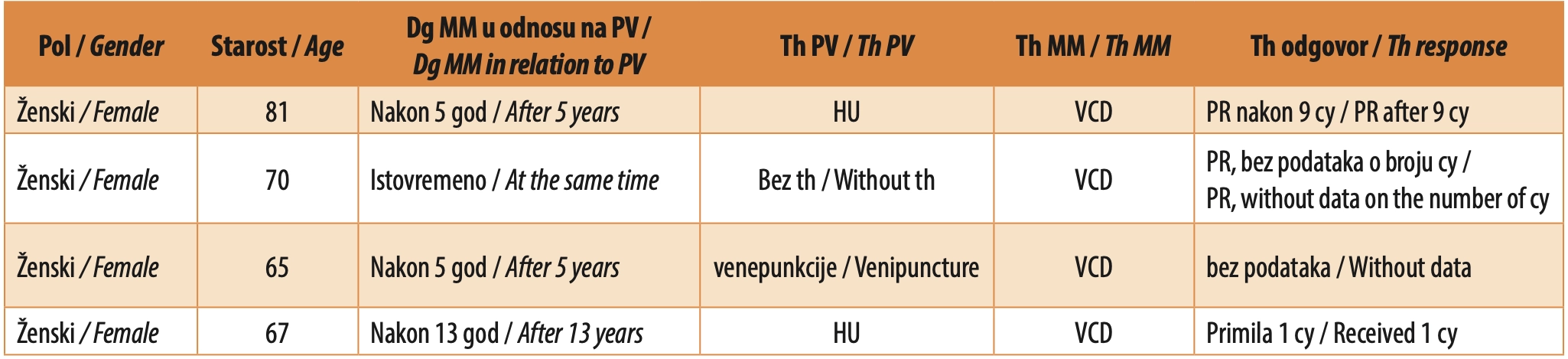
The simultaneous presence of these two diseases in a single patient suggests either the development of two independent clones or the transformation of a common progenitor cell with multipotent potential [9]. Several mechanisms have been proposed to explain this phenomenon. Some authors suggest that both disorders may originate from a common pluripotent hematopoietic stem cell capable of differentiating into both myeloid and lymphoid lineages [7]. Others propose that the coexistence may be coincidental or possibly related to therapy, particularly in patients treated with cytoreductive agents such as hydroxyurea [8]. In clinical practice, it is important to consider the potential role of prior cytoreductive therapy, which may act as an additional genotoxic stressor and promote clonal evolution [13]. It has been suggested that chronic bone marrow stimulation, activation of inflammatory cytokines, and an altered bone marrow microenvironment in PV may contribute to secondary clonal evolution and plasma cell proliferation [9]. More recent studies suggest that chronic stimulation of hematopoietic progenitors, driven by increased proliferative activity in PV, may create a microenvironment conducive to the development of secondary clonal disorders, including plasma cell dyscrasias [11],[12]. In addition, prolonged exposure to cytokines such as IL-6 and TNF-α may contribute to the activation of signaling pathways that promote plasma cell proliferation. Clinically, early detection of multiple myeloma in patients with PV can be difficult because symptoms like fatigue or lab abnormalities, such as elevated protein levels, might initially be mistaken for the underlying myeloproliferative disorder [7],[8]. From a diagnostic point of view, in a patient with known PV, the presence of hypergammaglobulinemia, renal dysfunction, or anemia that do not align with the expected disease course should raise suspicion of developing multiple myeloma [11],[13]. Recognizing this association early allows for timely targeted therapy and improved management of complications. From a treatment perspective, it is crucial to carefully balance therapies aimed at controlling erythrocytosis with those targeting plasma cell proliferation, considering potential toxicity and drug interactions [13].
This case report further highlights the importance of long-term follow-up for patients with myeloproliferative neoplasms, as clonal evolution can lead to the development of secondary malignancies. In this context, incorporating molecular diagnostics, such as JAK2 mutation analysis and detection of monoclonal paraprotein, is essential for early diagnosis and ongoing disease monitoring [10],[11],[12].
In our case, the appearance of a new clinical sign-specifically, gastrointestinal bleeding–prompted additional investigations, including routine biochemical monitoring, which was crucial in detecting hyperproteinemia and led to timely diagnostic evaluation and the identification of multiple myeloma. Managing such cases requires an individualized, multidisciplinary approach. Due to the rarity of this dual diagnosis, optimal treatment strategies and long-term outcomes have not been clearly established, and most evidence comes from isolated case reports. This case illustrates an unusual coexistence of polycythemia vera and multiple myeloma, two distinct clonal hematological disorders with different pathophysiological origins.
CONCLUSION
This case contributes to the small number of reports documenting the coexistence of polycythemia vera and multiple myeloma. It emphasizes the importance of vigilant long-term follow-up and thorough evaluation of new and unexpected signs, symptoms, and hematological or biochemical abnormalities in patients with chronic myeloproliferative neoplasms. Early recognition and timely treatment may enhance clinical outcomes and improve quality of life for these complex patients.
Informations

-
Keywords:
-
Received:
-
Revised:
-
Accepted:
-
Online first:
-
DOI:
-
Cite this article:

Sanja Aleksić
Clinic for Hematology, University Clinical Center Kragujevac
30 Zmaj Jovina Street, 34000 Kragujevac, Serbia
E-mail:
1. Tefferi A, Barbui T. Polycythemia vera: 2024 update on diagnosis, risk-stratification, and management. Am J Hematol. 2023 Sep;98(9):1465-87. doi: 10.1002/ajh.27002. [CROSSREF]
2. Tremblay D, Kremyanskaya M, Mascarenhas J, Hoffman R. Diagnosis and Treatment of Polycythemia Vera: A Review. JAMA. 2025 Jan 14;333(2):153- 60. doi: 10.1001/jama.2024.20377. [CROSSREF]
3. Lu X, Chang R. Polycythemia Vera. 2023 Apr 24. In: StatPearls [Internet]. Treasure Island (FL): StatPearls Publishing; 2025 Jan–. Available from: https://www.ncbi.nlm.nih.gov/books/NBK557660/ [HTTP]
4. Mejía-Ochoa M, Acevedo Toro PA, Cardona-Arias JA. Systematization of analytical studies of polycythemia vera, essential thrombocythemia and primary myelofibrosis, and a meta-analysis of the frequency of JAK2, CALR and MPL mutations: 2000-2018. BMC Cancer. 2019 Jun 17;19(1):590. doi: 10.1186/s12885-019-5764-4. [CROSSREF]
5. Patel AB, Masarova L, Mesa RA, Hobbs G, Pemmaraju N. Polycythemia vera: past, present and future. Leuk Lymphoma. 2024 Nov;65(11):1552-64. doi: 10.1080/10428194.2024.2361836. [CROSSREF]
6. Gay F, Marchetti E, Bertuglia G. Multiple Myeloma Unpacked. Hematol Oncol. 2025 Jun;43 Suppl 2(Suppl 2):e70067. doi: 10.1002/hon.70067. [CROSSREF]
7. Ho M, Paruzzo L, Minehart J, Nabar N, Noll JH, Luo T, et al. Extramedullary Multiple Myeloma: Challenges and Opportunities. Curr Oncol. 2025 Mar 20;32(3):182. doi: 10.3390/curroncol32030182. [CROSSREF]
8. Kimura H, Furukawa M, Mori H, Shiga Y, Asai J, Satoh K, et al. Development of multiple myeloma after 15years of treatment for polycythemia vera and successful treatment using bortezomib: A case report. Clin Case Rep. 2022 Nov 19;10(11): e6614. doi: 10.1002/ccr3.6614. [CROSSREF]
9. Cowan AJ, Green DJ, Kwok M, Lee S, Coffey DG, Holmberg LA, et al. Diagnosis and Management of Multiple Myeloma: A Review. JAMA. 2022 Feb 1;327(5):464-77. doi: 10.1001/jama.2022.0003. [CROSSREF]
10. Yuan J, Liu X, Wang Z, Li L, Wang F. Concurrent Polycythemia Vera with Newly Diagnosed Multiple Myeloma: Case Report and Literature Review. J Inflamm Res. 2023 Sep 18;16:4117-21. doi: 10.2147/JIR.S428977. [CROSSREF]
11. Landsman A, Barua P, Podrumar A. A Rare Coexistence of Multiple Myeloma and Polycythemia Vera. J Hematol. 2023 Oct;12(5):227-30. doi: 10.14740/ jh1167. [CROSSREF]
12. Xiang Q, Chu B, Lu M, Shi L, Wang Y, Fang L, et al. Coexistence of myeloproliferative neoplasms with multiple myeloma. Cancer Pathog Ther. 2023 Dec 9;2(3):212-4. doi: 10.1016/j.cpt.2023.12.001. [CROSSREF]
13. Allegra A, Pioggia G, Tonacci A, Casciaro M, Musolino C, Gangemi S. Synergic Crosstalk between Inflammation, Oxidative Stress, and Genomic Alterations in BCR-ABL-Negative Myeloproliferative Neoplasm. Antioxidants (Basel). 2020 Oct 23;9(11):1037. doi: 10.3390/antiox9111037. [CROSSREF]