


Onco-hypertension – a new clinical entity in modern medicine
- University Clinical Center of Serbia, Clinic for Cardiology, Belgrade, Serbia
ABSTRACT
Cardiovascular and oncological diseases represent an inevitable part of everyday medical practice at all levels of health care. Apart from common risk factors, these diseases are associated in other ways, and the potential cardiotoxicity of antineoplastic drugs is particularly significant. One of the frequent forms of cardiotoxicity is hypertension. Considering that it can manifest at any time during antineoplastic therapy and also after the completion of specific oncological treatment, onco-hypertension is a clinical entity that should always be kept in mind when caring for oncology patients. Regular arterial blood pressure checks in this population are necessary to ensure timely recognition and treatment of onco-hypertension and to carry out oncological treatment safely. Although the guidelines for the treatment of onco-hypertension are similar to the general recommendations for hypertension, some specificities primarily concern the choice of antihypertensive drugs and exceptions to target arterial blood pressure values depending on the stage of the oncological disease and its prognosis. It is crucial to recognize the time to stop cardiotoxic antineoplastic therapy or reduce the dose of the antineoplastic drug to avoid life-threatening cardiovascular complications. Numerous additional factors encountered in oncology patients, such as comorbidities, the presence of pain or other administered drugs, significantly contribute to the complexity of onco-hypertension. Given that this is a very sensitive population exposed to a specific type of psychological stress, the possibility of the “white coat effect” as well as masked hypertension should also be considered.
INTRODUCTION
The concept of cardiotoxicity in the context of cancer treatment was first mentioned in the early 1970s [1]. In 2020, nearly 20 million new cancer cases were diagnosed worldwide, while approximately 10 million oncology patients died during the same year [2]. Over the past 30 years, the number of patients with hypertension has doubled, reaching 1.3 billion globally in 2019 [3]. Of the approximately 20 million annual cardiovascular deaths, around 50% are directly associated with hypertension [4],[5]. Given the facts mentioned above, the first European guideline dedicated to cardio-oncology was published in 2022 [6]. Nevertheless, among all cardiovascular diseases, hypertension remains the most common comorbidity in oncology patients [7]. The prevalence of hypertension among oncology patients is about 40%, which is significantly higher than in the general population. Consequently, in recent years, the term onco-hypertension has emerged in the literature [8].
This paper examines the relationship among hypertension, malignancy, and antineoplastic therapy. An additional goal is to highlight the recommendations for the management of onco-hypertension and the specific therapeutic considerations that must be taken into account at all levels of healthcare to ensure timely and adequate patient management.
Hypertension and Malignancy
Onco-hypertension has four main aspects. Hypertension may be the cause of malignant disease [9],[10],[11],[12],[13],[14],[15], a consequence of malignancy [16],[17],[18], or the result of antineoplastic therapy [19]. Sometimes malignancy can also be linked to prior antihypertensive treatment [20],[21]. It is known that patients with hypertension have approximately twice the risk of developing renal cancer, especially when blood pressure values exceed 160/100 mmHg [9]. Among men, hypertension has been associated with colorectal and prostate cancer [13],[14], while in women it has been linked to postmenopausal breast cancer [15]. Antihypertensive therapy as a potential cause of malignancy is an area that requires further investigation. For ethical reasons, no randomized clinical trial has been designed to address this question. Currently, attention is focused on diuretics–due to a possible risk of renal cancer; thiazide diuretics–because of the increased risk of cutaneous squamous cell carcinoma; and angiotensin-converting enzyme inhibitors–due to a potential increase in lung cancer risk [20],[21],[22]. Hypertension may also occur as a consequence of malignancy itself, representing a component of paraneoplastic syndromes, such as those associated with renal cell carcinoma, hepatocellular carcinoma, soft-tissue sarcoma, and carcinoid syndrome [16],[17],[18]. However, the most prominent aspect of onco-hypertension is hypertension as a manifestation of cardiotoxicity induced by antineoplastic therapy [19],[23] (Table 1). According to literature data, 99% of children treated for malignant diseases develop at least one chronic condition during their lifetime due to prior antineoplastic therapy [19]. Moreover, individuals from this population experience, on average, 17 adverse effects of childhood antineoplastic treatment by the age of 50, of which 3–5 are severe or potentially life-threatening [19]. The prevalence of hypertension secondary to childhood antineoplastic therapy is as high as 70% by the age of 50 [19].
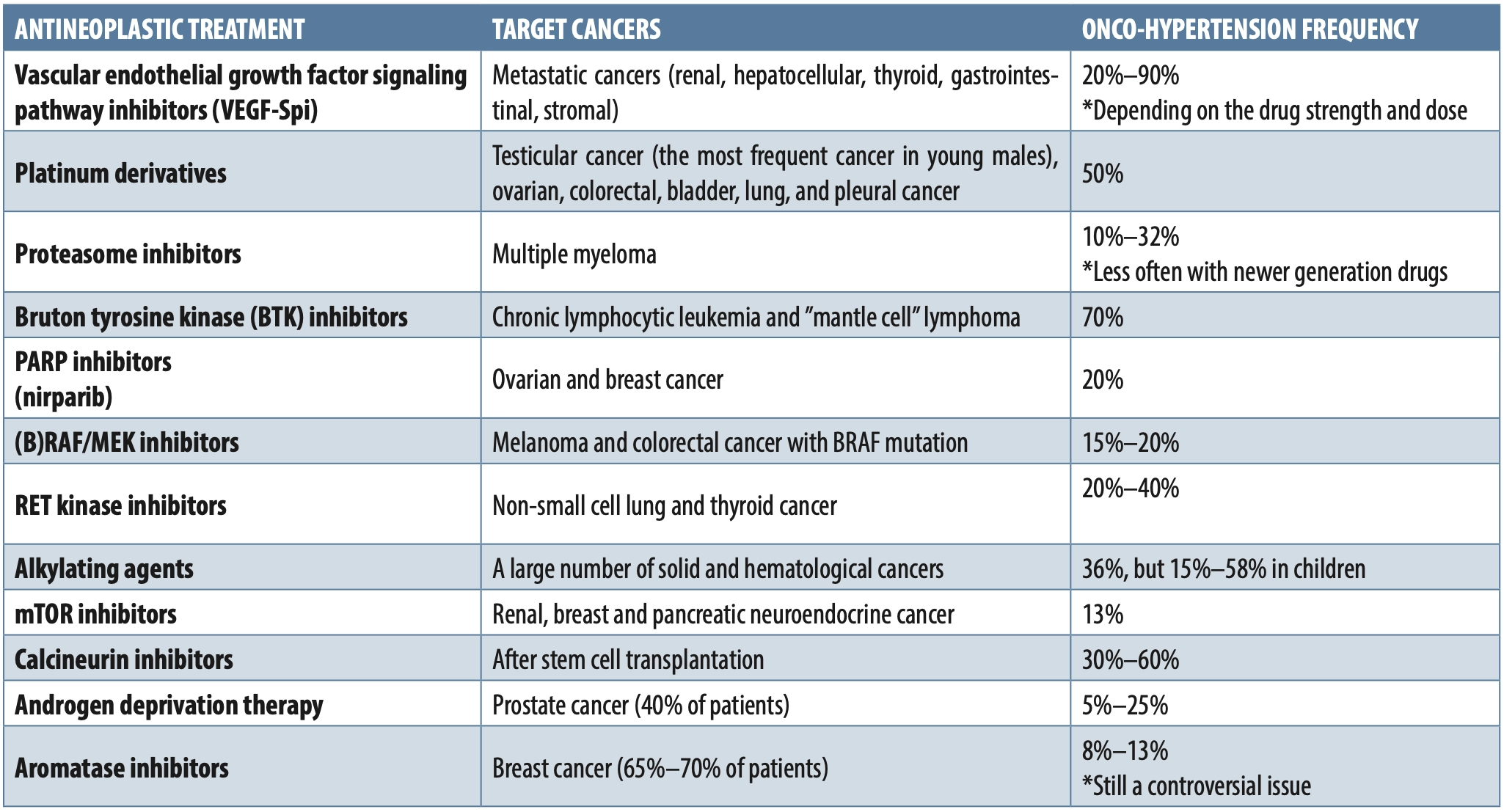
Onco-hypertension as a Consequence of Antineoplastic Therapy Cardiotoxicity
Onco-hypertension resulting from cardiotoxicity of antineoplastic therapy occurs with a frequency greater than 10% for most classes of antineoplastic drugs, categorizing it as a frequent adverse effect [24]. The mechanisms of onco-hypertension associated with antineoplastic cardiotoxicity are numerous, diverse, and only partially known. The most common mechanisms include inhibition of angiogenesis, reduction of capillary density, imbalance of vasoactive mediators (primarily decreased nitric oxide and increased endothelin-1 levels), oxidative stress, nephrotoxicity, and disturbances of the autonomic nervous system [24].
The timing of onco-hypertension as cardiotoxicity onset varies [6]. For most antineoplastic drugs, hypertension can develop at any time during therapy. Therefore, blood pressure should be measured at each clinical visit. In addition, home blood pressure monitoring is advised once weekly during the first three months of therapy, and monthly thereafter throughout treatment. This is particularly relevant for hematologic patients receiving Bruton tyrosine kinase inhibitors, as these therapies are often continued for years. However, hypertension as a consequence of antineoplastic treatment cardiotoxicity may also develop acutely, within days of treatment initiation, as is typical with vascular endothelial growth factor signaling pathway inhibitors (VEGF-SPi). For these agents, daily blood pressure monitoring is recommended during the first treatment cycle and after each dose escalation, and every 2–3 weeks thereafter. Although it has an acute onset, VEGF-SPi-induced hypertension is reversible. Also, hypertension as a consequence of cardiotoxicity of antineoplastic therapy can occur delayed, years after the initiation of treatment, as seen with platinum-based agents. Platinum becomes incorporated into DNA, and cisplatin can be detected in the bloodstream up to 13 years after exposure. Therefore, these patients require long-term follow-up and sustained blood pressure control [6].
Target Blood Pressure Values in Oncohypertension Management
In cancer patients, antihypertensive therapy is indicated when blood pressure values are ≥140/90 mmHg, that is, within grade 1 hypertension, if the malignancy is cured, if active cancer treatment is ongoing with curative intent, or in disseminated disease with an expected survival longer than three years (Class I recommendation) [6]. In patients with metastatic disease and expected survival between one and three years, grade 1 hypertension values may be considered acceptable (Class II recommendation). The same applies to patients with a poor prognosis and a life expectancy of less than 1 year (Class IIb recommendation). For most patients with onco-hypertension, target blood pressure values are < 140/90 mmHg (Class I recommendation). On the other side, lower targets (<130/80 mmHg) may be considered if well tolerated, particularly in those with high or very high cardiovascular risk (Class IIb recommendation). Absolute indication for discontinuation of antineoplastic therapy is grade III hypertension (≥180/100 mmHg). Therapy may be resumed once blood pressure is reduced below 160/100 mmHg, with mandatory consideration of antineoplastic dose reduction [6].
Choice of Antihypertensive Therapy in Oncohypertension
For patients with grade I hypertension (<160/100 mmHg), antihypertensive monotherapy is recommended [6]. First-line agents include angiotensin-converting enzyme inhibitors or angiotensin receptor blockers, while dihydropyridine calcium channel blockers are considered second-line therapy. In grade II hypertension, combination therapy is indicated, typically involving a renin–angiotensin–aldosterone system inhibitor and a calcium channel blocker, to achieve rapid and effective blood pressure control. In resistant hypertension, beta-blockers (particularly vasodilating agents such as nebivolol and carvedilol), then spironolactone, nitrates, and hydralazine should be considered. The class of drugs to be avoided in oncology patients includes non-dihydropyridine calcium channel blockers (verapamil and diltiazem). Although not absolutely contraindicated, their concomitant use with VEGF-SPi agents carries the risk of worsening hypertension due to CYP3A4-mediated pharmacokinetic interactions and increased plasma concentrations of the antineoplastic drug [6].
Additional Factors Contributing to Oncohypertension
In oncology patients, besides antineoplastic therapy, it’s necessary to be aware that numerous associated factors can affect arterial blood pressure [23],[24]. These include comorbidities (e.g., intracranial metastases), concomitant medications (such as corticosteroids used as adjuvant therapy or nonsteroidal anti-inflammatory drugs used for pain management), pain, stress, anxiety, renal dysfunction (radiation nephropathy or drug-induced nephrotoxicity), and baroreceptor insufficiency following neck or thoracic irradiation. Additionally, both “white coat effect” and masked hypertension may occur in these patients [23],[24].
CONCLUSION
Onco-hypertension represents a novel and increasingly prevalent form of hypertension, reflecting the rising incidence of cancer and the development of new antineoplastic drugs, which have cardiotoxic potential. Timely and adequate management of patients with onco-hypertension requires a thorough understanding of the cardiotoxic effects of antineoplastic therapy, along with consideration of oncological disease stage and the patient’s expected survival, to define individualized blood pressure targets. Management may be further complicated by concurrent cardiovascular diseases, additional chronic conditions, and factors that can compromise the efficacy of antihypertensive therapy. For all these reasons, hypertension in oncology patients demands an individualized and comprehensive approach that must be implemented at all levels of healthcare from primary care to specialized tertiary institutions.
Informations

-
Keywords:
-
Received:
-
Revised:
-
Accepted:
-
Online first:
-
DOI:
-
Cite this article:

Jelena Petrović
Clinic for Cardiology, University Clinical Center of Serbia
8 Dr Koste Todorovića Street, 11000 Belgrade, Serbia
E-mail:
1. Von Hoff DD, Layard MW, Basa P, Davis HL Jr, Von Hoff AL, Rozencweig M, et al. Risk factors for doxorubicin-induced congestive heart failure. Ann Intern Med. 1979;91(5):710-7. doi: 10.7326/0003-4819-91-5-710. [CROSSREF]
2. Sung H, Ferlay J, Siegel RL, Laversanne M, Soerjomataram I, Jemal A, et al. Global Cancer Statistics 2020: GLOBOCAN Estimates of Incidence and Mortality Worldwide for 36 Cancers in 185 Countries. CA Cancer J Clin. 2021;71(3):209-49. doi: 10.3322/caac.21660. [CROSSREF]
3. NCD Risk Factor Collaboration (NCD-RisC). Worldwide trends in hypertension prevalence and progress in treatment and control from 1990 to 2019: a pooled analysis of 1201 population-representative studies with 104 million participants. Lancet. 2021;398(10304):957-80. doi: 10.1016/S0140-6736(21)01330-1. [CROSSREF] Erratum in: Lancet. 2022;399(10324):520. doi: 10.1016/S0140-6736(22)00061-7. [CROSSREF]
4. World Health Organization. Cardiovascular diseases (CVDs) [Internet]. Geneva: World Health Organization; 2025 [cited 2025 Sep 27]. Available from: https://www.who.int/news-room/fact-sheets/detail/cardiovascular-diseases-(cvds) [HTTP]
5. World Health Organization. Hypertension [Internet]. Geneva: World Health Organization; 2025 [cited 2025 Sep 27]. Available from: https://www.who.int/news-room/fact-sheets/detail/hypertension [HTTP]
6. Lyon AR, López-Fernández T, Couch LS, Asteggiano R, Aznar MC, Bergler-Klein J, et al; ESC Scientific Document Group. 2022 ESC Guidelines on cardio-oncology developed in collaboration with the European Hematology Association (EHA), the European Society for Therapeutic Radiology and Oncology (ESTRO) and the International Cardio-Oncology Society (IC-OS). Eur Heart J. 2022;43(41):4229-361. doi: 10.1093/eurheartj/ehac244. Erratum in: Eur Heart J. 2023;44(18):1621. doi: 10.1093/eurheartj/ehad196. [CROSSREF]
7. Piccirillo JF, Tierney RM, Costas I, Grove L, Spitznagel EL Jr. Prognostic importance of comorbidity in a hospital-based cancer registry. JAMA. 2004;291(20):2441-7. doi: 10.1001/jama.291.20.2441. [CROSSREF]
8. Kidoguchi S, Sugano N, Tokudome G, Yokoo T, Yano Y, Hatake K, et al. New Concept of Onco-Hypertension and Future Perspectives. Hypertension. 2021;77(1):16-27. doi: 10.1161/HYPERTENSIONAHA.120.16044. [CROSSREF]
9. Weikert S, Boeing H, Pischon T, Weikert C, Olsen A, Tjonneland A, et al. Blood pressure and risk of renal cell carcinoma in the European prospective investigation into cancer and nutrition. Am J Epidemiol. 2008;167(4):438-46. doi: 10.1093/aje/kwm321. [CROSSREF]
10. Stocks T, Van Hemelrijck M, Manjer J, Bjørge T, Ulmer H, Hallmans G, et al. Blood pressure and risk of cancer incidence and mortality in the Metabolic Syndrome and Cancer Project. Hypertension. 2012;59(4):802-10. doi: 10.1161/HYPERTENSIONAHA.111.189258. [CROSSREF]
11. Radišauskas R, Kuzmickienė I, Milinavičienė E, Everatt R. Hypertension, serum lipids and cancer risk: A review of epidemiological evidence. Medicina (Kaunas). 2016;52(2):89-98. doi: 10.1016/j.medici.2016.03.002. [CROSSREF]
12. Kim CS, Han KD, Choi HS, Bae EH, Ma SK, Kim SW. Association of Hypertension and Blood Pressure with Kidney Cancer Risk: A Nationwide Population-Based Cohort Study. Hypertension. 2020;75(6):1439-46. doi: 10.1161/HYPERTENSIONAHA.120.14820. [CROSSREF]
13. Xuan K, Zhao T, Sun C, Patel AS, Liu H, Chen X, et al. The association between hypertension and colorectal cancer: a meta-analysis of observational studies. Eur J Cancer Prev. 2021;30(1):84-96. doi: 10.1097/CEJ.0000000000000578. [CROSSREF]
14. Liang Z, Xie B, Li J, Wang X, Wang S, Meng S, et al. Hypertension and risk of prostate cancer: a systematic review and meta-analysis. Sci Rep. 2016;6:31358. doi: 10.1038/srep31358. [CROSSREF]
15. Han H, Guo W, Shi W, Yu Y, Zhang Y, Ye X, et al. Hypertension and breast cancer risk: a systematic review and meta-analysis. Sci Rep. 2017;7:44877. doi: 10.1038/srep44877. [CROSSREF]
16. Arai H, Saitoh S, Matsumoto T, Makita F, Mitsugi S, Yuasa K, et al. Hypertension as a paraneoplastic syndrome in hepatocellular carcinoma. J Gastroenterol. 1999;34(4):530-4. doi: 10.1007/s005350050309. [CROSSREF]
17. van der Horst-Schrivers AN, Wymenga AN, Links TP, Willemse PH, Kema IP, de Vries EG. Complications of midgut carcinoid tumors and carcinoid syndrome. Neuroendocrinology. 2004;80 Suppl 1:28-32. doi: 10.1159/000080737. [CROSSREF]
18. Ikuerowo SO, Ojewuyi OO, Omisanjo OA, Abolarinwa AA, Bioku MJ, Doherty AF. Paraneoplastic syndromes and oncological outcomes in renal cancer. Niger J Clin Pract. 2019;22(9):1271-5. doi: 10.4103/njcp.njcp_35_19. [CROSSREF]
19. Gibson TM, Li Z, Green DM, Armstrong GT, Mulrooney DA, Srivastava D, et al. Blood Pressure Status in Adult Survivors of Childhood Cancer: A Report from the St. Jude Lifetime Cohort Study. Cancer Epidemiol Biomarkers Prev. 2017;26(12):1705-13. doi: 10.1158/1055-9965.EPI-17-0510. [CROSSREF]
20. Hashizume H, Nakatani E, Sasaki H, Miyachi Y. Hydrochlorothiazide increases risk of nonmelanoma skin cancer in an elderly Japanese cohort with hypertension: The Shizuoka study. JAAD Int. 2023;12:49-57. doi: 10.1016/j.jdin.2023.04.007. [CROSSREF]
21. Hicks BM, Filion KB, Yin H, Sakr L, Udell JA, Azoulay L. Angiotensin converting enzyme inhibitors and risk of lung cancer: population-based cohort study. BMJ. 2018;363:k4209. doi: 10.1136/bmj.k4209. [CROSSREF]
22. Xie Y, Xu P, Wang M, Zheng Y, Tian T, Yang S, et al. Antihypertensive medications are associated with the risk of kidney and bladder cancer: a systematic review and meta-analysis. Aging (Albany NY). 2020;12(2):1545-62. doi: 10.18632/aging.102699. [CROSSREF]
23. Cohen JB, Brown NJ, Brown SA, Dent S, van Dorst DCH, Herrmann SM, et al; American Heart Association Council on Hypertension; Council on Arteriosclerosis, Thrombosis and Vascular Biology; and Council on the Kidney in Cardiovascular Disease. Cancer Therapy-Related Hypertension: A Scientific Statement From the American Heart Association. Hypertension. 2023;80(3):e46-57. doi: 10.1161/HYP.0000000000000224. [CROSSREF]
24. Pandey S, Kalaria A, Jhaveri KD, Herrmann SM, Kim AS. Management of hypertension in patients with cancer: challenges and considerations. Clin Kidney J. 2023;16(12):2336-48. doi: 10.1093/ckj/sfad195. [CROSSREF]